Elder Care Scam Calls: What Caregivers and Family Need to Watch For (Medicare)
 Share:


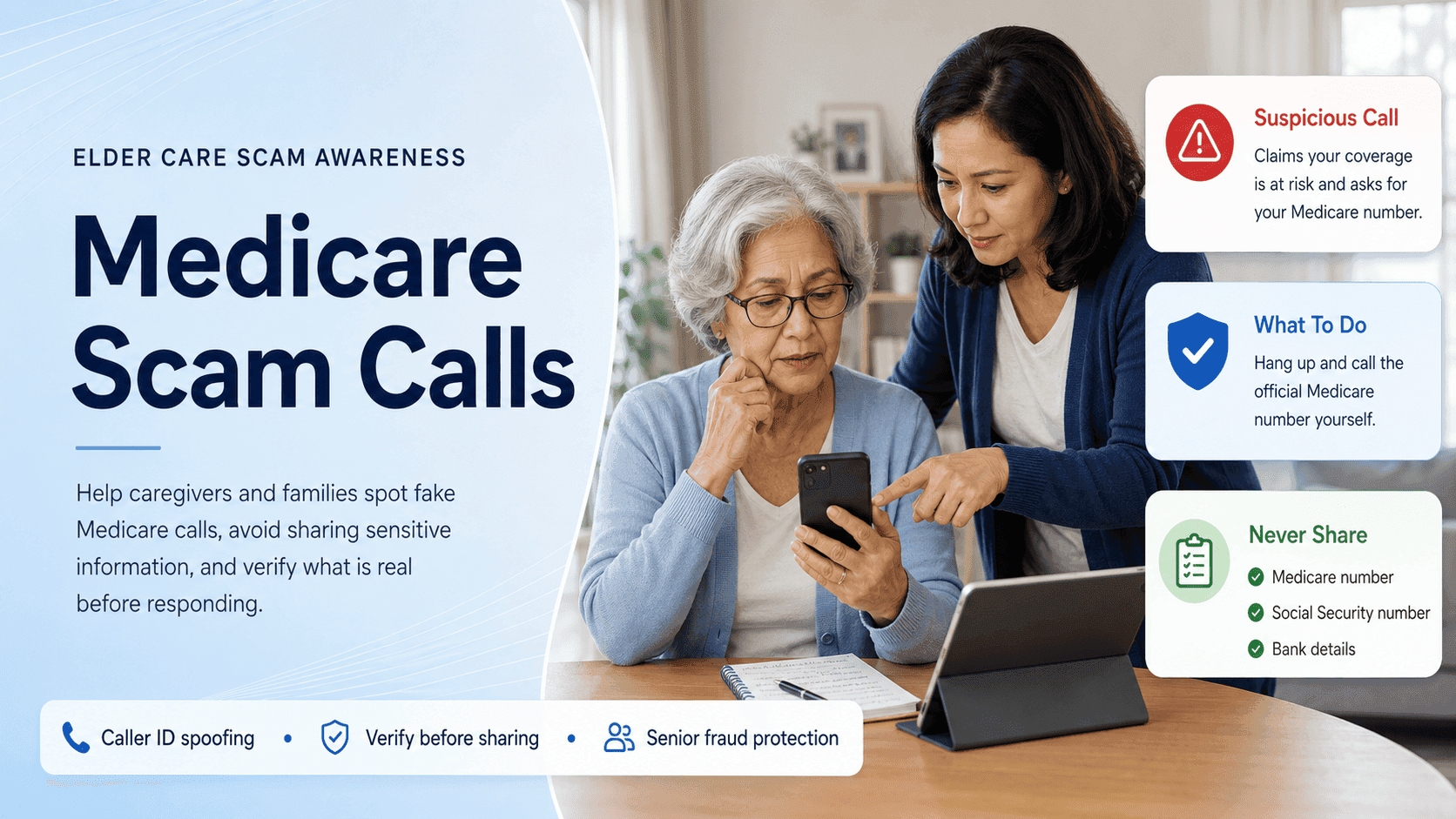
Medicare will almost never call you unprompted, so an unsolicited call "from Medicare" that asks for your number or a payment is a scam. That one fact stops most of these calls cold.
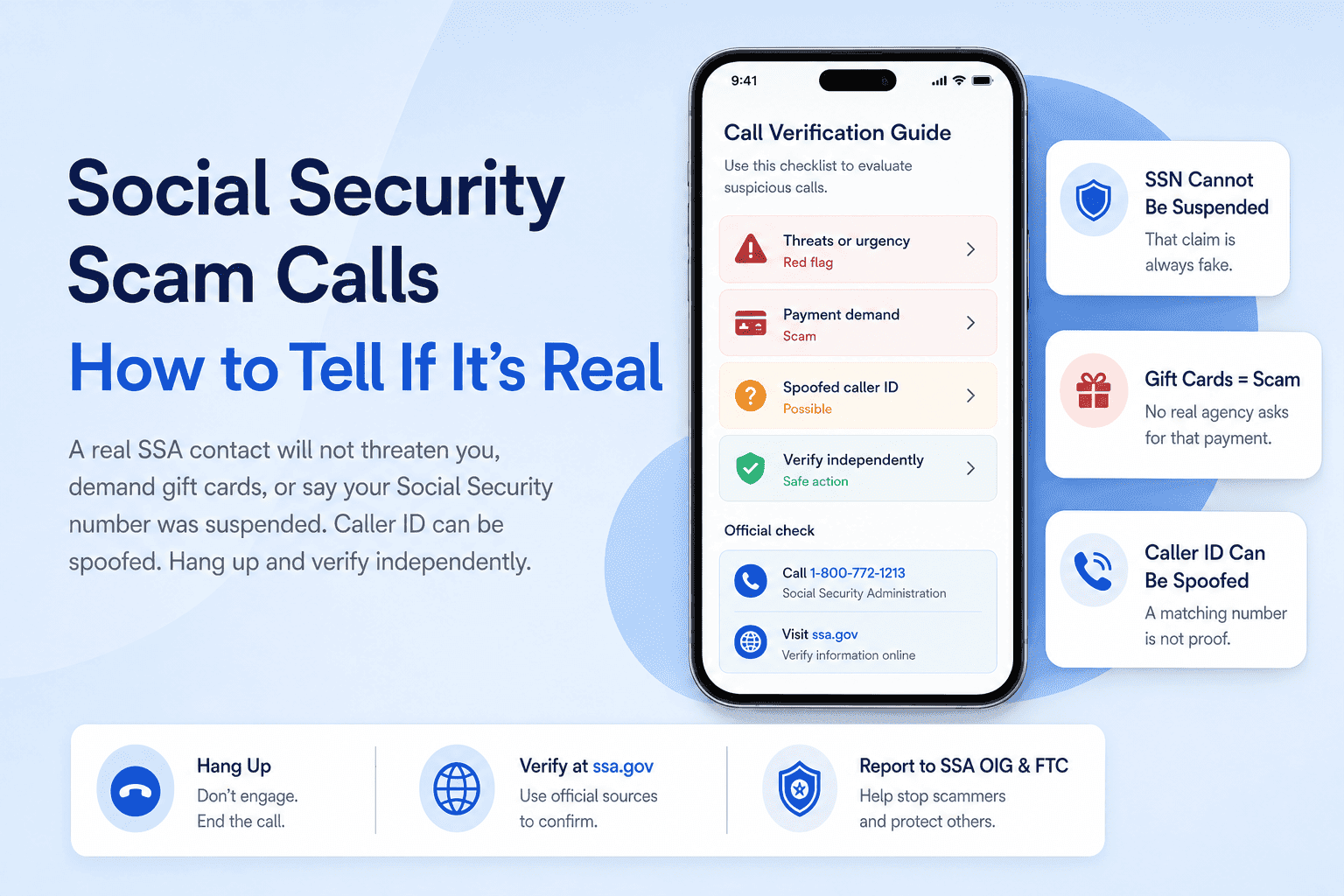
1. Red flags: urgency, threats about losing coverage, and any request for your Medicare number, Social Security number, or money.
2. The rule that works every time: hang up and dial the official number yourself. Never trust the number on the screen.
3. Never share by phone: your Medicare Beneficiary Identifier, Social Security number, or bank information.
4. Block calls: switch on carrier-level blocking and the phone spam filter, and add an allow-list blocker to any landline.
5. Report fraud: 1-800-MEDICARE (1-800-633-4227), the HHS OIG Hotline (1-800-HHS-TIPS), and the FTC.
Not sure a call is real? Verify a suspicious Medicare call in seconds.
If you help care for an aging parent, the phone has become one of the riskiest doors into their life. Scam calls to elderly Americans now cause billions of dollars in losses every year, and Medicare is one of the most common disguises. The FBI, through its elder fraud reporting, found that people age 60 and older lost more than $3.4 billion to fraud in 2023, and its 2024 figures showed the total climbing higher still. Across all ages, the Federal Trade Commission reported that Americans lost more than $12.5 billion to fraud in 2024, roughly a quarter more than the year before, with phone calls among the costliest ways scammers make contact.
You do not need to become a security expert to protect someone you love. You need a few clear rules, a short list of red flags, and a plan for the moment a suspicious call comes in. This guide gives you all three, written for the adult child and the family caregiver who is already stretched thin.
How to recognize elder care scam calls about Medicare
You can spot most elder care scam calls by remembering one fact: Medicare does not cold-call beneficiaries to ask for their number, confirm personal details, or collect a payment.
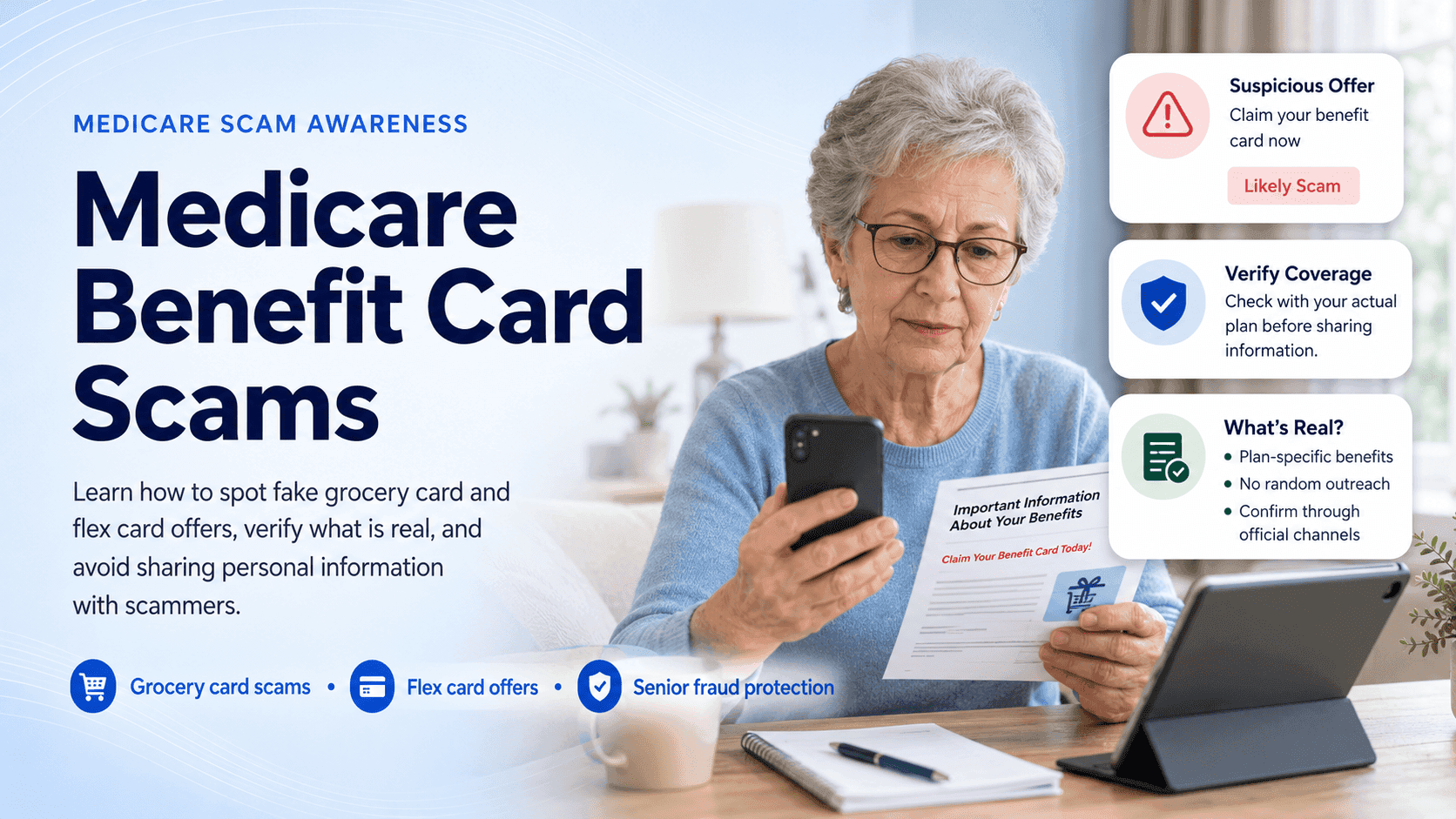
Fake Medicare calls usually open with a friendly or official greeting, then move fast to a request. Common openers include a "new Medicare card," a "free" genetic test or back brace, or a warning that coverage is about to lapse. The goal never changes: get the Medicare Beneficiary Identifier (MBI), a Social Security number, or a card payment.
Real Medicare communication comes mostly by mail. If your parent is enrolled in a Medicare Advantage or drug plan, that private plan may contact them, but it will not demand the full Medicare number or threaten to cancel coverage on the spot.
Caller ID proves nothing. Scammers routinely spoof 1-800-MEDICARE and local numbers so the call looks legitimate. Treat the number on the screen as a suggestion, not a fact.
When something feels off, the safest move is also the simplest. Hang up and call 1-800-633-4227 yourself, or use the number printed on the Medicare card. A real representative will not mind you calling back. Run the caller or number through our scam-verification check before you share anything.
Warning signs of elder care Medicare phone scams
The clearest warning sign of a Medicare phone scam is pressure, usually a threat that coverage will end unless you act right now.
1. Urgency and threats. The caller says coverage will be canceled today, or that you owe money and could face penalties. Real agencies give you time and send notices by mail.
2. A request for the Medicare number. Anyone asking you to "confirm" or "verify" the Medicare Beneficiary Identifier by phone is fishing for data.
3. Unusual payment demands. Gift cards, wire transfers, cryptocurrency, or a bank PIN are never how Medicare collects anything.
4. A "free" offer with a catch. A free brace, DNA kit, or genetic test in exchange for the Medicare number is bait for billing fraud.
5. A new-card or renewal pitch. Medicare mails cards automatically and free, so a call asking you to pay or confirm details for a card is a Medicare card scam.
6. Refusal to let you call back. A scammer will talk over you, stall, or claim the line will close if you hang up.
The table below lines up a legitimate Medicare contact against a scam call, signal by signal, so you can compare them at a glance.
| Signal | Legitimate Medicare / CMS | Scam call (red flag) | Why it matters |
|---|---|---|---|
| Who calls first | Rarely; usually only if you called them or your plan is following up | Calls you unprompted "from Medicare" | Unsolicited contact is the number one tell |
| Asks for MBI or SSN | Never asks you to confirm your full number by phone | Demands your full Medicare number "to verify" | This is data harvesting |
| Payment method | Never asks for gift cards, wire, crypto, or a bank PIN | Urgent payment by gift card or wire | No agency collects money this way |
| Tone | Neutral, with no pressure | Urgency and threats ("coverage ends today") | Pressure is designed to defeat judgment |
| Caller ID | May show 1-800-MEDICARE, but ID can be spoofed | Spoofed to mimic official numbers | Never trust caller ID on its own |
| "Free" offers | Does not cold-call offering free braces, kits, or tests | Offers free equipment or tests for your number | The offer is bait for billing fraud |
| Card replacement | New cards issued automatically, free, by mail | "Pay or confirm info for your new card" | This is the new-card scam pattern |
| How to verify | Hang up and call 1-800-633-4227 yourself | Discourages you from hanging up or calling back | Verifying breaks the scam |
How caregivers can block Medicare scam callers
Caregivers can block most Medicare scam callers by combining a carrier-level blocking service with the phone spam filter, then adding an allow-list to any landline.
On an iPhone: open Settings, tap Phone, then turn on "Silence Unknown Callers." Calls from numbers not saved in Contacts go straight to voicemail. Add the numbers your parent actually needs first, so trusted calls still ring through.
On an Android phone: open the Phone app, tap the menu, go to Settings, then Caller ID and spam, and switch on spam protection. On Pixel and many other models, Call Screen can answer unknown calls and ask who is calling before the phone even rings.
On a landline: ask the carrier about free network-level call blocking, which stops many robocalls before they reach the house. For stronger control, plug in an allow-list call blocker that only lets approved numbers ring. These devices help the most when memory or judgment is slipping.
Whatever the device, save 1-800-MEDICARE and the plan number in your parent contacts, so the real lines are easy to find and trusted calls always come through.
Best call-blocking tools for Medicare scam protection
The best call-blocking tools for seniors pair automatic spam filtering with an allow-list, so approved callers get through while unknown numbers are screened or blocked.
The Federal Communications Commission tracks robocall rules and publishes plain-language guidance on the blocking options carriers must offer. Use the table to match a tool to the phone and the person.
| Tool or method | Platform | Blocks spoofed / robocalls | Ease for seniors | Cost (est.) | Best for |
|---|---|---|---|---|---|
| Built-in "Silence Unknown Callers" | iPhone (iOS) | Partial (unknown numbers) | High (one toggle) | Free | Simple iPhone users |
| Google Call Screen / spam filter | Android (Pixel, most) | Strong (AI screening) | Medium | Free | Android households |
| Carrier call-labeling apps | All major carriers | Strong (network level) | High (automatic) | Free to $4/mo | Any carrier line |
| Third-party blocker apps | iOS / Android | Strong (crowd database) | Medium | Free to $5/mo | High-volume targets |
| Landline call blocker device | Landline | Strong (allow-list) | Medium (set up once) | $60 to $120 one-time | Seniors on home phones |
| Allow-list ("known callers only") | Landline and mobile | Very strong | High once set | Free to device cost | Cognitive decline cases |
| Nomorobo-style services | VoIP / landline / mobile | Strong | Medium | Free to $2/mo | VoIP and landline mix |
Features and pricing change often, so check current pricing with the carrier or app before you commit.
A caregiver's guide to protecting parents from Medicare phone scams
Protecting parents from Medicare phone scams works best as a family system, with clear roles, one simple household rule, and a routine that removes the pressure to decide alone.
Agree on a single family rule and repeat it often: we never give the Medicare number, the Social Security number, or a payment over the phone. A rule that is easy to remember is easy to follow under stress.
Assign roles. Pick one family member as the "verify" contact whom your parent calls whenever a suspicious call comes in. If there is a power of attorney or a trusted helper, make sure they know the rule too.
Reduce the pressure to answer. Encourage your parent to let unknown calls go to voicemail. The AARP Fraud Watch Network reports that phone calls remain one of the most common ways scammers reach older adults, so an unanswered call is a scam that fails.
Watch the harder cases. Cognitive decline and dementia make these calls far more dangerous, because the usual instincts weaken. Tighter controls like an allow-list and shared account monitoring matter even more here.
Keep the conversation kind. Shame keeps people silent, and silence is what fraud depends on. Make it clear that reporting a close call is a win. For broader habits that keep older adults safer, see our wider online-safety guidance for older adults.
What to do if a parent shared their Medicare number
If a parent shares their Medicare number with a scammer, act quickly: call 1-800-MEDICARE, watch their Medicare Summary Notices for charges they never received, and report the incident so the pattern can be tracked.
1. Call 1-800-MEDICARE (1-800-633-4227) and report that the Medicare number was shared. Ask what to watch for on the account.
2. Review Medicare Summary Notices (MSNs) and online claims for services, equipment, or tests your parent never received. Medical identity theft shows up here first.
3. Report suspected fraud to the HHS Office of Inspector General Hotline (1-800-HHS-TIPS) and your local Senior Medicare Patrol, which helps beneficiaries spot and report Medicare fraud.
4. If a Social Security number or bank details were also shared, treat it as identity theft. Freeze credit with all three bureaus and alert the bank.
5. Keep a simple record: the date, the number that called, what was said, and what was shared. Reports carry more weight with details.
The Medicare Beneficiary Identifier replaced the Social Security number on Medicare cards, but sharing it still opens the door to medical identity theft and false billing. Guard it like a credit card.
Report it and start protective monitoring in the Unscammed app, so nothing slips past while you handle the calls.
The response ladder below shows the right move at each stage, up to and including the point where money has already been sent.
| Stage | Situation | Immediate action | Who to contact | Urgency |
|---|---|---|---|---|
| 1. Suspicious call | Caller claims to be Medicare | Do not confirm any info; hang up | None yet | Low |
| 2. Verify | Unsure if real | Call 1-800-MEDICARE yourself | 1-800-633-4227 | Low |
| 3. Info requested | They pushed for MBI or SSN | Refuse; end call; note number and time | None yet | Medium |
| 4. Number shared | Parent gave the MBI | Call Medicare; watch MSN statements | 1-800-MEDICARE and SMP | High |
| 5. SSN or bank shared | Financial data exposed | Freeze credit; alert the bank | Bank, 3 credit bureaus, IdentityTheft.gov | Critical |
| 6. Money sent | Payment made | Contact bank or card immediately; report | Bank, FTC, local police | Critical |
| 7. Report | Any of the above | File reports so the pattern is tracked | OIG (1-800-HHS-TIPS), FTC | Always |
Step-by-step response to an elder Medicare scam call
Here is a step-by-step response for an elder Medicare scam call, starting the moment the phone rings and ending with the follow-up report.
1. Do not confirm anything. Do not say yes, read back a number, or verify a name or address.
2. Hang up. You owe an unsolicited caller nothing. Ending the call is not rude, it is smart.
3. Call the official line yourself. Dial 1-800-633-4227 or the number on the Medicare card, never a number the caller gave you.
4. Write down what happened. Note the time, the number shown, and any details the caller used.
5. Check recent statements. Look at Medicare Summary Notices and bank activity for anything unexpected.
6. Lock things down if data was shared. Freeze credit, alert the bank, and change exposed passwords.
7. Report it. File with the HHS OIG Hotline, your Senior Medicare Patrol, and the FTC so the pattern gets tracked.
Run these steps in order. The first three protect the person in the moment, and the last four protect them afterward.
How to report Medicare scam calls targeting seniors
Report Medicare scam calls to three places: 1-800-MEDICARE for anything involving the Medicare account, the HHS OIG Hotline and Senior Medicare Patrol for suspected fraud, and the FTC for the scam call itself.
Reporting Medicare fraud phone calls does more than clear your conscience. It feeds the databases that agencies use to spot patterns and build cases, and it can protect the next family on the scammer list. Medicare publishes official guidance on reporting fraud and abuse, and the HHS Office of Inspector General posts current consumer alerts about active Medicare scams.
| Who to contact | When to use it | How to reach them |
|---|---|---|
| 1-800-MEDICARE (1-800-633-4227) | Lost or shared card, billing questions, plan issues | Phone, or Medicare.gov |
| HHS OIG Hotline (1-800-HHS-TIPS) | Suspected Medicare fraud or false billing | Phone, or oig.hhs.gov |
| Senior Medicare Patrol (SMP) | Help reviewing statements and reporting fraud | Your local SMP office |
| Federal Trade Commission (FTC) | Any scam call or attempt | ReportFraud.ftc.gov |
| FCC | Robocall and caller ID spoofing complaints | FCC complaint center |
Own a home-care agency or clinic? Protect clients with our business tools and give staff a clear reporting path.
Checklist to help seniors avoid Medicare phone fraud
Use this quick checklist to help a senior avoid Medicare phone fraud. Print it, tape it near the phone, and review it together.
1. Let unknown calls go to voicemail. Real callers leave a message.
2. Never give your Medicare number, Social Security number, or bank details by phone.
3. Remember that Medicare cards are free and arrive by mail. No one needs a payment for one.
4. Say no to "free" braces, DNA kits, and genetic tests offered by phone.
5. Hang up on pressure. Urgency and threats are the sound of a scam.
6. Verify by calling 1-800-633-4227 yourself, not the number that called.
7. Keep 1-800-MEDICARE saved in your phone so the real line is one tap away.
8. Check your Medicare Summary Notices each time they arrive.
9. Tell a family member about any odd call, even if you hung up in time.
10. Register the number on the National Do Not Call Registry.
Scripts scammers use in Medicare elder care calls
Scammers reuse a handful of scripts in Medicare elder care calls, and each one carries a tell that gives it away.
The new-card script. "This is Medicare. We are issuing new cards with a chip, and I need to verify your Medicare number to activate yours." The tell: real cards are mailed automatically and free, and nobody needs to "activate" one by phone.
The genetic testing script. "You qualify for a free cancer screening or DNA test covered by Medicare. I just need your Medicare number to ship the kit." The tell: a "free" test tied to your Medicare number sets up billing fraud, because a lab then bills Medicare for tests no doctor ordered.
The back-brace script. "A doctor referred you for a free back or knee brace. Confirm your Medicare number and it ships today." The tell: durable medical equipment (DME) scams cold-call people and invent a referral to justify the billing.
The refund or overpayment script. "Medicare overcharged you and owes a refund. I need your bank details to send it." The tell: a real refund never requires you to hand over bank access by phone.
The plan-cancellation threat. "Your Medicare coverage will be canceled today unless you confirm your information and pay a fee." The tell: coverage is not canceled by a surprise phone call, and Medicare does not collect fees this way.
The words change, but the shape stays the same. A stranger creates urgency, then asks for your number or your money. Once you recognize the shape, the specific script stops mattering.
Expert viewpoint: the one habit that stops almost every Medicare scam call
In the cases we see at Unscammed, one habit stops almost every Medicare scam call before it does harm: hang up and call back the official number yourself. Scammers depend on keeping you on the line, because their method falls apart the moment you verify on your own. Break the connection and you break the scam.
If you take three actions this week, take these. First, set up call screening on your parent phone using the carrier blocking service and the built-in spam filter. Second, set a plain family rule and say it out loud: we never share the Medicare number by phone, and we never pay for anything a caller demands. Third, save 1-800-MEDICARE (1-800-633-4227) in your parent contacts so the real line is always one tap away.
We have watched families turn a frightening moment into a non-event just by pausing and calling back. That pause is your strongest tool. This article is educational and not legal or financial advice. If a crime is in progress or money is at immediate risk, contact your bank and local authorities right away, and where medical care is affected, tell the provider. Learn how Unscammed helps families fight financial fraud.
Frequently asked questions
Will Medicare ever call me and ask for my Medicare number?
No. Medicare does not make unsolicited calls asking you to verify or provide your Medicare Beneficiary Identifier, Social Security number, or bank details. Any caller demanding this to "keep your coverage active" is running a scam. Hang up and call 1-800-MEDICARE yourself.
What happens if my parent gave a scammer their Medicare number?
Watch for medical identity theft. Call 1-800-MEDICARE, review Medicare Summary Notices for charges they did not receive, report to the OIG Hotline and Senior Medicare Patrol, and consider a credit freeze if other personal details were shared.
What phone number does a real Medicare call come from?
Official Medicare contact comes from 1-800-MEDICARE (1-800-633-4227), but scammers spoof that number too. Never trust caller ID alone. Verify by hanging up and dialing 1-800-633-4227 directly, rather than any number a caller provides.
Are new Medicare card and card-renewal calls a scam?
Yes, almost always. Medicare cards are mailed automatically and free of charge, and Medicare does not call to "renew," "activate," or charge for a card. A caller asking you to pay or confirm details for a new card is a scam.
Can someone commit fraud with just my Medicare number?
Yes. A Medicare Beneficiary Identifier lets criminals bill Medicare for services never received, order unneeded equipment or tests, and commit medical identity theft. Guard it like a credit card and never confirm it to an unsolicited caller.
What is the fastest way to stop scam calls to an elderly parent?
Enable network-level call blocking through the carrier, turn on the phone spam filter or "silence unknown callers," and for landlines add an allow-list blocker. Combine tools and register the number on the National Do Not Call Registry.
Is it safe to call back a missed "Medicare" call?
Do not call back the number shown. Instead, dial 1-800-MEDICARE (1-800-633-4227) directly. Scammers spoof and seed callback numbers that route to fraudsters, so only ever use the official number you look up yourself.
You're not on your own from here
Elder care scam calls thrive on speed and silence. You take both away by slowing the moment down and talking it through. You cannot stop every call from coming, but you can decide in advance exactly what happens when one does: no numbers shared, no money sent, and a quick call back to the real line.
Set up the blocking tools this week. Say the family rule out loud. Save the official number. Those three small moves protect the person you love far more than any single warning ever could.
You do not have to handle this alone.
Unscammed helps families verify suspicious calls, report fraud to the right agencies, and watch for follow-up scams.
Featured Articles