
What Evidence to Save After an AI Scam or Phishing Attack
Banks, police and agencies all ask for proof. Learn what to save from phishing emails, fake websites, calls and AI scams, and how to store it before you report.
Published: Oct 9, 2026Scammers can clone a parent, child or spouse from a few seconds of audio. Learn how AI voice cloning scams work, how to spot a fake call, and how to protect your family.
 Share:


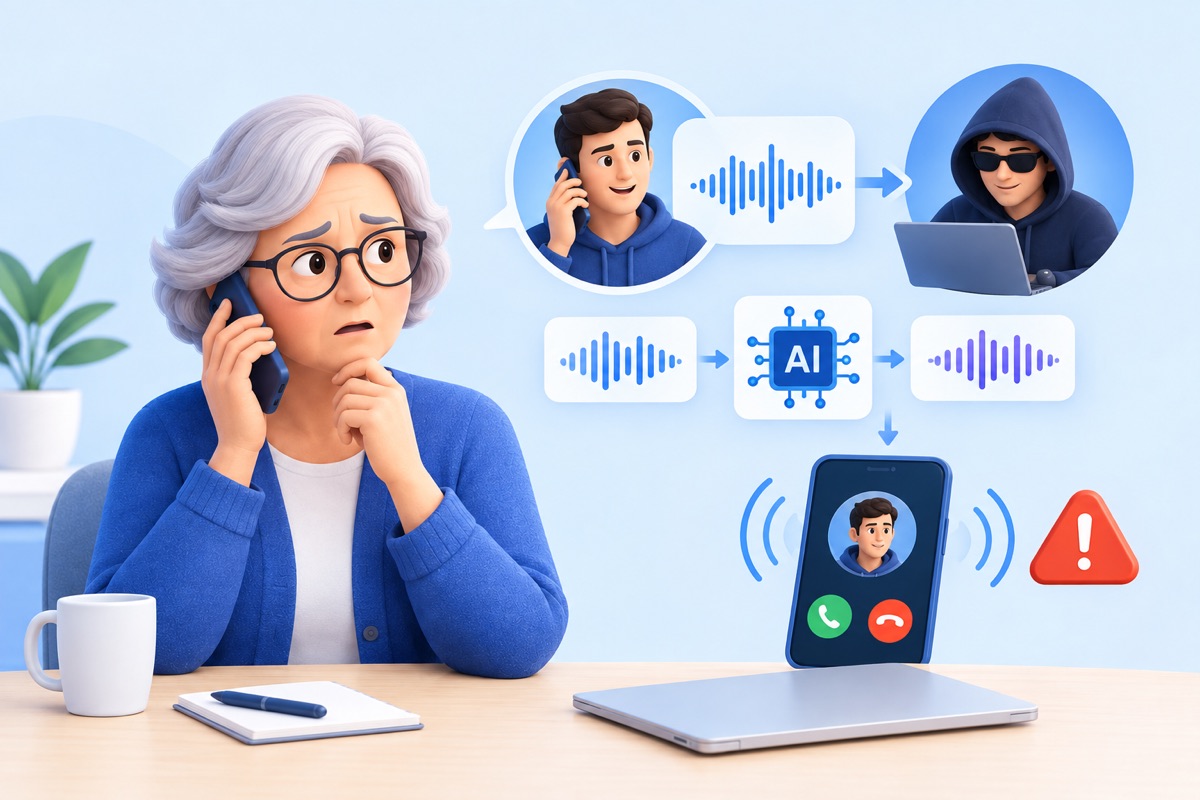
AI voice cloning allows scammers to create fake voices that sound like a parent, child, or spouse. They use these cloned voices to make urgent requests for money transfers, gift cards, or wire payments. This type of scam is becoming more common, with FBI data showing the growing use of AI in reported fraud.
In 2025, the FBI's Internet Crime Complaint Center logged over 22,000 complaints involving AI, with nearly $900 million in reported losses, and voice cloning is one of the tactics behind that surge.
This pattern matches a 2026 FBI Internet Crime Complaint Center advisory, which found that criminals combine AI-generated voice cloning with fake videos and cloned websites to make fraudulent requests appear legitimate, and recommend verifying any unexpected or urgent request through a separate, already-known contact channel before sending money or personal information.
This guide explains how organizations can protect themselves from deepfake vishing attacks, including AI voice cloning and phishing.
An AI voice cloning scam works by feeding a short audio sample of a real person's voice into an AI tool, which generates new speech in that same voice reading a script the scammer controls. The FBI's Internet Crime Complaint Center (IC3) confirms this method is now an established fraud tactic, not a fringe technique.
Here are the steps that usually show how AI voice scams happen:
If you've already been targeted by one of these calls, Unscammed can help you file reports with the right agencies in one pass, instead of tracking each step yourself.
Voice cloning scams are growing mainly because the tools have become more accessible. What once required technical skill, paid software, and several minutes of clean audio can now produce a usable clone from just a few seconds of speech, often through free, browser-based tools that need no special expertise.
People also generate large amounts of public voice data without realizing it, through social media videos, podcast clips, and voicemail greetings, giving scammers easy source material without needing direct contact with the target. The process itself has also gotten faster, with a finished clone now achievable in well under an hour.
According to the FBI's Internet Crime Complaint Center (IC3), AI was added as a formal crime category for the first time in its 2025 Internet Crime Report, logging 22,364 complaints and nearly $893 million in losses.
According to the FTC, scammers only need a short audio clip of a person's voice, often pulled from content already posted online, along with a voice-cloning program to generate a convincing fake call. The FBI's Internet Crime Complaint Center (IC3) confirms the same pattern, noting that criminals generate short audio clips containing a loved one's voice specifically to impersonate a close relative in a crisis situation.
Where scammers source audio:
Both agencies point to the same underlying issue: the audio doesn't need to be obtained directly from the target. Anything posted publicly, even in passing, can be extracted and reused. This is why the FBI's guidance focuses less on avoiding phone calls altogether and more on limiting how much voice content is available online in the first place.
What the FBI recommends to reduce exposure:
The amount of audio required to begin the cloning process is minimal. Neither agency specifies an exact duration, but both describe it as a short clip, meaning scammers don't need extended recordings or repeated access to someone's voice. A single public video, greeting, or voice note is treated as sufficient starting material.
These three technologies are often confused because they all alter or generate speech, but each works differently and carries a different level of risk when used in a scam. Understanding the distinction helps clarify why voice cloning specifically is the version tied to impersonation fraud.
| Technology | What It Does | Tied to a Specific Person? | Common Scam Use |
|---|---|---|---|
| Text-to-Speech (TTS) | Converts written text into spoken audio using a generic or stock voice. | No | Robocalls, automated phishing messages |
| Voice Cloning | Analyzes a real person's voice sample to generate new speech that sounds like them. | Yes | Fake emergency calls, executive impersonation, bank account access |
| Voice Changer | Alters pitch, tone, or characteristics of a live voice in real time during a call. | No. It modifies the speaker's own voice, not a copy of someone else's. | Disguising identity during a live scam call |
A familiar voice can sound convincing, but the voice itself is not enough to confirm who is calling. Look at the caller's behaviour, the details they provide, and what they are asking you to do. These checks can help identify a possible impersonation scam.
Both the FBI and FTC recommend establishing a codeword or phrase with family members in advance, specifically as a countermeasure to AI scams. IC3 lists this as a direct tip to protect yourself: create a secret word or phrase with your family to verify their identity.
How to set one up, based on FBI and FTC guidance:
Several tools are available to help identify whether a voice on a call or recording has been AI-generated. These fall into two categories: consumer-facing apps built for individuals, and enterprise-grade systems used by call centers and financial institutions to screen calls at scale.
| Tool | Type | What It Does |
|---|---|---|
| McAfee Deepfake Detector | Consumer | Scans audio in videos to flag AI-generated speech; built into select McAfee security products. |
| Pindrop | Enterprise | Analyzes call audio in real time to detect synthetic voice and caller fraud in contact centers. |
| Resemble Detect | Enterprise | Screens audio for signs of AI voice generation, used by businesses handling high call volumes. |
| AI Voice Detector | Consumer | Standalone tool for checking whether a specific audio clip is AI-generated. |
Yes. The FBI's Internet Crime Complaint Center (IC3) tracks this as a business email compromise (BEC) variant, where a cloned voice is used to authorize a fraudulent wire transfer or gain account access rather than to fake a family emergency. IC3 states that criminals also use AI-generated audio clips of individuals to obtain access to bank accounts, extending the same technique beyond personal scams into a financial fraud vector aimed at organizations.
| Metric | Figure |
|---|---|
| BEC losses | $3.046 billion |
| Total AI-related fraud losses | ~$893 million |
| Common target roles | CFOs, finance/accounts payable staff |
| Typical method | Cloned executive voice + spoofed caller ID, paired with email instructions |
| Reporting channel | ic3.gov |
Could your team spot an AI voice scam? AI-generated calls can make it harder for employees to know whether a request is genuine. Unscammed’s business scam protection platform helps small businesses train employees with simulated scam calls, texts, and emails, so they can practise identifying suspicious requests before facing a real one.
Reducing the number of scam calls that reach you involves a combination of carrier tools, registry sign-up, and basic call habits. According to the FCC and FTC, no single method blocks every unwanted call, but layering a few approaches meaningfully cuts down exposure.
Already lost money to a scam like this? Unscammed has helped file over $50 million in reported scams, automating your filing to the FBI and FTC so you don't face it alone.
Voice cloning tools work from a pre-recorded audio sample, not a live call. Scammers typically collect clips beforehand from social media, voicemail greetings, or public videos, then generate the clone offline before placing the actual scam call.
No. AI text to speech generates generic synthetic speech that isn't tied to any specific person. Voice cloning uses a real person's voice sample to generate speech that sounds like them specifically, which is why it's the version used in impersonation scams.
An AI voice changer alters a scammer's own voice in real time, shifting pitch or tone, while a voice clone replaces it entirely with a synthetic copy of someone else's voice. Voice changers are used more often to disguise identity than to impersonate a specific relative.
Older scam scripts relied on an unfamiliar voice, which was a natural warning sign. AI scams remove that signal entirely by using a cloned voice the listener recognizes, so the FBI and FTC now recommend verifying identity through a separate method rather than by ear.
No. The FTC states clearly that the Registry only stops sales calls from legitimate companies that follow the law. It has no effect on scammers, including those using cloned voices, since illegal callers don't check the list before dialing.
Carrier-level call blocking, third-party blocking apps, and letting unknown numbers go to voicemail are the main tools recommended by the FCC. None of these detect a cloned voice specifically, so they are paired with independent verification once a call does get through.

Banks, police and agencies all ask for proof. Learn what to save from phishing emails, fake websites, calls and AI scams, and how to store it before you report.
Published: Oct 9, 2026 Fake toll balances, fraud alerts and missed deliveries all arrive by text. Learn the signs of a scam text, what to do when you get one, and where to report it.
Published: Oct 4, 2026