Older adults lose billions to fraud every year, and the thief is not always a stranger. Learn the warning signs of elder financial abuse and how to report it.
Key Takeaways
Elder financial abuse is growing fast across the US, but knowing the signs and acting quickly can
protect the people you love.
- Scammers often pretend to be family, government agencies, or trusted businesses to gain access to money.
- Warning signs include sudden withdrawals, new "friends" asking about finances, and unpaid bills.
- Reporting quickly to APS, the FTC, or local police gives the best chance of stopping further loss.
- Both strangers and trusted family members can be responsible, so stay alert either way.
- Banks can flag suspicious activity and help freeze accounts before more damage happens.
- Talking openly with older loved ones and checking in regularly is one of the simplest ways to catch problems early.
Received a scam call or been scammed? Visit Unscammed to get help and report it for free.
Every year, billions of dollars vanish from older adults' bank accounts. The FBI says people 60 and over lost $7.7 billion. That's a 59% jump from the year before. Most of it came from investment scams, fake romance
schemes, and callers posing as government workers.
But here's the hard truth: the thief isn't always a stranger. Sometimes it's a family member. A
caregiver. A trusted friend. And when it's someone close, it's often harder to spot, because we trust
them and we aren't watching as closely.
That's why catching it early matters so much. This guide will help you spot the warning signs, report
the abuse, and find help if someone you love is being taken advantage of.
What Is Elder Financial Abuse?
Elder financial abuse is when someone illegally or improperly uses an older adult's money, property, or assets. It can be
as simple as stealing cash from a wallet or as complex as forging documents to transfer property
ownership. The people who do this can be strangers running phone scams, but they can also be people the
older adult knows and trusts, like family members, caregivers, or friends.
How Elder Financial Abuse Works
Elder financial abuse happens in two ways: from strangers and from people you know and trust.
1. From Strangers (Fraud)
Scammers use pressure and fear. They might call pretending to be from tech support, a bank, or a
government agency. They claim your computer or bank account has been hacked. Then they tell you to
move your money to a "safe" account to protect it. In reality, that "safe" account belongs to the
scammers. Some victims lose their entire life savings this way.
The FBI warns about a scam called "The Phantom Hacker." It works in three steps:
- A fake tech support caller gets remote access to your computer. They claim your device has been
hacked.
- Another caller pretends to be from your bank. They tell you to move your money to a "safe" account
they control.
- A third caller poses as a government official. They pressure you to keep transferring money, and to
keep it all a secret.
2. From People You Know (Abuse)
This can be harder to spot. A family member, caregiver, or trusted friend takes control slowly. They
might borrow money and never pay it back. They might add their name to a bank account, cash checks
without permission, or use a credit card for themselves. Sometimes they pressure or threaten the older
adult to get what they want. Because they are trusted, nobody questions it until the damage is done.
What Are the Warning Signs of Elder Financial Abuse?
1. Unusual Withdrawals
Unusual withdrawals may signal elder financial exploitation. U.S. government data shows the scale can be significant, with older adults losing billions to fraud and individual losses sometimes reaching tens of thousands
of dollars.
| Unusual Withdrawal Sign | What It May Mean |
|---|
| Large or unexplained withdrawals | Someone else may be taking money without permission. |
| New ATM activity | Someone else may have access to the card and account. |
| Large wire transfers | Money may be going to scammers or someone exploiting them. |
| Early account or CD closure | Someone may be pressuring them to get quick cash. |
| New overdrafts or bounced checks | Money is being drained, causing bills to go unpaid. |
2. Unusual Payments
Pay attention if an older person suddenly starts sending money in ways they don't normally use. Gift
cards, crypto, wire transfers, and payment apps can all be used in scams.
Some things to watch for:
- They are asked to buy gift cards and share the numbers.
- Someone tells them to send crypto right away.
- Money is sent to a person they have never met.
- They are told not to tell family members about the payment.
The FTC warns that scammers often ask people to use payment methods that make it hard to get their money back.
3. A New Person Controls Money
Sometimes, an older person may need help with their finances. That's not a problem by itself. The
concern starts when someone new suddenly takes control of their finances, like a caregiver, friend, or relative getting involved in their money, which can be a warning sign.
For example, someone may start:
- Paying their bills
- Using their bank card
- Accessing their bank account
- Making money decisions for them
4. Sudden Legal Changes
A sudden change to a will, power of attorney, or beneficiary should not be ignored. It is even more concerning if the older person doesn't
understand the change or cannot explain why it was made.
5. Unpaid Bills
A few late bills can happen to anyone. But if an older person has enough money and suddenly stops
paying regular bills, it's worth finding out why.
Look at bills for things such as:
- Electricity
- Rent or mortgage
- Medical care
- Credit cards
- Other regular expenses
6. Fear or Anxiety
Money problems can change how a person behaves. An older adult may become quiet, worried, or scared
around a certain person.
Take notice if they:
- Seem nervous when a caregiver arrives
- Become quiet when money is discussed
- Look afraid of a family member or friend
- Suddenly seem less confident about making their own choices
7. Someone Speaks for Them
An older adult should be able to speak about their own money and decisions whenever they are able to do
so. Be cautious when another person constantly answers questions, controls conversations, or prevents
the older adult from speaking privately. This can be particularly concerning when the person also
controls the older adult's money or financial documents.
8. Requests for “Taxes” or “Fees”
Be careful when someone says an older adult must pay money before receiving a prize, winnings, or some other benefit. This is a common scam trick.
| What the caller says | What to remember |
|---|
| Pay a fee to get your prize. | You don't have to pay to receive a real prize. |
| Send money for taxes first. | An unexpected payment demand can be a scam. |
| Buy gift cards to make the payment. | Gift cards are a common payment method used by scammers. |
| Send crypto right now. | Pressure to pay quickly is a major warning sign. |
What Are the Top Online Scams Targeting Older Adults?
Online scams can take many forms. They often start with a message, call, email, or website that looks
real and asks for money or personal information.
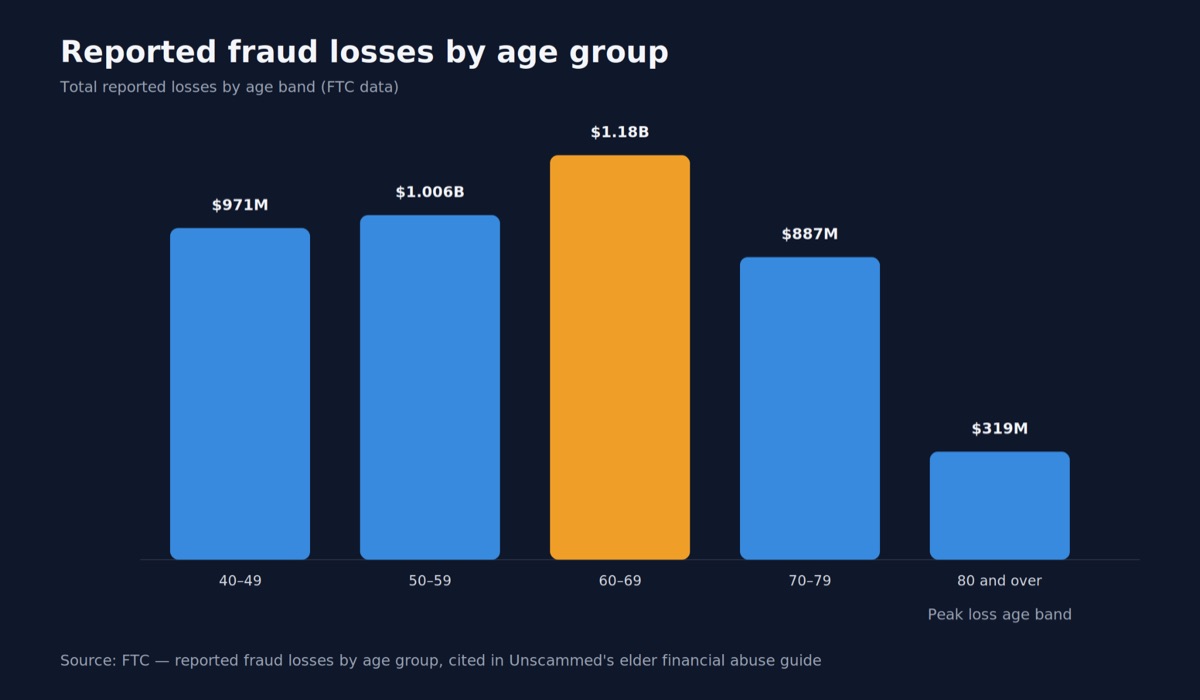
| Age Group | Fraud Reports | Total Reported Losses |
|---|
| 40–49 | 191,508 | $971 million |
| 50–59 | 175,898 | $1.006 billion |
| 60–69 | 208,896 | $1.180 billion |
| 70–79 | 159,550 | $887 million |
| 80 and over | 51,713 | $319 million |
1. Investment Scams
Someone reaches out with an investment opportunity, often tied to crypto or the stock market, promising guaranteed returns if you act fast. There's no
real investment behind it, just a scammer waiting for your money to land in their account.
2. Tech Support Scams
A scary pop-up flashes on the screen: your computer has a virus, call this number now. Once you call, a
fake "technician" either charges for repairs that were never needed or talks their way into remote
access to your device, and from there, they can see everything, including your bank details.
3. Government Impersonation Scams
The phone rings, and the caller says they're from the IRS, Social Security, or Medicare. Something
urgent has come up, such as unpaid taxes or a suspended benefit, and it can only be fixed with an
immediate payment or gift cards. Worth remembering: real government agencies never ask for money this
way.
4. Business Email Compromise
An email lands in the inbox that looks exactly like it's from a bank, a business, or even a family
member, because scammers hacked or closely faked the account. It asks for a wire transfer or payment,
and since it looks so legitimate, many people send the money without a second thought.
5. Phishing and Spoofing
Ever get a text or email that looks like it's from your bank or a delivery company, asking you to click
a link and confirm your login? That's phishing. The moment someone clicks and enters their details,
scammers have everything they need to get into the real account. If it has already happened, here's what evidence to save after a phishing attack.
6. Grandparent Scams
The phone rings late at night. A panicked voice on the other end sounds just like a grandchild, saying
they're in trouble and need money right now, usually through gift cards or a wire transfer. They'll
often beg you not to tell anyone else in the family, which is exactly what gives most people no time to
check if it's real.
7. Recovery Scams
This one targets people who've already lost money once. A caller claims to be a lawyer, investigator,
or official who can recover the stolen funds, for an upfront fee, of course. There is no recovery. It's
often the same scammer, or a new one, coming back for a second round.
8. AI Voice Cloning Scams
Technology has made this one especially convincing. Using just a short clip of someone's voice,
sometimes pulled from a social media video, scammers can recreate a loved one's voice almost
perfectly. The panicked emergency call that follows sounds so real that most people don't stop to
question it before sending money.
How to Report Elder Financial Abuse
If you or someone you love got scammed, take a breath. You're not alone, and you can fight back.
Here's what to do next.
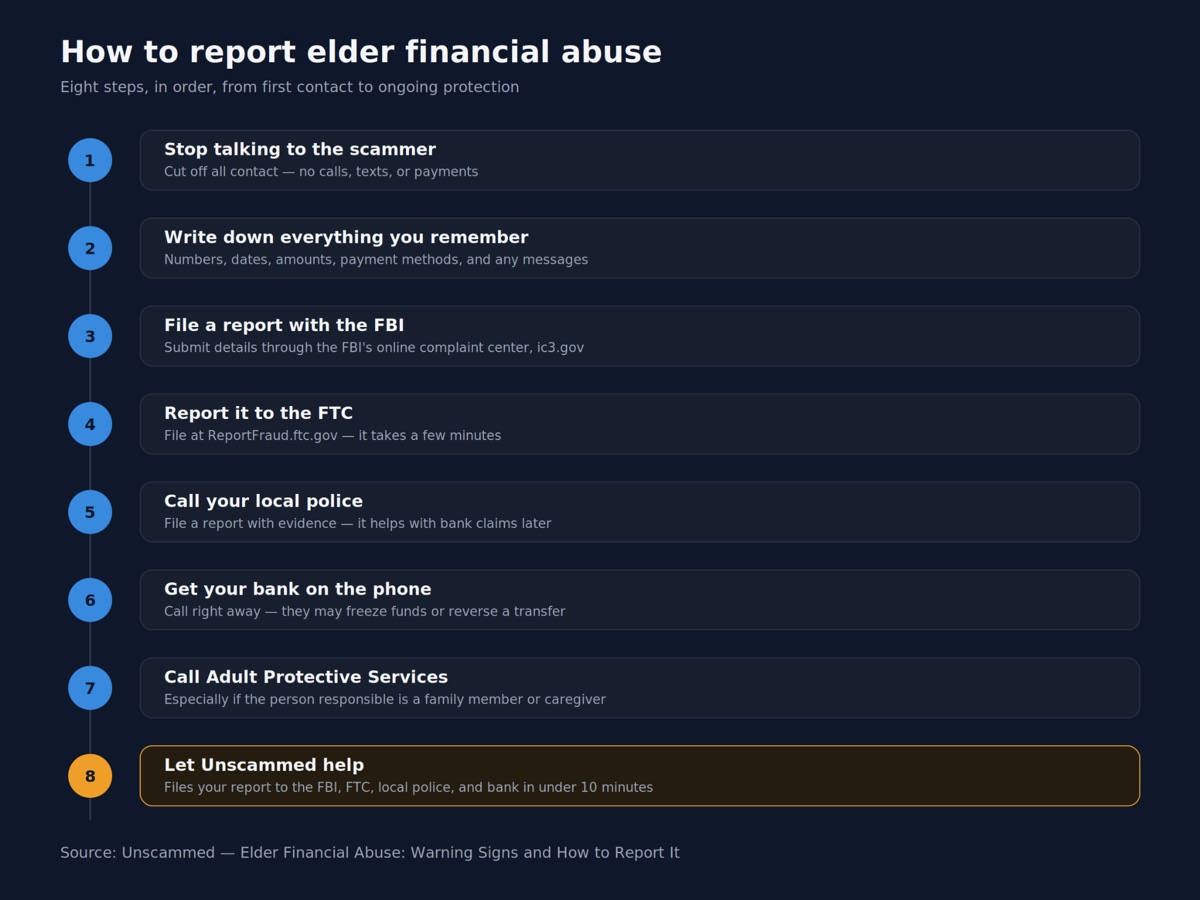
Step 1: Stop Talking to the Scammer
If they're still calling or emailing, stop replying. Don't answer the phone. Don't text back. Don't
send another dollar. Scammers are good at what they do, and they'll keep pushing until they get
everything. The best move is to cut them off completely.
Step 2: Write Down Everything You Remember
- The scammer's phone number and name (if you have it)
- Dates and times of calls or messages
- How much money was sent and how (wire transfer, gift cards, cryptocurrency, bank transfer)
- Any account numbers involved
- Any emails, texts, or documents they sent you
Having this ready will make filing reports much faster.
Step 3: File a Report With the FBI
Head over to ic3.gov. That's the FBI's online complaint center. Fill
out the form with as much detail as you can. Even if you think it's a long shot, report it. The FBI uses
every complaint to track down scammers and stop them from hurting more people.
Step 4: Report It to the FTC
Go to ReportFraud.ftc.gov and file a report there too. The
FTC collects all this data and uses it to go after scammers. It only takes a few minutes.
Step 5: Call Your Local Police
Stop by your local police station or give them a call. File a report and bring whatever evidence you
have. They might not be able to get your money back, but having a police report on file can help when
you talk to your bank.
Step 6: Get Your Bank on the Phone
If you sent money or gave out account info, call your bank or credit card company right away. Do it
now, not later. They might be able to stop a transfer, freeze your account, or reverse a charge. The
faster you act, the better your odds.
Step 7: Call Adult Protective Services
If the person who took the money is a family member, caregiver, or someone close, reach out to your
state's Adult Protective Services. They investigate these cases and can step in to keep your loved one safe.
Step 8: Let Unscammed Help
You don't have to go through each of these reporting steps on your own. Visit Unscammed: we file your report in under 10 minutes and send it to the FBI, FTC, local
police, and even your bank if you've lost money.
Staying One Step Ahead of Scammers
Elder financial abuse can happen to anyone, and it isn't always easy to spot. A scam may start with a
phone call, text, email, or even someone you know and trust. Knowing the warning signs and acting
quickly can help protect your loved one's money and personal information.
If you're unsure about a suspicious call or message, Unscammed can help you figure out what to do next.
You can call 1-866-UNSCAMY any time for a quick scam check. There's
no app to download, and you can get help directly over the phone.
Frequently Asked Questions
What's the difference between elder financial abuse and a scam?
A scam is when a stranger tricks someone into handing over money or personal info. Elder financial abuse covers more than that. It includes cases where someone the senior actually knows, such as a family member, a caregiver, or even a close friend, ends up misusing their money or property. So a scam is one kind of abuse, but abuse doesn’t always come from a stranger.
How do I protect a parent's accounts if I suspect abuse?
First, just talk to them. Keep it calm, not accusing, since most people get defensive if they feel judged. From there, you can ask their bank about setting up a trusted contact on the account, someone the bank can call if they notice anything odd. It also helps to sit down together and go through statements every so often. If things look serious, don't wait: get in touch with Adult Protective Services.
What legal protections exist for elder financial abuse victims?
Every state has its own laws around this, so protections aren't exactly the same everywhere. At the federal level, the Elder Justice Act helps fund things like Adult Protective Services and other programs working to stop elder fraud. Banks can also report suspected abuse without worrying about violating privacy rules.
Can banks flag suspicious activity on senior accounts?
Yes, and they actually do this fairly often. If a bank notices something off, like a big withdrawal out of nowhere or money being wired somewhere unusual, they can report it to FinCEN, which is part of the Treasury Department. Some banks will even pause the transaction or call the account holder directly before anything goes through.
What should adult children watch for during regular visits?
Look around for unopened mail or bills that haven't been paid. Pay attention if a new person seems unusually interested in your parent's money. And watch how your parent acts: are they confused about a recent purchase, nervous around someone in particular, or suddenly avoiding money conversations altogether? Those small shifts are usually the first clue.
Is elder financial abuse usually committed by strangers or family members?
It can be either. But people are often surprised to learn how often it's someone close, such as a relative, a caregiver, or a trusted friend, rather than a random stranger. That closeness makes it hard to spot and even harder to bring up once you notice it.
How quickly should I report suspected elder financial abuse?
As soon as you can. Whether that means calling the bank, reaching out to Adult Protective Services, or going to local police, acting fast gives the best shot at freezing accounts or getting money back before more damage is done.

 Share: