Caregiver Scams: How Paid Caregivers and Fake Services Target Seniors
 Share:


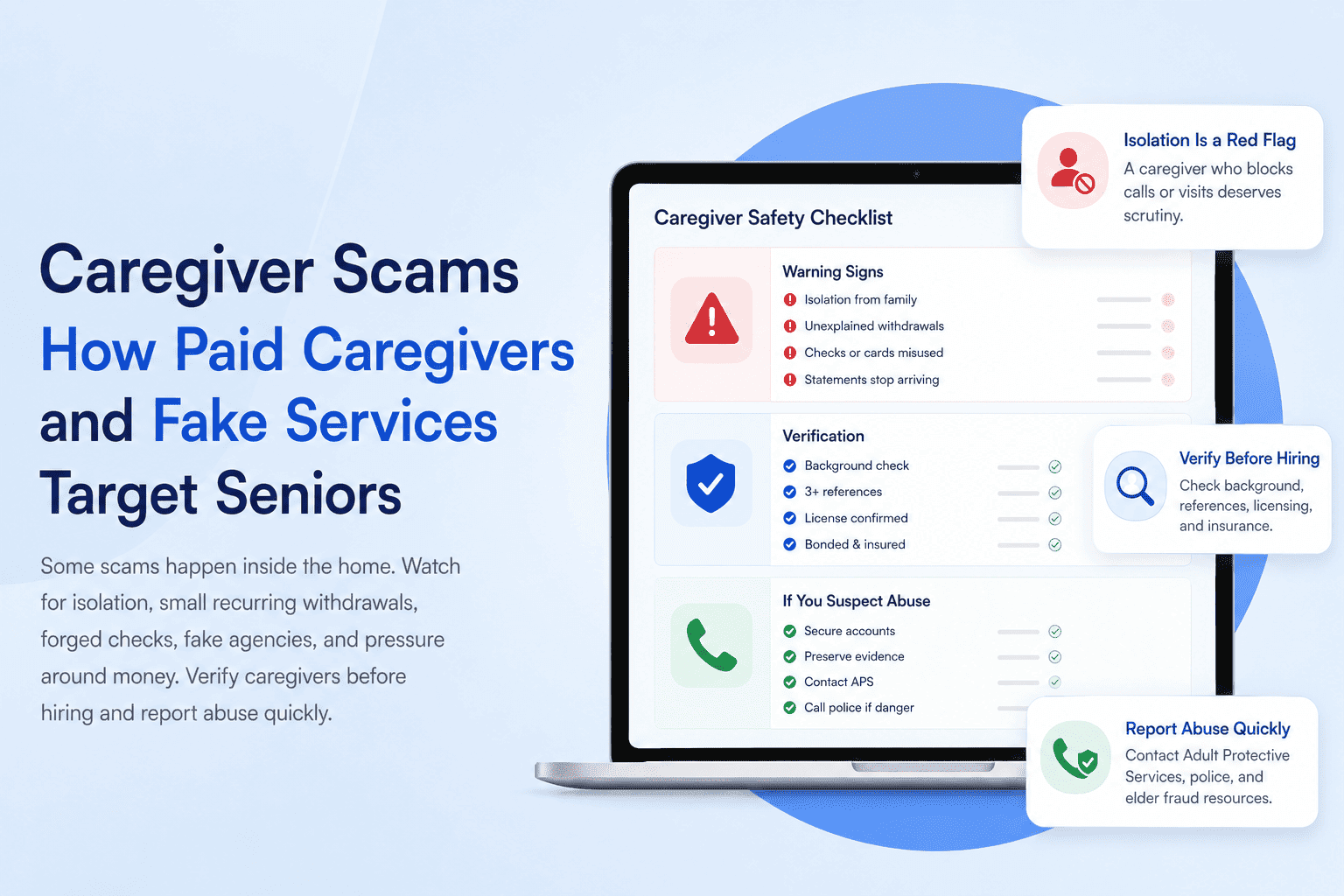
A caregiver scam happens when someone hired to help an older adult uses that access to steal money, property, or identity instead. Across the reports our fraud team reviews, one pattern shows up again and again: a trusted in-home caregiver gains financial access slowly, over weeks or months, until small withdrawals turn into serious losses. Caregiver scams are quieter than most fraud, and that is exactly why families miss them. This guide covers how they work, the warning signs, the background checks that prevent them, and where to report abuse.
In short. A caregiver scam is a form of elder financial abuse in which a paid aide or a fake caregiving agency exploits a senior for money. The two dominant forms are a real hired caregiver who slowly extracts funds, and a fake agency that takes payment and delivers no legitimate care. The single most protective move is to verify the caregiver or agency before hiring.
Key takeaways
A caregiver scam is elder financial exploitation carried out by someone trusted with access, usually a paid in-home caregiver or a fraudulent agency.
The most common methods are cash skimming, forged checks, unauthorized card use, coerced gifts, and quietly adding a name to accounts or beneficiary forms.
The warning signs families miss most are isolation of the senior, small recurring withdrawals that look normal, and a caregiver who resists any oversight.
Report caregiver fraud to Adult Protective Services, local police, and the National Elder Fraud Hotline, and preserve evidence before confronting anyone.
The strongest prevention is a real background check before hiring, plus ongoing, view-only account monitoring.
Before anyone signs a care contract, you can run a free scam verification check on the caregiver or agency.
What Is a Caregiver Scam and How Does It Work?
A caregiver scam is the misuse of a caregiving role to steal from an older adult. It takes two main forms: a genuine hired caregiver who exploits trust and access over time, and a fake caregiving agency that collects payment while providing little or no real care.
Most caregiver fraud follows a slow arc, not a single dramatic theft. It starts with access, because a caregiver is inside the home, near the mail, the checkbook, and the medication schedule. Familiarity builds next, as the senior comes to rely on the caregiver for daily needs and company, which makes questioning them feel like a betrayal. Isolation often follows, sometimes on purpose, as the caregiver discourages visits or screens phone calls. Extraction is the final stage, when small amounts begin to move in ways that look ordinary on a statement.
The second channel skips the relationship entirely. A fake caregiving agency advertises online, takes a deposit or the first month’s fee, then sends an unvetted worker or no one at all. Some fraudulent operators also bill Medicare or long-term care insurance for services that were never delivered.
Both channels share one trait that makes them hard to catch: they wear the appearance of help. The National Institute on Aging describes financial exploitation as a recognized form of elder abuse, and it often hides inside a relationship the family arranged in good faith.
Scale is part of the problem too. Elder financial abuse is widely believed to be underreported, because victims may feel ashamed or may not realize a trusted helper is the source. The true number of cases almost certainly runs well above what agencies record each year.
Types of Caregiver Scams
| Scam type | Who runs it | How the money is taken | Typical target | Speed of loss | Hardest signal to catch |
|---|---|---|---|---|---|
| Trusted-caregiver exploitation | A real, hired in-home caregiver | Skimming cash, forged checks, card misuse, coerced gifts | Isolated seniors with cognitive decline | Slow, weeks to months | Small, recurring amounts that look normal |
| Fake caregiving agency | A fraudulent or unlicensed agency | Upfront deposits, no service, insurance or Medicare billing fraud | Adult children arranging care remotely | Fast, at payment | A polished website with no real license |
| Beneficiary or POA manipulation | A caregiver with legal or account access | Changing beneficiaries, adding self to accounts, abusing power of attorney | Seniors with new, informal legal arrangements | Slow, found late | Documents that appear voluntarily signed |
| Identity theft by caregiver | A caregiver with access to mail and documents | Opening credit, filing false tax returns, draining accounts | Seniors who store sensitive papers at home | Medium, weeks | New accounts the senior never opened |
| Overbilling or phantom hours | A caregiver or dishonest agency | Charging for unworked hours or services never rendered | Families paying privately or via LTC insurance | Ongoing | Timesheets no one can independently verify |
Can Hired Caregivers Financially Exploit Elderly Clients?
Yes. A hired caregiver combines three things that make exploitation possible: daily physical access, a clear view of private financial details, and a trusted relationship. When a client also lives with memory loss or reduced capacity, the opportunity grows and the odds of getting caught shrink.
The methods our analysts see most often are not exotic. They are ordinary transactions that hide in plain sight:
Skimming cash from a wallet, a drawer, or grocery change.
Writing or forging checks, or using a debit card for personal purchases.
Pressuring the senior for gifts, loans, or a raise framed as gratitude.
Adding themselves to a bank account or a beneficiary form.
Redirecting mail, statements, or a replacement card to hide the activity.
What makes these methods effective is how normal they look. A small cash withdrawal, a check to a hardware store, or a slightly larger grocery bill rarely triggers a second glance. When the client cannot reliably recall the week’s spending, no one is left to notice the drift.
The National Council on Aging reports that a trusted person is often the one responsible for elder financial abuse, which is why proximity matters more than any single trick.
Simple controls close most of these openings. Transaction alerts and view-only access go a long way toward protecting a loved one’s financial accounts, and they work quietly in the background without straining the relationship.
What Background Checks Should Families Require Before Hiring a Caregiver?
Before hiring any caregiver, run a documented background check that covers criminal history, identity, references, and credentials. Hiring through an agency does not remove this step. It changes it from something you do yourself to something you confirm the agency already did.
Run these checks in order:
Criminal history at both the county and national level.
The sex offender registry.
At least three references, verified by phone rather than by reading letters.
Any license or certification, confirmed with the state board.
The driving record, if the role includes transportation.
Proof that the caregiver or agency is bonded and insured.
Government-issued identification, verified in person.
Independent hires put every step on you. Agencies should handle screening, but the quality varies, so ask for their policy in writing and confirm the aide who shows up is the person they vetted.
Verification Checklist: Independent Caregiver vs. Agency Caregiver
| Verification step | Hiring independently (you must do it) | Hiring through an agency (confirm they did it) | Why it matters |
|---|---|---|---|
| National and county criminal check | Required; you initiate it | Ask for their screening policy in writing | Catches prior theft or fraud convictions |
| Sex offender registry check | Required | Should be standard | Vulnerable-adult safety |
| Reference verification (3+) | You call directly | Request references, then verify them | Uncovers past exploitation patterns |
| License or certification | You verify with the state board | Ask for aide credentials and the agency license number | Confirms legal authorization to provide care |
| Bonded and insured | You confirm coverage exists | Ask for proof of bonding and liability insurance | Provides recourse if theft occurs |
| Identity verification | You verify government ID | Confirm the agency verified identity | Prevents ghost or substitute workers |
| Written care contract | You draft or use a template | Review scope, rate, and cancellation terms | Prevents overbilling disputes |
| Financial boundaries clause | You set rules on money handling | Confirm the agency policy on cash and cards | Reduces exploitation opportunity |
If any answer feels vague or rushed, pause and verify a caregiver or agency’s legitimacy before the first shift begins.
What Are the Warning Signs of Caregiver Financial Exploitation?
The warning signs of caregiver financial exploitation cluster into four areas: financial, behavioral, relational, and documentation. Isolation is the strongest single predictor. When a caregiver works to keep family and friends at a distance, treat it as a serious signal, not a personality quirk.
Financial signs. Unexplained withdrawals, missing cash or valuables, new or maxed-out cards, and checks made out to the caregiver.
Behavioral signs. The senior grows anxious about money, defers every decision to the caregiver, or cannot explain recent charges.
Relational and isolation signs. The caregiver screens phone calls, discourages family visits, or answers questions meant for the senior.
Documentation signs. A sudden new power of attorney, a changed will or beneficiary, or account statements that stop arriving in the mail.
Any two of these together deserve attention. A single missing $20 is easy to dismiss. A pattern of small withdrawals paired with a caregiver who keeps relatives at arm’s length is the shape most cases take before the family notices the total.
Isolation earns the top spot for a reason. It removes the people most likely to catch the pattern. Once visits slow and calls get screened, the caregiver becomes the family’s only window into the senior’s daily life, and that is precisely the window fraud needs.
How Do Fake Caregiving Agencies Scam Families?
A fake caregiving agency scams families by taking money for care it never intends to deliver. The con usually runs through a professional-looking website, an upfront deposit, and an unvetted worker who arrives briefly or never shows, after which the operator goes quiet.
The con tends to follow these steps:
The operator posts polished listings on job boards and search ads.
They pressure families to pay a deposit or the first month before any visit.
They send an unscreened aide, a rotating cast of strangers, or no one.
They avoid giving a license number, a physical office, or a written contract.
They stop responding once payment clears, or keep billing insurance for care that never happened.
The clearest red flags are easy to remember. Watch for a request to pay by gift card or wire, no verifiable license number, no physical address, and pressure to decide today. Legitimate agencies expect questions and answer them.
When a company feels off, you can check whether a care business is registered and legitimate before you pay a cent.
What Should I Do If I Suspect a Caregiver Is Stealing From a Relative?
If you suspect a caregiver is stealing from a relative, protect the person first, then the evidence, and confront no one yet. Quiet, careful action preserves both the senior’s safety and the case that Adult Protective Services or police will need.
Move through these steps in order:
Make sure the senior is safe. Call 911 if they are in immediate danger.
Document everything: statements, photos of missing items, dates, and written notes.
Secure accounts and valuables. Change online-banking access and move important papers.
Do not confront the caregiver yet, because a warning gives them time to hide or destroy proof.
Contact Adult Protective Services and local law enforcement to open a case.
Consult an elder-law attorney about restitution and protective options.
Evidence is what turns suspicion into a case. Bank records, canceled checks, and a simple dated log of what went missing carry far more weight than a confrontation, which usually just alerts the person you are trying to stop.
Where Do I Report Caregiver Abuse or Fraud?
Report caregiver abuse to Adult Protective Services first, and call 911 if the senior is in danger. Also file with the National Elder Fraud Hotline, the state licensing board for any agency involved, and the FTC. Fast, documented reports help investigators act while the trail is fresh.
Adult Protective Services (APS). The lead agency for suspected elder abuse and financial exploitation, reachable through a state or county line.
911 or local police. For immediate danger or a crime in progress.
National Elder Fraud Hotline. Call 833-372-8311 for guidance and case support from the Department of Justice.
State Long-Term Care Ombudsman. For concerns about a care provider’s conduct.
State Attorney General or Medicaid Fraud Control Unit. For insurance or Medicaid billing fraud.
FTC at ReportFraud.ftc.gov. For the national fraud record that agencies use to spot patterns.
State licensing board. To report and check the status of a home care agency.
Managing several reports at once is hard when a relative’s money is on the line.
Report the scam and start a case in the Unscammed app
How Do In-Home Care Scams Differ From Online Scams?
In-home care scams and online scams differ most in speed and relationship. An in-home caregiver scam builds slowly through physical access and trust, which makes it hard to spot. An online scam usually moves fast, often through a single urgent transfer, and leaves a clearer digital trail.
In-Home Care Scams vs. Online Scams
| Dimension | In-home caregiver scam | Online scam (remote) |
|---|---|---|
| Point of contact | Physical, inside the home | Digital: email, text, call, social media |
| Relationship | Built over time, trust-based | Often anonymous or impersonated |
| Speed of loss | Slow and cumulative | Often fast, sometimes one large transfer |
| Primary leverage | Physical access, isolation, and capacity | Urgency, fear, romance, or authority impersonation |
| Evidence trail | Physical items, checks, in-person witnesses | Digital logs, IP data, transaction records |
| Detection difficulty | High; the abuser is a trusted insider | Medium; patterns are more recognizable |
| Who usually notices | Family, the bank, or APS | Bank fraud systems, the victim, or platforms |
| First reporting channel | Adult Protective Services and police | FTC, the platform, and the bank |
| Prevention lever | Background checks and account monitoring | Awareness and verification before paying |
The insider problem is the hard part. Because the abuser is trusted, in-home fraud often surfaces only when a relative reviews a statement or a bank flags an odd pattern. Online fraud tends to trip automated defenses sooner, which gives families a faster warning.
That delay carries a cost. By the time an in-home case is clear, the money has usually moved through everyday spending, and documents may appear to have been signed willingly. Undue influence is harder to prove than a single fraudulent wire, which is why prevention matters more here than almost anywhere else.
What Legal Protections Exist for Seniors Receiving Paid Care?
Seniors receiving paid care are protected by several overlapping laws. Every state has elder abuse and financial exploitation statutes, most have mandatory reporting rules for certain professionals, and civil remedies can force restitution. Power of attorney and licensing rules add further safeguards.
State elder abuse and financial exploitation statutes that criminalize theft from vulnerable adults.
Mandatory reporting laws that require some professionals to report suspected abuse.
Power of attorney safeguards, including limits, oversight, and the right to revoke.
Licensing requirements that home care agencies must meet to operate.
Civil remedies such as restitution, damages, and recovery of misused funds.
For families acting as financial caregivers, the Consumer Financial Protection Bureau publishes plain-language guides on managing someone else’s money responsibly, including the duties that come with holding power of attorney.
One caution before you act on any of this. This section is general information, not legal advice. For a specific situation, consult a licensed elder-law attorney in your state.
How Can Families Monitor Accounts Without Appearing Distrustful?
Families can monitor a senior’s accounts without seeming distrustful by treating oversight as normal financial hygiene that protects everyone, including the caregiver. Shared, transparent systems lower both the opportunity for fraud and the suspicion that surrounds it.
Set up view-only online access so you can see activity without controlling the account.
Turn on transaction alerts for withdrawals above a set amount.
Use a separate care fund account with a low balance and a spending limit.
Review statements together each month as a shared routine.
Involve the senior in the setup so it feels like teamwork, not surveillance.
Tell the caregiver that clear records protect them too if a question ever comes up.
If you want a steady partner in this, you can learn how the Unscammed team helps families stay protected.
Expert Viewpoint: Stopping Caregiver Scams Before They Start
The families who avoid the worst losses tend to do three things, in this order. First, they verify before they hire. A background check, a license confirmation, and three real reference calls stop most bad actors at the door. Second, they set financial boundaries and monitor accounts from day one. View-only access and transaction alerts turn a hidden, slow theft into something a family catches in weeks rather than after an estate is settled. Third, when something looks wrong, they report fast and preserve evidence instead of confronting the caregiver, because a quiet call to Adult Protective Services protects both the senior and the case.
None of this requires suspecting every caregiver. Most are honest and devoted to the people they look after. It requires the same steady habits you would apply to any part of a loved one’s finances. Put the controls in place early, and a caregiver scam has far less room to grow.
Frequently asked questions
How common is caregiver financial abuse in the US?
Elder financial abuse is widespread and heavily underreported. The National Council on Aging notes that a large share of elder abuse is committed by someone the victim knows, and financial exploitation is among the most common forms. In many caregiver cases, the person responsible is someone the family hired and trusted.
Can a caregiver go to jail for stealing from an elderly person?
Yes. Theft, forgery, and elder financial exploitation are crimes in every state. Penalties can include fines, court-ordered restitution, and prison time, and many states impose tougher sentences when the victim is an older or vulnerable adult. The exact charge depends on the amount taken and how.
Is caregiver theft covered by insurance or bonding?
Sometimes. Agency caregivers are often bonded and insured, which can open a path to recover losses if a worker steals. Independent caregivers hired privately usually carry no bonding at all. This is why confirming bonding and liability coverage in writing before hiring matters so much.
Should I confront a caregiver I suspect is stealing?
No, not first. Confronting a suspect early can destroy evidence, prompt retaliation, or put the senior at risk. Document what you have found, quietly secure accounts and valuables, then contact Adult Protective Services and law enforcement. Let investigators handle the direct questioning.
How do I check if a home care agency is licensed?
Contact your state health department or home care licensing board and ask whether the agency holds an active license. Request the license number directly and confirm it matches state records. A legitimate agency shares this without hesitation, and our business verification page can add a second layer of checking.
What is the fastest way to report elder financial exploitation?
Call Adult Protective Services in the senior’s county, or dial 911 if there is immediate danger. You can also reach the National Elder Fraud Hotline at 833-372-8311 for guidance and case support. Keep a record of every report, and track the case in the Unscammed app.
Can a caregiver be added to a senior’s bank account legally?
Only with the senior’s informed, voluntary consent and the mental capacity to give it. A caregiver who pushes for a joint account, a new power of attorney, or a beneficiary change is showing one of the clearest red flags of undue influence. Treat any pressure around account access as a warning sign.
Does hiring through an agency prevent caregiver scams?
It lowers the risk but does not remove it. A reputable agency screens, bonds, and supervises its workers, which independent hiring often skips. Even so, families should still verify the agency’s license, set financial boundaries, and monitor accounts, because no arrangement is fully immune.
Protecting the people who need care most
A caregiver scam succeeds on quiet and trust, so the answer is transparency, not fear. Verify before you hire, keep money visible, and know where to report if something feels wrong. Most caregivers earn the trust families place in them. The few who do not lose their opening the moment a household treats financial oversight as a normal routine.
You do not have to sort out a suspected caregiver scam alone.
Featured Articles