Social Security Scam Calls: How to Tell If It's Real
 Share:


A social security scam call almost always lands when your guard is down. The phone rings during dinner or in the middle of a workday, a recorded voice or a stern “officer” claims to be from the government, and the word “urgent” arrives within the first few seconds. Your number has been suspended. There’s a warrant. Act now or lose your benefits.
That jolt of fear is the entire point. Social security scam calls are built to push you past clear thinking and into fast compliance. The reassuring part is that they run on a narrow, repetitive script, and once you can name the moves, the whole thing falls apart. At Unscammed, our team reviews suspicious calls, texts, and links flagged by people across the US, and the same tactics surface again and again.
If you take away nothing else about a social security scam call, remember these six things:
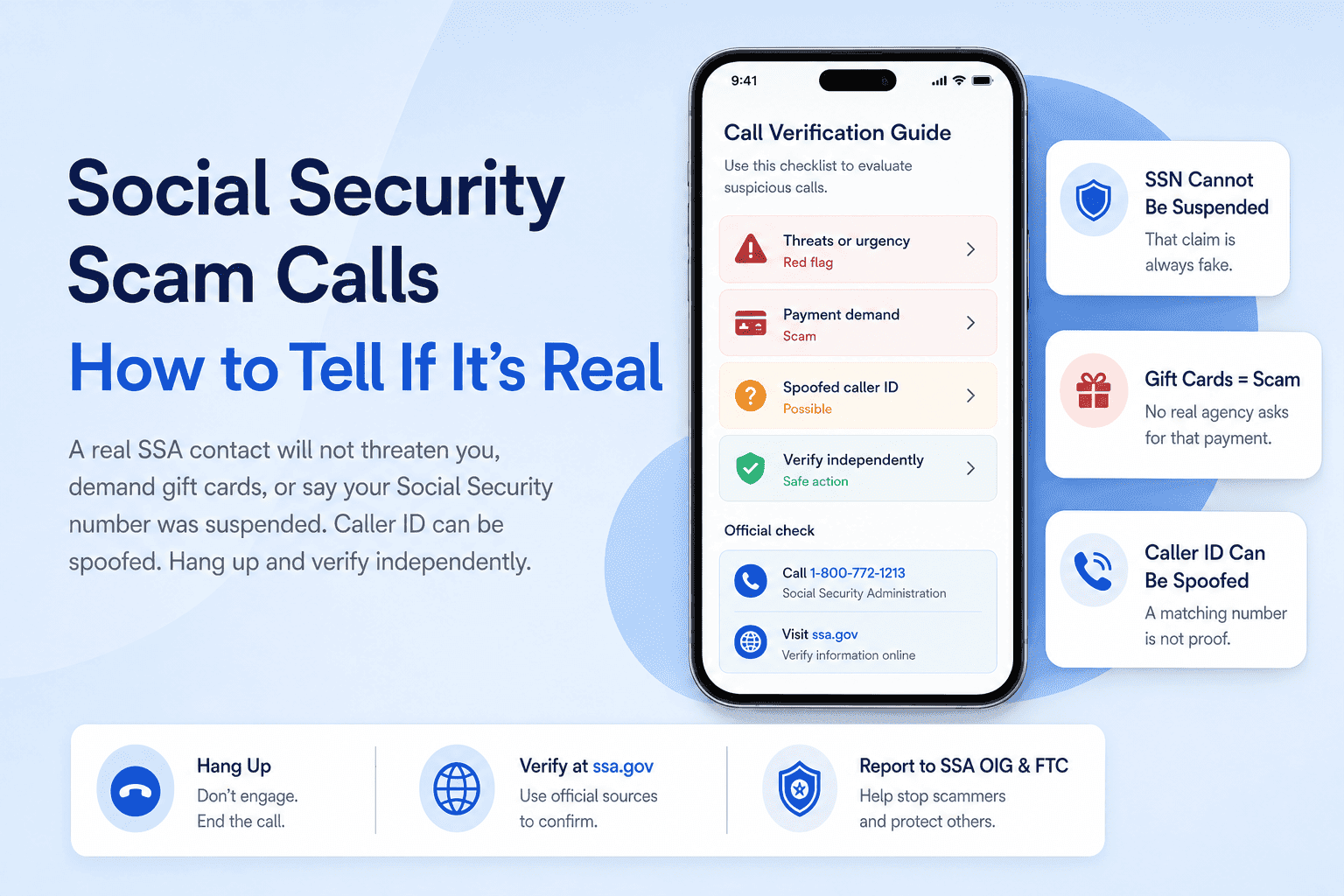
The Social Security Administration (SSA) almost never calls out of the blue, and it will never threaten you, demand payment, or claim your number has been suspended.
No real US agency accepts gift cards, wire transfers, cryptocurrency, or cash to “fix” a problem. A payment demand like that is proof of a scam.
Your Social Security number cannot be suspended, frozen, or blocked. It is a permanent identifier, so any caller who says otherwise is lying.
Caller ID means nothing. Scammers routinely spoof the real SSA number (1-800-772-1213) so it looks legitimate on your screen.
The safe move is always the same: hang up, then verify by calling 1-800-772-1213 yourself or signing in at ssa.gov.
US consumers reported losing more than $12.5 billion to fraud in 2024, a 25% jump over the prior year, according to the Federal Trade Commission. Government impersonation remains one of the most damaging categories.
Not sure if a call was real? Run it through our free scam check first.
Does the Social Security Administration Actually Call People?
Yes, but rarely, and never the way scammers do. The Social Security Administration may call if you have an open claim or recently requested a callback. It will not phone you out of the blue to demand payment, threaten arrest, or announce that your number is suspended. Those tactics signal a scam.
The confusion is fair. The SSA is a real agency with real reasons to reach people, so a blanket “they never call” rule would be wrong and could make you dismiss a legitimate contact. Genuine calls do happen, mostly when you already have something in motion: a pending application, an appeal, a benefits question you raised, or a callback you specifically asked for. In those cases the conversation is calm and routine, and the representative will not pressure you or ask you to prove your identity by reading your full number aloud.
What the SSA does not do is the part that matters. It does not cold-call to announce a crisis. It does not threaten jail or deportation. It does not demand that you settle a “problem” with a gift card or a wire transfer. When any of those elements appear, you are no longer talking to the government, no matter what your caller ID shows.
The agency is direct about this itself. The SSA’s official scam guidance states that it will never threaten you, suspend your Social Security number, or require payment by gift card, prepaid card, cryptocurrency, or cash. The table below puts the two behaviors side by side.
Real SSA Contact vs. Social Security Scam Call
| Behavior / Signal | Legitimate SSA | Social Security Scam Call | Why the difference matters |
|---|---|---|---|
| Reason for contact | Responds to your active claim or a callback you requested; routine mail is the norm | Contacts you out of the blue about a “problem” | Unsolicited “urgent problem” calls are the top scam tell |
| Tone | Professional, unrushed, willing to let you call back | Fear, urgency, pressure to act “right now” | Urgency short-circuits judgment; agencies do not rush you |
| Your SSN | Never asks you to confirm your full SSN by phone unexpectedly | Demands you “verify” or read out your full SSN | A real agency already has your record |
| Payment | Never requests payment by gift card, wire, crypto, or cash | Demands immediate payment to “fix” or “protect” | No US agency accepts gift cards; this alone confirms fraud |
| Threats | Never threatens arrest, deportation, or benefit suspension by phone | Threatens jail, frozen assets, a suspended SSN or benefits | The SSA resolves issues by mail and due process, not phone threats |
| Caller ID | May show an SSA number, but you should still verify independently | Spoofs the real SSA number to look genuine | Caller ID can be faked, so it is never proof of legitimacy |
| Callback | Encourages you to call the public number, 1-800-772-1213 | Insists you use only the number they give you | Their number routes back to the scammer |
| Channel mix | Primarily official mail; secure messages in your my SSA account | Robocalls, live “agents,” follow-up texts and emails | Mismatched, multi-channel pressure is a red flag |
How Do I Know if a Social Security Scam Call Is Fake?
A social security scam call gives itself away through pressure and demands that a real agency would never make. Watch for these red flags:
A threat of arrest, a lawsuit, deportation, or suspended benefits unless you act immediately
Any demand for payment by gift card, wire transfer, cryptocurrency, or cash
A request to confirm or “verify” your full Social Security number over the phone
A recorded “press 1 to speak to an officer” robocall
A caller ID that shows the official SSA number even as the caller turns aggressive
Instructions to keep the call secret or to move money into a “safe” account
A callback number the caller insists you must use instead of the public SSA line
Any single one of these is reason enough to hang up. You do not need to wait for a second warning sign.
The caller ID point deserves its own explanation, because it fools even careful people. Scammers use spoofing software to make any number they choose appear on your screen, including the genuine SSA line, 1-800-772-1213. A matching number is not evidence of a real call. It is a cheap trick, and it is often the reason a social security scam call number looks trustworthy at first glance. Treat the display as decoration, not proof of who is on the line.
Get a second opinion in seconds. Verify a suspicious call, text, or website with our free scam verification tool.
Why Do Scammers Say My Social Security Number Is Suspended?
Because the lie sounds official and terrifying, even though it is impossible. Your Social Security number cannot be suspended, frozen, blocked, or deactivated. It is a permanent identifier assigned to you for life. Any caller who claims your number has been suspended has already revealed the call as a scam.
The “suspended SSN” script works on two levels. First, it invents a problem that feels plausible to anyone unfamiliar with how the system operates. Most people never have a reason to learn that the number is permanent, so the threat sounds credible in the moment. Second, it hands you a villain and a deadline in the same breath: your number was flagged for suspicious activity, possibly tied to crimes committed in another state, and you have minutes to sort it out.
Fear does the heavy lifting. Once you believe your identity is on the line, the scammer offers a fake rescue: confirm your details so they can “reactivate” the number, or shift your savings into a “secure” account while the investigation runs. Both paths end the same way, with your information or your money in a stranger’s hands. The claim itself is the tell. No phone call can suspend a number that, by design, cannot be suspended.
What Do Social Security Scammers Threaten Victims With?
Scare tactics are the engine of every social security phone scam, and they tend to escalate as the call drags on. Early threats stay vague: a suspended number, a flagged account. If you hesitate rather than hang up, the pressure sharpens into something more frightening, such as an active arrest warrant, a lawsuit, frozen bank accounts, seized assets, or deportation for non-citizens. Some scripts add a criminal accusation, claiming your number turned up at a crime scene or in a drug case.
None of it reflects how the government actually works. Real agencies resolve issues through the mail and formal due process, with time to respond and the right to appeal. They do not deliver ultimatums by phone. The table below maps the most common threats against the reality and the response that keeps you safe.
Scammer Threat vs. Reality vs. Your Correct Response
| Scare tactic used on the call | The reality | What you should actually do |
|---|---|---|
| “Your Social Security number has been suspended.” | SSNs are permanent and cannot be suspended, frozen, or blocked | Recognize it as an instant fake; hang up |
| “There is a warrant for your arrest.” | The SSA does not issue arrest warrants or threaten jail by phone | Do not respond to the threat; do not pay |
| “Your benefits will be stopped today unless you act.” | Benefit changes come by mail with appeal rights, not phone ultimatums | Verify at 1-800-772-1213, not the caller’s number |
| “Your SSN is linked to a crime or drug case.” | A scare script with no basis; the SSA does not run criminal cases | Stop talking, hang up, report the call |
| “Move your money to a safe account or gift cards.” | No agency asks you to move money or buy gift cards | Never move money; this is theft in progress |
| “Confirm your details so we can protect you.” | Real protection never requires reading out your SSN or bank login | Give no information; verify independently |
| “Don’t tell anyone, this is confidential.” | Secrecy is a manipulation tactic, not a real procedure | Tell a trusted person and report it |
What Information Should I Never Give on an Unexpected Call?
On any call you did not start, never share:
Your full Social Security number
Your date of birth
Bank account or debit/credit card numbers
Online account usernames or passwords
One-time passcodes or two-factor authentication (2FA) codes
Your Medicare number
Your mother’s maiden name or other security-question answers
The rule is short: if the call came to you unexpectedly, give nothing and verify on your own.
One-time passcodes deserve extra caution. A scammer who already has your username and password needs only that six-digit code to break into your account, and the quickest way to get it is to have you read it aloud. No legitimate representative will ever ask for a 2FA code, since the entire purpose of the code is to keep it away from everyone but you.
Building safer habits online and by phone starts here. See our practical online safety guide.
What Should I Do if I Get a Social Security Scam Call?
Follow these steps in order the moment you suspect a scam:
Do not engage or press any buttons. Interacting, even to “opt out,” confirms your number is live.
Hang up. You owe an unsolicited caller nothing, and ending the call is always safe.
Do not call back the number they gave you. It routes straight to the scammer or a partner.
Do not send money, gift cards, or crypto, and do not move funds into a “safe” account.
Verify independently by calling 1-800-772-1213 or signing in at ssa.gov, using contact details you looked up yourself.
Report the call to the SSA OIG and the FTC (see the next section for exactly where).
Monitor your credit and accounts for anything unfamiliar over the following weeks.
Helping an older parent or relative? Walk through these steps together. Saying the plan out loud before a call ever comes makes it far easier to follow when the pressure is real.
Where Do I Report a Social Security Scam Call?
Report SSA imposter calls to the SSA Office of the Inspector General (SSA OIG) at oig.ssa.gov and to the Federal Trade Commission at ReportFraud.ftc.gov. If you lost money or shared personal data, also file at IdentityTheft.gov and, for financial loss, at IC3.gov.
Reporting matters even when you lost nothing. Every report feeds the data that agencies use to track scam networks, warn the public, and build cases. It takes a few minutes, and you do not have to have been defrauded to file one.
The reason to use more than one channel is that each does a different job. The SSA OIG handles Social Security imposter reports specifically. The FTC aggregates fraud data nationally and publishes the guidance that helps others avoid the same trap. IdentityTheft.gov builds a personalized recovery plan if your information was exposed. The table below shows where each report goes and what it accomplishes.
Where and How to Report a Social Security Scam Call
| Channel | Best for | Where to go | What it does | Timing |
|---|---|---|---|---|
| SSA Office of the Inspector General (SSA OIG) | Any SSA imposter call, even with no loss | oig.ssa.gov | Logs the imposter report with the responsible agency | Report every time, no loss needed |
| Federal Trade Commission (FTC) | General scam and fraud reporting | ReportFraud.ftc.gov | Feeds national fraud data and guidance | Any suspicious contact |
| FTC Identity Theft portal | You gave your SSN or personal data | IdentityTheft.gov | Builds a personalized recovery plan | If data was shared |
| Credit bureaus | Preventing new-account fraud | Equifax, Experian, TransUnion | Places a free credit freeze or fraud alert | Same day if data shared |
| FBI IC3 | You lost money | IC3.gov | Routes financial-crime complaints to investigators | If money was sent |
| Local law enforcement | Loss, coercion, or vulnerable-adult exploitation | Local non-emergency line | Creates a local record; supports elder-fraud cases | If loss or an at-risk victim |
If a scam has hit your company or your employees’ data, we can help. Explore Unscammed for Business.
Can a Social Security Scam Lead to Identity Theft?
Yes, and it is the most serious long-term risk. A confirmed Social Security number paired with your date of birth is enough for a criminal to open credit cards and loans in your name, file a fraudulent tax return to grab your refund, redirect your benefits, or apply for services you will later be billed for. The damage can surface months after the call, long after you have put it out of your mind.
If you shared any details, act quickly. Place a free credit freeze with all three bureaus, Equifax, Experian, and TransUnion, which blocks new accounts from being opened in your name. Then start a recovery plan at IdentityTheft.gov, the FTC’s official tool that generates step-by-step instructions based on exactly what was exposed.
How Do These Scams Target Older Adults Specifically?
Older adults are targeted deliberately, not by accident. Many rely on Social Security for the bulk of their income, which makes any threat to those benefits feel existential. A lifetime of dealing with government agencies by phone and mail can translate into a default trust in official-sounding callers. Isolation plays a role too, since a person living alone has no one nearby to offer a second opinion in the moment.
The data reflects the imbalance. The Federal Trade Commission has repeatedly reported that adults 60 and older suffer higher median losses to government impersonation scams than younger adults, and nonprofit groups such as the AARP Fraud Watch Network track the same pattern across their membership.
For families, the most effective protection is a shared plan agreed on in advance. Set a household rule that no one gives information to an unexpected caller, ever, and that any “urgent” agency call gets verified together at 1-800-772-1213 before anyone responds. Watch for these signs that an older relative may have been targeted:
New secrecy or defensiveness about phone calls
Unexplained gift card purchases or cash withdrawals
Sudden urgency about a money “problem” or a government matter
Reluctance to discuss a recent call that seems to have shaken them
Raise it gently. Shame keeps victims quiet, and quiet is exactly what scammers count on.
What Is the Official Way to Verify My Social Security Status?
The only official ways to check your Social Security status are your personal “my Social Security” account at ssa.gov/myaccount, the national line 1-800-772-1213 (TTY 1-800-325-0778), or your local SSA office. Never verify through a phone number, link, or website that a caller hands you.
The principle underneath every safe response is independent verification. A scammer’s whole advantage rests on keeping you inside the channel they control, whether that is a live call, a callback number, or a link in a text. The instant you step outside it and reach the SSA through details you looked up yourself, the illusion collapses, because the real agency has no record of the crisis you were just told about.
Your “my Social Security” account is the fastest way to see your actual status, benefits, and any genuine notices. Setting one up before you ever need it means you have a trusted source ready the moment a suspicious call arrives. When in doubt, hang up and go straight to the source. It costs you two minutes and strips the scammer of every ounce of leverage.
Learn who we are and why our verification standards are trusted: about Unscammed.
Social Security Scams by Channel: Call vs Text vs Email
The same con travels across formats, and recognizing the shared DNA helps you catch it anywhere.
Call (vishing): live pressure, robocalls, a “press 1” prompt, and a spoofed SSA number on your display.
Text (smishing): fake links, a message that urges you to “verify your account,” and a short callback number.
Email (phishing): a spoofed sender, lookalike ssa domains, and attachments you were not expecting.
The tell is identical in all three: unsolicited contact, plus manufactured urgency, plus a request for your data or your money. Do not click links or call numbers inside any of them. Go directly to ssa.gov and report the message to the FTC at ReportFraud.ftc.gov.
Expert Viewpoint: The One Rule That Beats Every Social Security Scam Call
In our verification work at Unscammed, the pattern is consistent to the point of being boring. Genuine agencies do not threaten, and they do not demand payment. Every social security scam call we review breaks one or both of those rules, usually inside the first thirty seconds. That single insight is more reliable than any caller ID, any official-sounding voice, and any number on your screen.
So carry one rule with you: verify before you trust, every time, without exception. When a call, text, or email produces fear and a demand in the same breath, that combination is the scam announcing itself.
Commit three moves to muscle memory. Hang up. Verify at the official number, 1-800-772-1213. Report it. Do those three things and there is no version of this scam that works on you.
The safest habit is to verify before you trust. Check any suspicious call, text, or link now with our free tool.
Frequently Asked Questions
Will Social Security ever call to ask for my number?
No. Social Security will not call unexpectedly to ask you to confirm your full number. It already has your record. If a caller demands your SSN to “verify” or “reactivate” it, hang up and call the SSA directly at 1-800-772-1213.
What phone number does a real Social Security call come from?
There is no single safe number, because scammers spoof the real SSA line (1-800-772-1213) to appear genuine on your caller ID. Never trust the display. Verify by calling that public number yourself or by signing in at ssa.gov.
I already gave a scammer my Social Security number. What now?
Act fast. Place a free credit freeze with Equifax, Experian, and TransUnion, then create a recovery plan at IdentityTheft.gov. Report the call to the SSA OIG at oig.ssa.gov and monitor your accounts and mail for unfamiliar activity.
Are Social Security scam texts and emails as dangerous as calls?
Yes. Scam texts (smishing) and emails (phishing) use the same pressure and fake links to steal your data. Do not click links or call numbers inside them. Go directly to ssa.gov and report the message to the FTC at ReportFraud.ftc.gov.
Can I get my money back after a Social Security scam?
Recovery is possible but not guaranteed and depends on the payment method and speed. Contact your bank or card issuer immediately, report to IC3.gov if money was sent, and file with the FTC. Gift card and crypto losses are the hardest to reverse.
How can I protect an elderly parent from Social Security scam calls?
Set a family rule that no one gives information to unexpected callers. Enable call blocking, register on the Do Not Call list, and agree that any “urgent” agency call gets verified together at 1-800-772-1213 before anyone responds.
Does hanging up on a scam call put me at risk?
No. Hanging up is the safest response and cannot harm you. The real risk is staying on the line, pressing prompts, or calling back the number the scammer provided, all of which mark you as an active target and invite more attempts.
Featured Articles