How to Protect Elderly Parents From Scams: A Family Checklist
 Share:


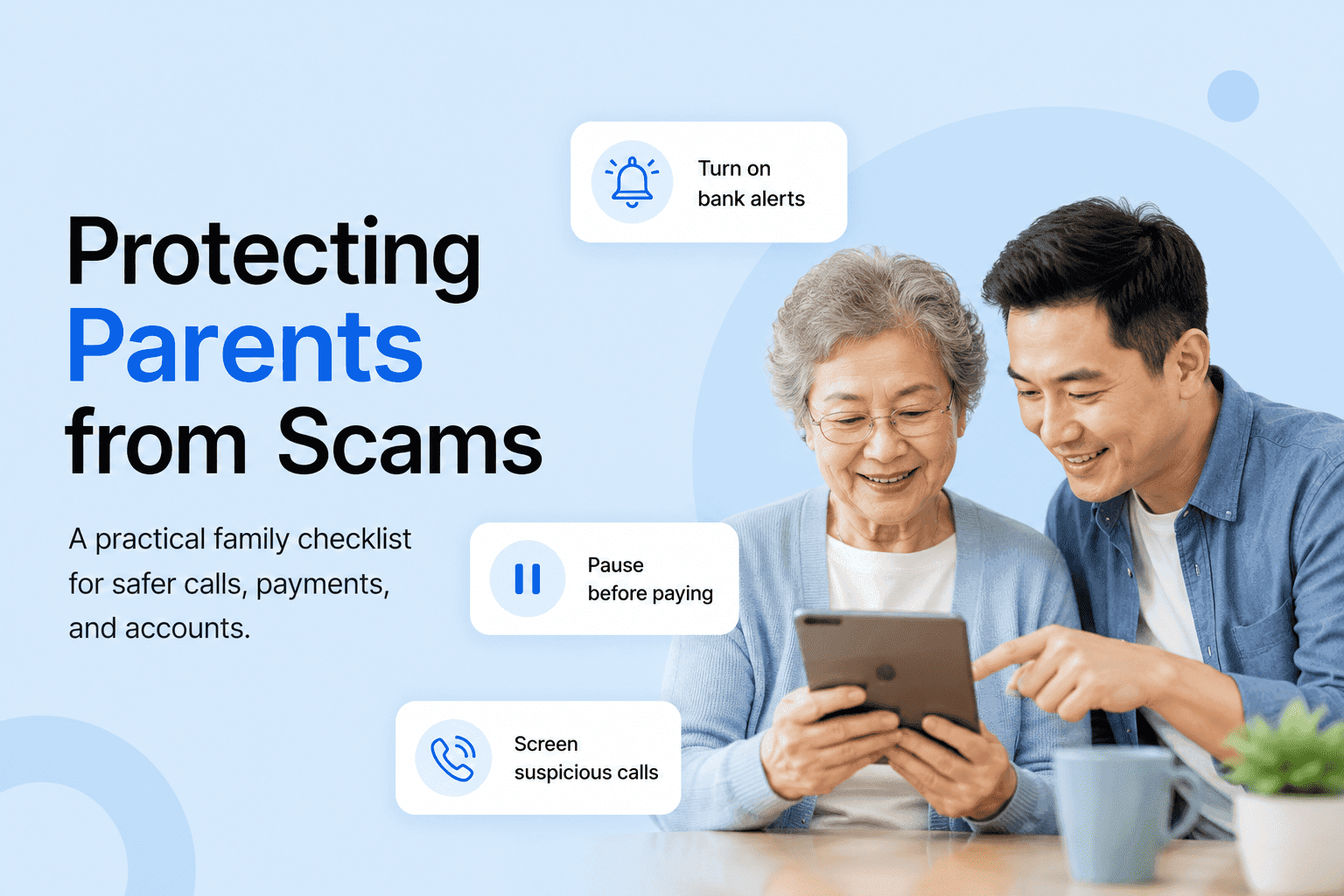
Watching a parent grow older brings a quiet new worry along with it: the phone call, the friendly email, the “urgent” problem that could drain savings they spent decades building. The reassuring part is that most scams run on the same short list of scripts, and a family that plans ahead can stop the majority of them before a single dollar moves.
Here is how to protect elderly parents from scams, written as a family checklist you can actually use. Work from the top, because the first steps are the free, fast ones that do the most to keep an account safe.
If you do only a few things this week, do these:
1. Switch on free bank transaction alerts and add yourself as a trusted contact on your parent’s accounts.
2. Learn the top three warning signs: new secrecy about money, unusual gift card or wire activity, and a sudden “urgent” caller or online partner pressing for payment.
3. Agree on one family rule that no money moves before a quick call to you.
4. If money has already gone out, call the bank the same hour and ask for a recall or dispute.
5. Keep the reporting numbers handy: the FTC at ReportFraud.ftc.gov, the FBI at ic3.gov, and the National Elder Fraud Hotline at 833-372-8311.
The risk is real, and the numbers show it. In its 2024 Elder Fraud Report, the FBI’s Internet Crime Complaint Center recorded more than $4.8 billion in losses reported by Americans aged 60 and older, the highest total of any age group. Any time a call or message feels off, you can verify a suspicious message or caller before your parent replies or pays.
How can I protect my elderly parents from scams?
Protection works best as three overlapping layers: an open conversation, a little technology on the phone and computer, and a few controls on the accounts. Elderly scam prevention holds up better as a standing family habit than as a single lecture, because scammers keep rewriting the story while the emotional hooks stay the same. The same approach answers how to protect seniors from scams in general, and it scales down neatly to one parent in one household.
Here is the family checklist. You can finish the first four items in an afternoon, and most cost nothing.
1. Have the first conversation early, before anything goes wrong, and lead with “us,” not “you.”
2. Turn on bank and card transaction alerts for charges and transfers over a low amount.
3. Add yourself or a sibling as a trusted contact at the bank and the brokerage.
4. Set up view-only account access so you can watch without moving money.
5. Place a credit freeze at all three bureaus, Equifax, Experian, and TransUnion.
6. Register the phone on the National Do Not Call Registry and add call screening.
7. Agree on one simple rule you both follow: pause and call before paying anyone unexpected.
8. Keep a shared list of the agencies and numbers to call if something happens.
9. Review statements together once a month, briefly, so it stays normal.
10. Revisit the plan after any big life change, such as a move, a loss, or a new diagnosis.
These fall into three buckets. Conversation keeps the lines honest, technology filters what reaches your parent, and account controls limit the damage if something slips through. You do not need all ten at once. You need enough overlap that no single mistake can drain an account.
What are the warning signs a parent is being scammed?
The signs your elderly parent is being scammed usually show up in three places: the money, the mood, and the phone. Treat a cluster of them as a reason to ask gentle questions, not a reason to panic.
Financial signs
1. New or repeated gift card purchases, often in odd amounts.
2. Cash withdrawals, wires, or app payments your parent cannot fully explain.
3. Statements that go missing, or a quiet switch to paperless with no access shared.
4. Unfamiliar charges, a new account, or a savings balance that keeps dropping.
Behavioral signs
1. Secrecy or defensiveness about money, phone calls, or a “new friend.”
2. A sudden sense of urgency about a payment or a deadline.
3. Pulling back from family while spending more time on the phone or online.
4. Anxiety, confusion, or shame when finances come up.
Communication signs
1. Frequent calls or texts from unknown numbers, often at the same time each day.
2. Talk of a lottery win, a surprise inheritance, a “government” caller, or a romantic partner they have never met in person.
3. Requests to keep something “just between us.”
4. Pressure to pay with gift cards, a wire, cryptocurrency, or a payment app.
The common playbooks behind these signs are in the table just below.
Which scams target seniors most, and how do they work?
Older adults are targeted for reasons that have little to do with intelligence. Many live alone, which makes a friendly caller genuinely welcome. Retirement savings and home equity mean the potential payout is large. A generation raised to be polite tends to stay on the phone and hear a stranger out. And normal age-related shifts in memory or judgment can make a fast-talking pitch harder to shut down. The National Council on Aging keeps a running list of the most common scams that target older adults, and the categories barely change even as the scripts do.
Scale matters too. AARP’s research puts the annual cost of elder financial exploitation at roughly $28.3 billion, and a striking share of that comes from people the victim already knows, a detail families miss when they picture a faceless stranger. The table below covers the scams targeting the elderly that we see most, along with the emotional lever each one pulls.
| Scam type | How it reaches the victim | The emotional lever | Typical ask | Red flag phrase | Reversible? |
|---|---|---|---|---|---|
| Grandparent scam | Phone call, sometimes an AI voice clone | Fear for a loved one | Wire or gift cards for “bail” or a “hospital bill” | “Don’t tell Mom and Dad” | Rarely |
| Government impersonation (SSA, IRS, Medicare) | Call, text, robocall | Fear of arrest or lost benefits | Payment or SSN “verification” | “Your Social Security number is suspended” | Rarely |
| Tech support scam | Pop-up, call, email | Fear of a hacked computer | Remote access plus payment | “Your computer is infected, call now” | Sometimes |
| Romance scam | Dating app, social media, DM | Loneliness and affection | Ongoing money transfers | “I need help until we finally meet” | Rarely |
| Lottery and sweepstakes | Mail, call, email | Excitement and hope | Fees or taxes to “release winnings” | “You won, just pay the processing fee” | Rarely |
| Investment and crypto (“pig butchering”) | Social media, messaging apps | Trust built over weeks, then greed | Deposits into a fake platform | “Guaranteed returns, act fast” | Rarely |
| Gift card and payment scam | Any channel, as the payment step | Urgency | Read card numbers over the phone | “Pay with Apple or Google Play cards” | Almost never |
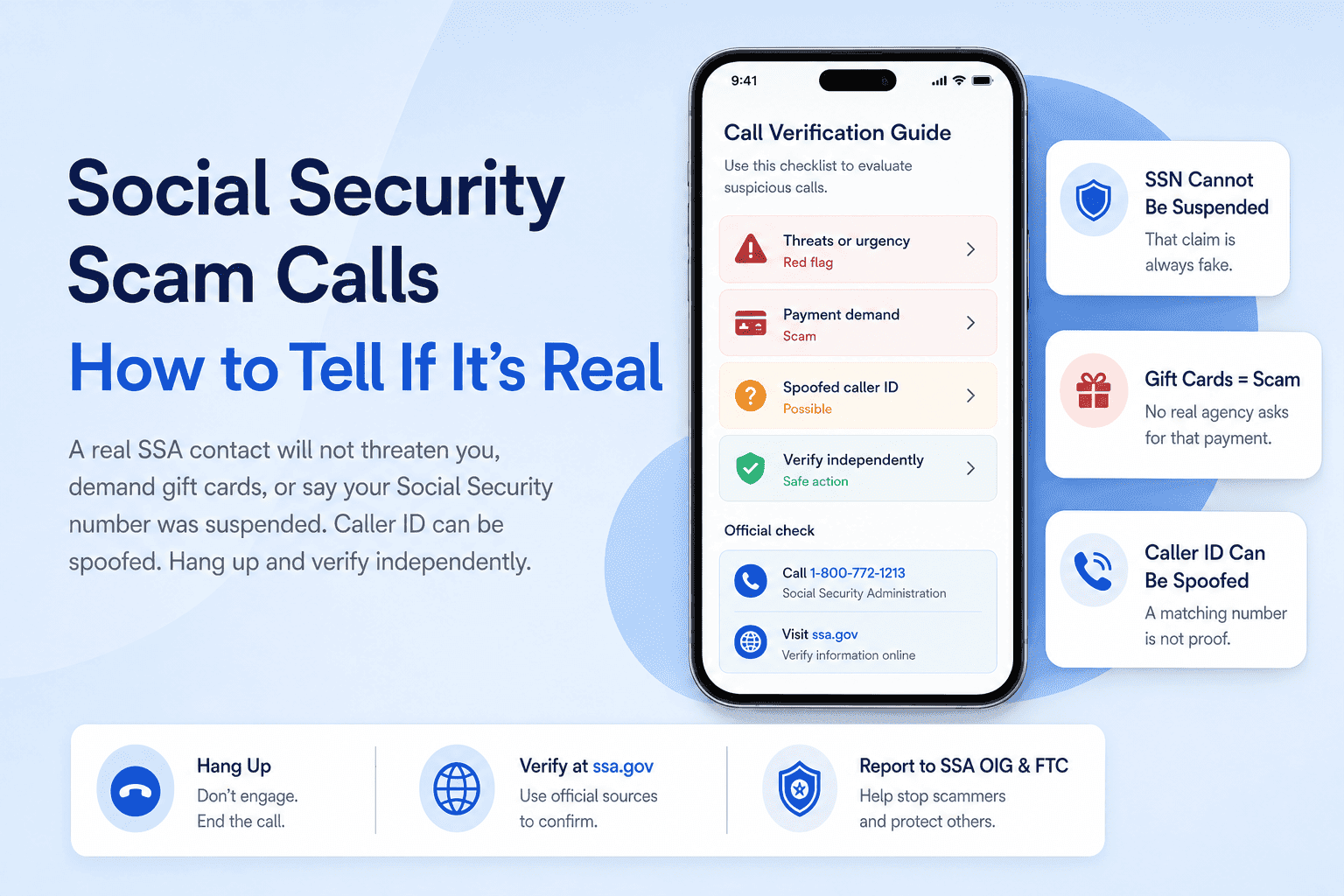
What this looks like in real life. A daughter noticed her father buying $500 in gift cards twice in one week. He said a “Social Security agent” had warned him that his number was suspended and that a fine had to be paid in cards to avoid arrest. That single phrase, a suspended Social Security number paid in gift cards, is a scam nearly every time. Real agencies never demand payment that way.
Should I monitor my aging parent’s bank accounts?
Yes, with your parent’s consent or the right legal authority, and view-only access is usually all you need. Monitoring gives you a chance to catch a problem early. It does not mean managing your parent’s money for them.
The lightest version is read-only online access that lets you see transactions without the ability to move funds. A joint account gives you more control, but it also merges finances in ways that can complicate taxes, benefits eligibility, and inheritance, so treat it as a bigger decision rather than a default. When you are working out how to help elderly parents with finances, aim for the least intrusive control that still keeps them safe.
Whatever you choose, get clear agreement first. Watching a parent’s money behind their back damages the trust you will need if something ever goes wrong, and trust is what keeps them telling you about the strange call before they act on it. For everyday habits worth building together, these online safety habits to set up together pair well with account monitoring.
How do I set up account alerts for an elderly parent?
Setting up alerts is the highest-value fifteen minutes you can spend, and it is the clearest answer to how to set up bank alerts for elderly parents.
1. Sign in to the bank’s app or website with your parent, on their account.
2. Open the alerts or notifications settings.
3. Turn on transaction alerts and set a low dollar threshold, for example any charge or transfer over $100.
4. Add alerts for new payees, address changes, and large ATM withdrawals.
5. Choose how alerts arrive. Text and email both work, and you can send them to your parent and, with permission, to you.
6. While you are there, name a trusted contact so the bank can reach a relative if staff notice something concerning.
How do POA and banking protections work for vulnerable adults?
These tools exist to protect aging parents from financial abuse, including the quieter kind that comes from people close to them. Three of them do most of the work.
A durable power of attorney (POA) is a legal document that lets your parent name someone to manage money if they no longer can. “Durable” means it stays in effect after a loss of capacity, which is the whole point. It differs from guardianship or conservatorship, which a court imposes when no plan exists, usually after capacity is already gone and at real cost to the family. Set up a POA while your parent is well and can choose freely.
A trusted contact person is a lighter tool. Banks and brokerages can list a relative or friend to call if they suspect exploitation or cannot reach the account holder. It grants no authority to move money, so it is easy to agree to and easy to put in place. Brokerage firms are already expected to ask customers for one.
The Senior Safe Act, passed in 2018, works quietly behind all of this. It shields banks, credit unions, and their trained employees from certain liability when they report suspected exploitation in good faith. In practice, it is why a teller might pause a large, out-of-character withdrawal and ask a few questions. That pause has protected a lot of people.
A few contrasts help you pick the right level of involvement:
1. Monitoring versus control: view-only access watches without taking over; POA grants authority to act. Start with the least restrictive option that keeps your parent safe.
2. Speed versus reversibility: card charges can often be disputed, while wires and gift cards usually cannot. That is why alerts and screening matter more than recovery.
3. Prevention versus response: call screening and alerts prevent; hotlines and the bank’s fraud team respond. A strong family plan uses both.
This section is general information, not legal advice. An elder law attorney can match the right documents to your parent’s situation and state. The CFPB also publishes plain-language resources for older adults and their families worth reading before that meeting.
How do I talk to a parent about scam risks without upsetting them?
The conversation lands better when it protects dignity and autonomy instead of taking them away. A useful opener sounds like this: “Mom, I read that scammers are getting really good at faking bank calls, and I want us to have a plan so neither of us gets caught. Can we set one up together?”
1. Pick a calm moment, not a crisis, and put yourself in the plan too, so it reads as teamwork.
2. Share a story, yours or one in the news, so the risk feels external rather than a judgment of them.
3. Ask permission before suggesting any change. Their independence is the point, not an obstacle to it.
4. Frame every control as protecting the family’s plans, not policing their choices.
5. Agree on one rule you both keep: pause and call before paying anyone unexpected.
6. Write down the plan and the numbers to call, and leave a copy where they can find it.
7. Return to it briefly now and then, so the topic stays ordinary instead of dramatic.
The FTC’s Pass It On campaign gives older adults plain, non-patronizing materials they can read and share, which can make the first conversation feel less like a warning and more like a shared project.
What tools help families catch scams targeting seniors early?
Senior fraud protection services span a range of prices and effort, and the most effective ones cost nothing. Think in layers. Alerts and a credit freeze guard the accounts. Call screening and spam blocking cut down the daily flood of scam calls. A shared monitoring routine catches whatever slips past the first two. The table compares the main options so you can assemble a mix that fits your parent’s comfort with technology.
| Protection layer | What it does | Cost range | Effort to set up | Consent needed | Best for |
|---|---|---|---|---|---|
| Bank transaction alerts | Notifies on charges over a threshold | Free | Low | Yes, account holder | Catching fraud fast |
| View-only account access | Lets family see, not move, money | Free | Low to medium | Yes | Ongoing monitoring |
| Trusted contact designation | Bank can call a relative if concerned | Free | Low | Yes | Early bank-side flagging |
| Credit freeze | Blocks new credit in your parent’s name | Free | Medium | Yes | Preventing new-account fraud |
| Call-screening or spam-blocking app | Filters likely scam calls | Free to a few dollars a month | Medium | Device access | Reducing robocalls |
| Landline call blocker device | Screens calls on a home phone | One-time purchase | Medium | Physical setup | Non-smartphone users |
| Durable power of attorney | Legal authority to act financially | Attorney fee | High | Yes, legal | Advanced or declining capacity |
Are there services that screen calls for elderly parents?
Yes, and they come in three main forms. Carrier-level blocking is built into most phone plans and is often free, so start there. Third-party call-screening apps add smarter filtering on a smartphone and usually cost a few dollars a month. Landline call blockers are physical devices that screen calls on a home phone, which suits parents who do not use a smartphone. None of them catch everything, so treat screening as one layer, not a guarantee. If a call or message still gets through and seems off, you can run any suspicious number or link through our scam checker before anyone acts on it.
What should I do if my parent already sent money to a scammer?
Move fast. With wires, cryptocurrency, and gift cards, the window to recover anything is short, sometimes only hours. Work through these steps in order and do not wait until you feel certain.
1. Call the bank or card issuer’s fraud line right now and ask them to stop, recall, or dispute the payment.
2. For a wire, ask the sending bank to attempt a recall and to contact the receiving bank immediately.
3. Freeze or lock the affected cards and accounts so nothing else moves.
4. Change passwords and PINs, and turn on two-factor authentication wherever possible.
5. Write down everything: names, numbers, amounts, times, and screenshots. This record matters for disputes and reports.
6. Report the fraud to the FTC and, for online scams, the FBI, using the details in the reporting table below.
7. If a gift card was used, call the card’s company at once. Some can freeze the balance if it has not been drained.
Reversibility depends on how the money moved. Credit card charges are the most likely to be reversed, thanks to dispute rights. Bank transfers can sometimes be pulled back if you catch them quickly. Wires, crypto, and gift cards usually cannot, which is exactly why the earlier layers matter so much.
If this is happening right now, you do not have to figure it out alone.
Get step-by-step help from our team
What agencies help families report scams against elderly relatives?
Reporting does two things. It can open a path to help, and it feeds the data that lets investigators spot patterns across thousands of cases. Here is how to report elder fraud, and which office fits which problem. The Justice Department’s National Elder Fraud Hotline, at 833-372-8311, pairs callers with case managers who guide them through reporting and next steps; you can read how it works on the Office for Victims of Crime’s elder fraud page.
| Agency or resource | Best used for | How to contact | What they do | Response type |
|---|---|---|---|---|
| FTC | General consumer fraud and identity theft | ReportFraud.ftc.gov / IdentityTheft.gov | Records reports, builds cases, gives a recovery plan | Online report plus recovery steps |
| FBI IC3 | Online and cyber-enabled fraud | ic3.gov | Investigates internet crime and aggregates data | Online complaint |
| CFPB | Bank, card, and financial-product issues | consumerfinance.gov/complaint | Forwards the complaint to the institution and seeks a response | Company response within days |
| Adult Protective Services (APS) | Suspected exploitation of a vulnerable adult | State or county APS line | Investigates abuse and exploitation | Caseworker follow-up |
| National Elder Fraud Hotline | Guidance and case management for seniors | 833-372-8311 | Personalized reporting support | Live case manager |
| State Attorney General | State-level consumer protection | Your state AG website | Enforcement, mediation, and public alerts | Varies by state |
Start with the FTC for almost any consumer scam and the FBI’s IC3 for anything that happened online. Bring in Adult Protective Services when you suspect a vulnerable adult is being exploited, and call the hotline when you want a person to walk you through it. The FBI also maintains a helpful overview of how elder fraud works and where to turn.
Expert viewpoint: building a lasting family safety net
At Unscammed, the cases we see rarely start with one dramatic mistake. They build quietly. A friendly caller becomes a daily habit. A small “fee” becomes a series of transfers. By the time a family notices, the money has often moved through channels that do not reverse. The pattern is consistent enough that we plan around it.
The families who handle this best tend to share one habit. They treat protection as a shared, ongoing system with three parts: an open conversation that keeps things honest, a few well-chosen tools on the phone and accounts, and simple account controls like alerts and a trusted contact. Each part covers a gap the others leave. Together they turn a lone senior facing a professional into a family facing it as a team.
The most useful thing you can do today is take away the secrecy and the speed that scams depend on. Agree on the pause-and-call rule, switch on the alerts, and keep the reporting numbers handy. If you want a hand building that plan, see how we help protect families and businesses or learn more about Unscammed and our mission.
This article is educational and is not legal or financial advice.
Frequently asked questions
Can money lost to a scam be recovered?
Sometimes, and speed decides it. Credit card charges and some bank transfers can be disputed or recalled if you report them within days. Wires, cryptocurrency, and gift cards are rarely recoverable once sent. Contact the bank the same hour, then report to the FTC and, for online fraud, the FBI.
Is it legal to monitor my elderly parent’s accounts?
Yes, with your parent’s consent or proper legal authority such as a durable power of attorney or being named on the account. Monitoring without any authority raises legal and trust problems, even with good intentions. Ask first and agree together. View-only access is usually enough and keeps their independence intact.
How often do scams actually target seniors?
Often, and the losses are large. The FBI’s 2024 Elder Fraud Report logged more than $4.8 billion in losses reported by adults 60 and older, and many cases go unreported. Check the FTC and FBI sites for current figures, since the numbers rise most years. Treat it as a real, ongoing risk.
What is the single most effective step I can take today?
Turn on bank transaction alerts and add yourself as a trusted contact on your parent’s accounts. Both are free, take minutes, and need only your parent’s consent. Alerts catch fraud fast, and a trusted contact lets the bank reach you if staff notice something wrong before you do.
Should I take away my parent’s phone or credit cards?
Usually no. Removing autonomy tends to cause secrecy and resistance, which makes them less safe. Start with layered controls: alerts, spending limits, and call screening that keep their independence. Move toward a power of attorney only if capacity is genuinely declining, and get an elder law attorney’s guidance first.
What do I do if my parent refuses to believe they were scammed?
Stay calm and avoid shaming, which only ends the conversation. Focus on protecting the household rather than proving them wrong. Bring in a trusted third party, such as their bank’s fraud team or a respected relative. Keep the relationship open so they keep talking to you, which is your best long-term safeguard.
Featured Articles