Medicare Benefit Card Scams: Grocery Cards, Flex Cards, and What's Real
 Share:


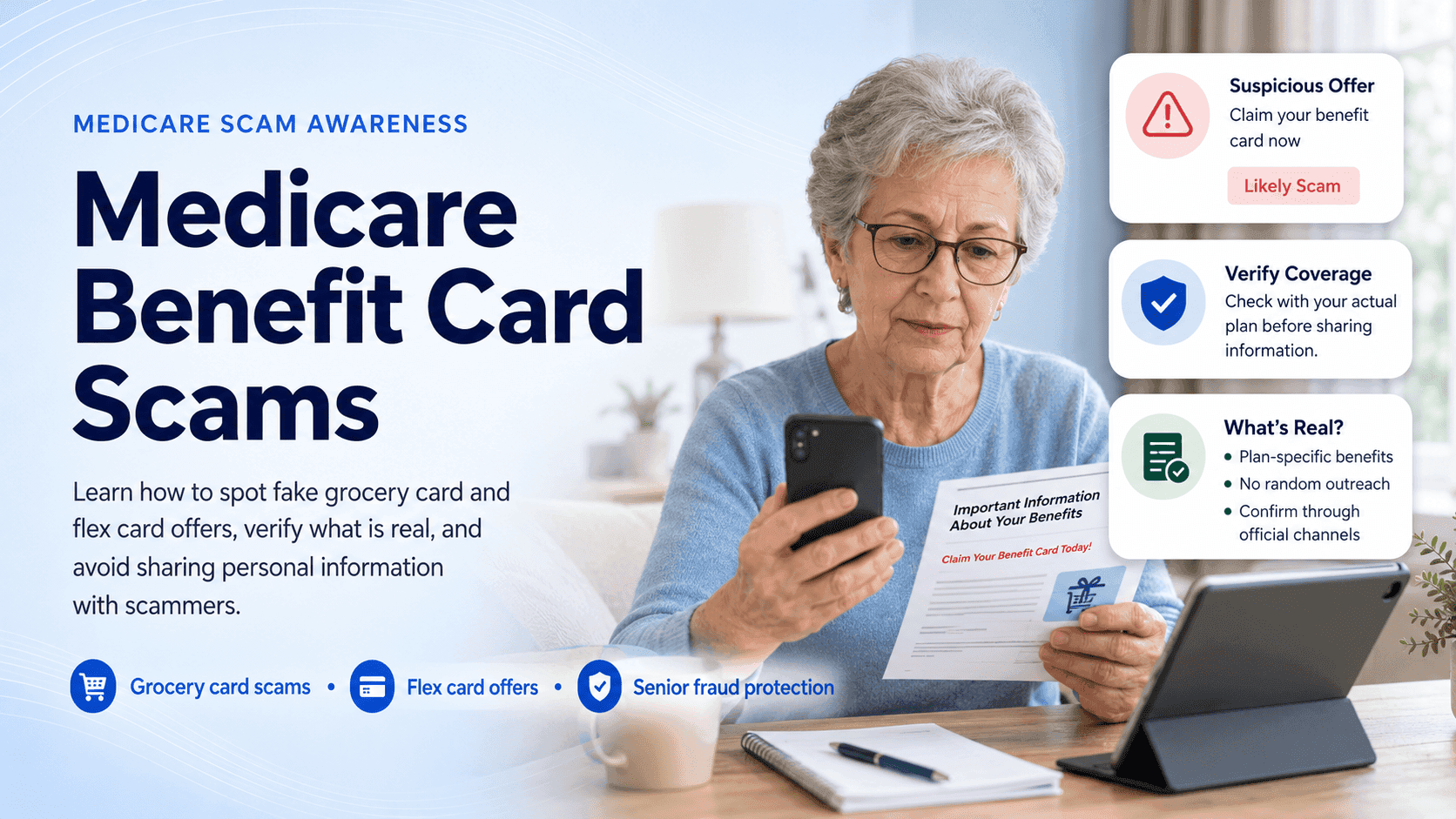
A caller tells you there is $2,800 waiting on a Medicare benefit card with your name on it, and all you have to do is confirm your Medicare number to release it. The pitch sounds official because it borrows the language of a real benefit. That overlap is what makes a medicare card scam so effective, and so hard to read.
Here is the honest version. Real grocery and flex allowances do exist, but only as a feature inside some Medicare Advantage plans. Any unsolicited call, text, or ad offering a free Medicare benefit card in exchange for your Medicare number is almost always a scam. This guide separates the genuine benefit from the fraud that copies its name, and shows you how to check any offer before you share a single detail.
If you remember nothing else, remember these five things:
Original Medicare (Parts A and B) has no grocery card, flex card, or spending allowance.
The “$2,800 flex card for everyone” figure is a marketing exaggeration, not a universal benefit.
Real allowances reach you through a plan you already joined, never through a hotline or an ad’s claim form.
No legitimate agency asks for your Medicare number, Social Security number, or bank details on an inbound call or text.
If you already shared information, call 1-800-MEDICARE and report to the FTC. Fast action limits the damage.
Not sure whether an offer is legitimate? Run it through our free scam verification tool before you share anything.
Is the Medicare grocery card a scam?
A grocery card is not automatically a scam. Real grocery allowances do exist inside some Medicare Advantage plans. The scam is almost always the pitch: an unsolicited call, text, or ad that dangles a free card and asks for your Medicare number to unlock it. The product can be real. The stranger offering it usually is not.
Here is the part that trips people up. A medicare grocery card scam does not work by inventing something impossible. It works by describing something that is partly true. Certain Medicare Advantage plans, especially the special needs plans built for people who qualify for both Medicare and Medicaid, do load a grocery or healthy food allowance onto a member card. So when a caller mentions a grocery benefit, the detail lands as familiar rather than absurd.
The difference sits in two places: the source and the ask. A real grocery allowance shows up in the plan you already enrolled in. You read about it in your plan’s welcome packet or member portal, and the money is simply there to use at approved stores. A scam version arrives from someone you never contacted, and it comes with a request. Confirm your Medicare number. Verify your date of birth. Pay a small activation fee. Real benefits never work that way.
If you have worried that hanging up means losing a benefit, put that fear down. You are not missing out by refusing to hand your Medicare number to a stranger. A legitimate grocery allowance does not disappear because you declined a phone call, and it was never available through that call to begin with. The people most at risk are the ones who assume the offer must be real because the words match something they have heard. The words matching is the tactic, not the proof.
Here is how a real Medicare Advantage benefit and a typical scam offer line up side by side.
| Signal | Legitimate Medicare Advantage benefit | Typical scam “benefit card” offer | Why it matters |
|---|---|---|---|
| Who contacts you | You find it in your own plan materials or portal | Unsolicited call, text, robocall, social ad, or TV number | Real benefits are not “claimed” from a stranger |
| What it is called | OTC allowance, grocery allowance, or flex allowance (a plan feature) | “Free $2,800 Medicare flex card,” “government benefit card” | Inflated, generic naming is a red flag |
| Where funds come from | Loaded by your enrolled private plan | Vague “government” or “Medicare” source | Medicare itself does not mail flex cards |
| Eligibility framing | Based on your plan and, sometimes, condition or dual status | “Everyone on Medicare qualifies” | Blanket eligibility claims are false |
| Information requested | None beyond your normal secure plan login | Medicare number, SSN, DOB, bank or card details | Legitimate plans do not cold-ask for your MBI |
| Cost to receive | Included in the plan you already chose | “Small activation fee” or gift-card payment | You never pay to unlock a real Medicare benefit |
| Pressure and timing | No countdown; the benefit persists all year | Urgency, “act now,” “offer expires today” | Scarcity pressure is a manipulation tactic |
| Plan changes | Only with your informed consent in a valid window | Secret or tricked plan switch | Unauthorized switching is Medicare fraud |
| Verification | Confirmable via 1-800-MEDICARE and medicare.gov | Caller discourages you from verifying | Real sources welcome verification |
| Original Medicare access | Not available (no grocery or flex card exists) | Falsely promised to Original Medicare enrollees | Original Medicare has no such card, period |
What is a Medicare flex or spending allowance card?
A Medicare flex card is an informal marketing name for a preloaded, debit-style card that some Medicare Advantage plans give members. Funds cover approved purchases such as over-the-counter health items, and in certain plans, groceries or utility bills. It is a feature of a private plan, not a standalone government program.
You will not find the phrase “flex card” anywhere in official Medicare rules. It is a term the insurance marketing world invented because it sounds generous and is easy to remember. What sits underneath the name is a real, if modest, plan benefit. A medicare spending allowance card is the same idea described more plainly: a set amount your plan loads for specific categories of spending, refreshed monthly or quarterly depending on the plan.
Now the number everyone has seen. The “$2,800 Medicare flex card” figure that fills TV ads and pop-ups is a marketing ceiling, not a promise. It usually represents the highest possible annual value across a narrow set of plans for members who meet strict eligibility rules, often people enrolled in a dual-eligible or chronic-condition special needs plan. Most real allowances are far smaller, and many plans offer nothing close to that headline. Treating $2,800 as a flat amount waiting for every senior is where the ad stops being marketing and starts working like bait.
Is the Medicare flex card real or fake?
The flex card is real as a plan feature and fake as a universal giveaway. Real versions come bundled inside specific Medicare Advantage plans and reach you through the plan you joined. The fake version is the free-standing “card” pitched in an ad or cold call, which exists only to collect your Medicare number and other details. Same name, opposite intent.
Good digital habits protect the accounts these cards touch, so it is worth a moment to protect yourself while shopping and banking online before you ever load funds or log into a plan portal.
| Card or allowance | What it actually is | Who can realistically get it | Typical real value | How the scam version differs |
|---|---|---|---|---|
| Flex / spending allowance card | Informal name for a preloaded card in some Advantage plans | Certain Medicare Advantage members, often D-SNP or C-SNP | Modest; varies widely by plan, often below advertised figures | Advertised as a flat “$2,800 for everyone” |
| Grocery / healthy food allowance | Food benefit in some special needs plans | Usually dual-eligible or chronic-condition SNP members | Set monthly or quarterly amount per plan | Promised to all seniors “free” with no plan |
| Over-the-counter (OTC) card | Allowance for approved health items | Many Medicare Advantage plan members | Small recurring allowance per plan rules | Used as bait to harvest your Medicare number |
| Medicare Savings Program (MSP) | State program that helps pay premiums or costs | Lower-income beneficiaries who qualify | Premium and cost-sharing help, not a spending card | Repackaged as a “cash card” you must claim |
| Original Medicare (Parts A and B) | Federal coverage with no supplemental spending card | Anyone enrolled in Original Medicare | No grocery, flex, or OTC card exists | Any “Original Medicare grocery card” is fake |
Related programs such as Medicare Savings Programs and Extra Help, the Part D Low-Income Subsidy, are also real. They lower what you pay for coverage and drugs rather than arriving as a spendable card, so any pitch that turns them into a “free cash card” is misreading them on purpose.
How do I know if a Medicare benefit card offer is legitimate?
A legitimate offer comes from a plan you already joined. It never asks for payment to activate, and it does not require you to give your Medicare number to a stranger. It is a scam when the contact is unsolicited, urgent, and hungry for personal data. Those three traits together are the clearest signal you will get.
A real benefit has a quiet, boring quality. Treat an offer as legitimate if:
It appears in your own plan’s official materials, member card, or online account.
It costs nothing extra, because it was included in the plan you chose.
It never depends on reading your Medicare number aloud to someone who called you.
You can confirm it by calling the number on your member card or 1-800-MEDICARE.
Treat it as a scam if:
The contact was unsolicited: a robocall, a text (a tactic called smishing), or a social ad.
There is pressure and a deadline: “act now,” “today only,” “your card expires.”
Someone asks for your Medicare number, SSN, date of birth, or bank details.
It is framed as free money from “the government” with no plan attached.
You are pushed to switch plans on the spot, sometimes without realizing it.
When an offer looks official but feels off, check the source first. Our scam verification team checks numbers, links, and sender details so you do not have to guess.
Why do scammers use benefit cards to target seniors?
Benefit card scams work because they sit on top of something true. Real Medicare Advantage plans do include supplemental perks, so a fake card offer does not have to overcome disbelief. It only has to sound familiar, and that is a low bar for a practiced fraudster.
Three pressures make the pitch land harder with older adults. The first is fixed income. When money is tight, a card described as “free groceries” or “help with utilities” speaks straight to a real monthly worry. The second is trust in government branding. Words like Medicare, Social Security, and “federal benefit” carry authority, and scammers wrap themselves in that authority on purpose. Spoofed caller ID that reads “SSA” or “Medicare” finishes the illusion.
The third pressure is timing. Medicare’s Annual Enrollment Period runs mid-October through early December, and that window brings a flood of legitimate plan advertising. Fraud rises alongside it. During enrollment season, a scam call blends into a crowd of real ones, which is why the Annual Enrollment Period fraud spike is so reliable year after year.
If your parent saw a benefit card promoted on television and asked whether it was safe, that instinct to check was the right one. A TV slot is not a seal of approval. Some ads promote real plans in misleading terms, and some are pure fraud. The medium says nothing about the honesty of the offer.
What personal information do these scam offers usually ask for?
Every benefit card scam has the same real goal, which is to collect information it can sell or use. Here is what these offers reach for, and why each piece matters.
Medicare number (your Medicare Beneficiary Identifier, or MBI). With it, a criminal can bill Medicare for care you never received. That is medical identity theft, and it can quietly drain your benefits and corrupt your medical records.
Social Security number. This opens the door to broad identity theft, new-account fraud, and tax fraud in your name.
Date of birth. On its own it seems harmless. Paired with your name and MBI, it helps a scammer pass as you.
Bank account or debit card details. These lead straight to unauthorized withdrawals.
Current plan information. This helps a fraudster switch your coverage without consent or build a more convincing follow-up.
Medicare.gov login credentials. Handing these over gives a stranger direct access to your account.
Notice the pattern. None of this is needed to give you a benefit you supposedly already earned. Every item is useful only to someone who wants to take something from you. A real plan already holds your details and never asks a caller to read them back.
How do real Medicare benefits get issued vs scam versions?
Real benefits are issued through a plan you actively chose. Scam versions are pushed at you through cold outreach that ends in a data grab or a payment request. The honest path is slow and paperwork-heavy. The scam path is fast and urgent. That contrast is your best tell.
The real path looks like this. You enroll in a Medicare Advantage plan during a valid enrollment window. The insurer mails you plan materials that spell out your benefits, including any OTC, grocery, or flex allowance. You receive a member card or gain access to a portal, and the benefit is simply available at approved retailers or pharmacies. There is no separate card to “claim,” no hotline that unlocks funds, and no fee to activate anything.
The scam path runs in the opposite direction. It starts with contact you never requested. A voice or a text says a card is waiting and that you must act now to claim it. Next comes the information harvest: your Medicare number, maybe your Social Security number, sometimes your bank details. In the worst cases, the caller quietly enrolls you in a different plan or charges an “activation fee” by gift card or wire. You end up worse off than before the call, and the promised card never existed.
The tell is the direction of the request. Real benefits flow to you because of a decision you already made. Scams flow toward the criminal because of a decision they want you to make in a hurry. Unscammed exists to close that gap for people who are not sure which path they are on. You can learn how we vet and verify offers and organizations before you decide to trust them.
What should I do if I already gave my info for a “benefit card”?
If you already shared information, take a breath. Giving out your Medicare number is serious, but it is recoverable when you act quickly. Work through the steps below in order, starting the moment you realize what happened.
End contact and save everything. Hang up or stop replying. Do not use any phone number or link from the offer again. Keep the message, the number, and any names for your reports.
Call 1-800-MEDICARE (1-800-633-4227). Report exactly what you shared. Ask them to note your account and tell you what to watch for.
Watch your Medicare Summary Notices. Review each statement for care or equipment you never received. False claims are the clearest sign your number is being misused.
Protect your identity if you shared your SSN. Place a fraud alert or a credit freeze with the credit bureaus, and start a recovery plan at IdentityTheft.gov.
Call your bank right away if you gave financial details. Ask the fraud department to freeze or replace the account and reverse any charges.
Report the scam to the FTC at ReportFraud.ftc.gov. Your report feeds the data agencies use to track and shut down these operations.
Speed matters more than perfection. You do not need every detail before you call. A same-day report to 1-800-MEDICARE and a fraud alert within twenty-four hours put you far ahead of most victims.
You do not have to manage the aftermath alone. Track the offer, log the caller, and get step-by-step recovery guidance inside the Unscammed app.
Where do I report a Medicare benefit card scam?
Report a benefit card scam to 1-800-MEDICARE and to the FTC at ReportFraud.ftc.gov. If you lost money or shared your Social Security number, add your bank, IdentityTheft.gov, and your state Attorney General. Reporting is free, and you can do it even if you shared nothing at all.
Each channel does a slightly different job, so use the ones that fit what happened:
1-800-MEDICARE (1-800-633-4227). The first call for anything involving your Medicare number or a suspicious plan change. You can also start at the Medicare fraud reporting page on medicare.gov.
Federal Trade Commission. File at ReportFraud.ftc.gov, the national clearinghouse for fraud reports of every kind.
Senior Medicare Patrol (SMP). Free, local help for older adults who suspect Medicare fraud or billing errors. SMP counselors can walk you through your options.
HHS Office of Inspector General. The OIG hotline handles Medicare and Medicaid fraud complaints directly.
IdentityTheft.gov. The FTC’s recovery site if your identity may be at risk.
State Attorney General. Your state office tracks local scam patterns and can act on them.
| What happened | Immediate risk | First action | Who to contact | Timeframe |
|---|---|---|---|---|
| Shared Medicare number (MBI) | Fraudulent billing, medical identity theft | Report and monitor claims | 1-800-MEDICARE; review Medicare Summary Notices | Same day |
| Shared Social Security number | Broad identity theft | Fraud alert or credit freeze | IdentityTheft.gov; the three credit bureaus | Within 24 hours |
| Gave bank or debit details | Unauthorized withdrawals | Freeze or replace the account | Your bank’s fraud department | Immediately |
| Paid by gift card or wire | Likely unrecoverable funds | Report the transaction fast | Card issuer; FTC at ReportFraud.ftc.gov | Immediately |
| Enrolled or switched without consent | Wrong or lost coverage | Request correction and document it | 1-800-MEDICARE; your State Health Insurance Assistance Program | Within days |
| Only received the offer (no info shared) | Future targeting | Block and report the sender | FTC; Senior Medicare Patrol (SMP) | When convenient |
How common are these scams among Medicare Advantage plans?
These scams cluster around Medicare Advantage because that is where the real benefits live. More than half of all eligible Medicare beneficiaries are now enrolled in Medicare Advantage plans, according to KFF and CMS enrollment data, which hands fraudsters an enormous, familiar ecosystem to imitate. The larger the real benefit market grows, the easier it is to hide a fake offer inside it.
The broader fraud numbers set the context. The Federal Trade Commission reported that consumers lost about $12.5 billion to fraud in 2024, roughly a quarter more than the year before, with imposter scams the most reported category in its Consumer Sentinel Network Data Book. Government imposter scams, the exact playbook behind fake Medicare cards, rank near the top of that list.
Older adults carry a heavy share of the harm. In its report on protecting older consumers, the FTC has noted that people over 60 tend to report the largest individual losses and that phone contact drives the biggest losses for this group. The true totals run higher than any report shows, because most fraud is never reported at all.
Two patterns hold every year. Volume peaks during the Annual Enrollment Period, and the phone remains the most dangerous channel. Treat unsolicited calls about Medicare benefits with extra caution between October and December.
What should family members tell elderly relatives about these offers?
Your job is not to frighten your relative into silence. It is to give them a simple rule they can use under pressure. The most protective message is short: real Medicare benefits reach you through your own plan, and nobody legitimate will punish you for hanging up to check.
Share a script they can lean on when a call comes in:
“I never give my Medicare or Social Security number to anyone who calls me.”
“If it is a real benefit, it will be in my plan paperwork. I will look there.”
“I am going to hang up and call the number on my Medicare card.”
“No, I will not pay a fee or buy a gift card to get a benefit.”
Reassure them on the two fears scammers exploit most. First, benefits do not vanish because you decline a call, so there is no reason to rush. Second, no agency will penalize a person for verifying an offer through official channels. Verifying is exactly what careful people do.
Community centers, pharmacies, and senior services often want to help spread this message. They can request fraud-awareness resources through our business and partnerships page.
Expert viewpoint
[Senior Fraud Analyst name], Senior Fraud Analyst, Unscammed
Real allowances exist inside some Medicare Advantage plans, but any card offered to you out of the blue is a funnel for your Medicare number, not a gift. That single distinction resolves almost every case we see.
A few rules worth keeping close:
Real Medicare benefits find you through your plan. Scams find you through your phone.
No legitimate agency will ever punish you for hanging up and calling 1-800-MEDICARE to verify.
If an offer needs your Medicare number to hand you a benefit you supposedly already earned, that is the scam telling on itself.
The next step is the easy one. Before you respond to any benefit card offer, confirm it through medicare.gov, 1-800-MEDICARE, or your plan’s own number. If you would rather have a second set of eyes, run the message or caller through our scam verification tool first.
Frequently asked questions
Does Original Medicare give you a grocery card?
No. Original Medicare (Parts A and B) does not include any grocery card, flex card, or spending allowance. Grocery and OTC allowances only exist inside some Medicare Advantage (Part C) plans. Any offer of a grocery card “from Original Medicare” is a scam.
Is the $2,800 Medicare flex card real?
The flat “$2,800 flex card for everyone” is a marketing exaggeration used in ads and scams. Real Medicare Advantage allowances vary by plan and eligibility and are usually much smaller. No single card gives every senior $2,800, and Medicare does not mail flex cards directly.
How much is the Medicare grocery allowance actually worth?
It varies by plan. Legitimate grocery or healthy food allowances typically apply to specific Medicare Advantage special needs plans, often for dual-eligible or chronic-condition members, and are set as a fixed monthly or quarterly amount. Check your plan documents or call your plan to confirm your exact benefit.
Do I have to pay to get a Medicare benefit card?
No. You never pay a fee, buy a gift card, or send money to “activate” a real Medicare benefit. Any request for payment to unlock a Medicare flex, grocery, or OTC card is a scam. Legitimate benefits are included in the plan you already enrolled in.
Can scammers steal my identity with just my Medicare number?
Yes. Your Medicare number can be used for medical identity theft and fraudulent billing to Medicare. If you shared it, call 1-800-MEDICARE, watch your Medicare Summary Notices for claims you did not make, and report the incident to the FTC at ReportFraud.ftc.gov.
Will I lose my Medicare coverage if I ignore or hang up on these offers?
No. Hanging up, deleting a text, or ignoring an ad never affects your Medicare coverage. Real benefits do not expire because you declined a call. If you feel pressured to act immediately to “keep” a benefit, that urgency is itself a scam tactic.
Are the Medicare flex card TV commercials legal?
Some ads come from licensed insurance marketers promoting real Medicare Advantage plans, but many use misleading “free money” framing that regulators have warned about. Treat any TV or online ad as a lead to verify independently, not as proof. Confirm any benefit through medicare.gov or 1-800-MEDICARE.
How do I check a Medicare offer without getting scammed again?
Do not use phone numbers or links from the offer itself. Verify only through official channels: medicare.gov, 1-800-MEDICARE, or your plan’s number on your member card. You can also run the message or caller through Unscammed’s scam verification tool before you respond.
The bottom line
Real Medicare benefits find you through your plan. Scams find you through your phone. That one sentence handles nearly every benefit card offer you will ever receive. Grocery and flex allowances are real inside some Medicare Advantage plans, but a card “offered” to you out of the blue is a way to collect your Medicare number, not a gift you forgot to claim.
A quick note on what this is. Unscammed is an independent consumer-protection resource. We are not affiliated with, endorsed by, or acting on behalf of Medicare, the Centers for Medicare & Medicaid Services, the Social Security Administration, or any government agency, and we do not sell insurance. This article is educational and does not replace advice from a licensed advisor or an official Medicare representative. Dollar figures and enrollment numbers are reported estimates attributed to the FTC and to KFF and CMS; benefit amounts and eligibility change by plan and by year, so confirm your own coverage at medicare.gov or with your plan.
Before you respond to any benefit card offer, check it first. It takes a minute, and it is exactly what careful people do.
Featured Articles