Chargeback Scam: How to Dispute a Fraudulent Transaction
After a scam, a lot of people search for "chargeback" hoping it works like an emergency refund button. Sometimes it does help, especially when a credit card was involved, but it is not automatic, and the word itself carries two very different meanings depending on which side of the transaction you are on. You might be a victim trying to reverse a fraudulent charge, or you might be a seller hit by a buyer who falsely claims fraud after receiving what they paid for. Both situations get called a "chargeback scam," and the right moves are not the same.
 Share:


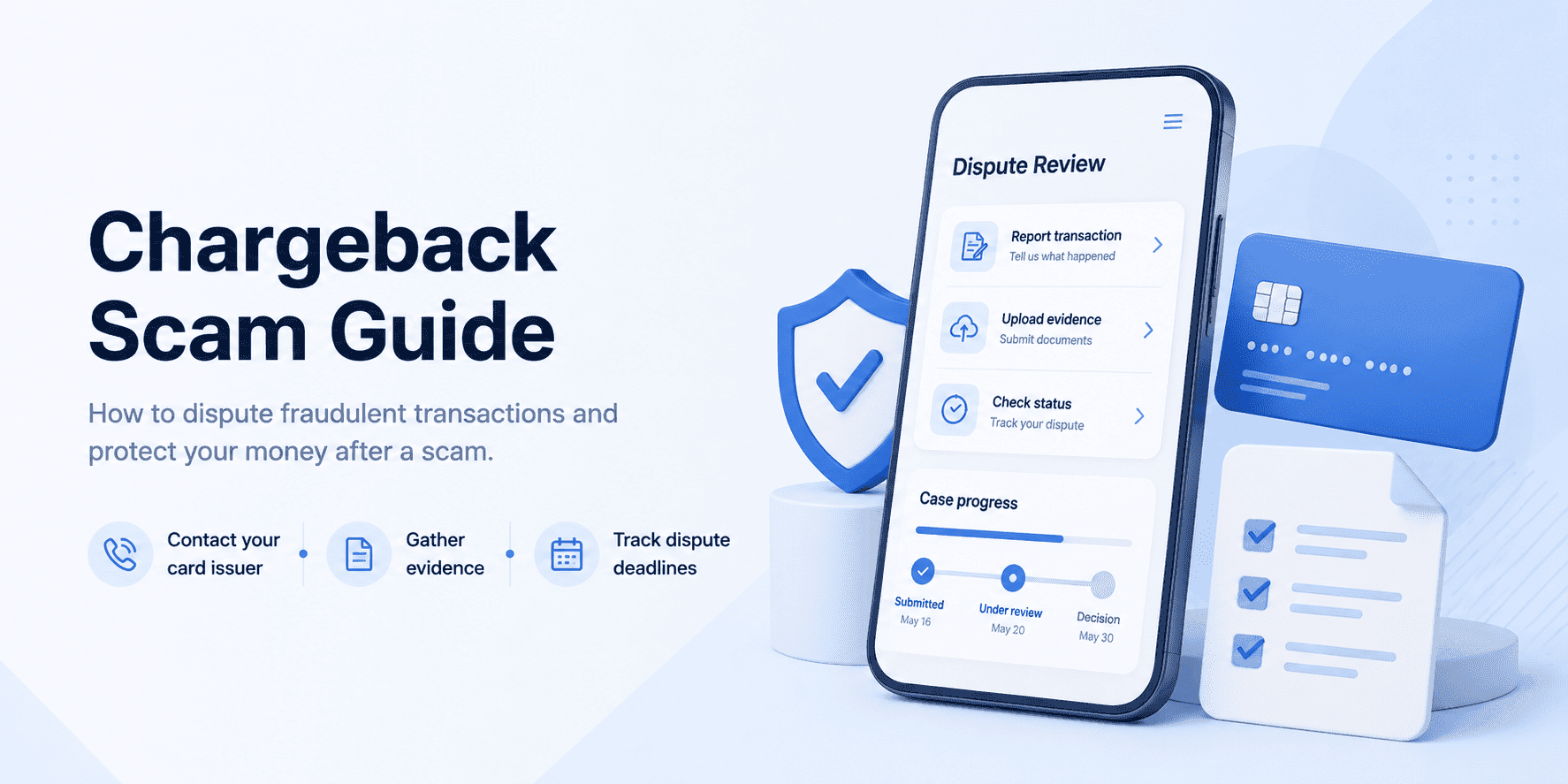
This guide covers both. It explains what a chargeback scam actually is, how a legitimate dispute works after you have been scammed, how to dispute fraudulent credit card and debit card charges, what evidence improves your case, what to do if a scammer files a chargeback against you, when to file an IC3 report alongside the dispute, and how to spot the fake “chargeback recovery” services that prey on people who just lost money. This topic attracts a lot of opportunists wearing customer-support badges, so a healthy dose of skepticism will serve you well.
Before you file a dispute or respond to a recovery service, you can organize your chargeback evidence so the transaction, the messages, and the timeline sit together in one place.
What Is a Chargeback Scam?
The phrase has two main meanings, and sorting out which one applies to you is the first step.
Meaning 1: You Were Scammed and Need to File a Chargeback
This is the situation where you paid for something fraudulent or unauthorized and you want the card issuer to reverse the charge. It covers a wide range of cases:
A fake online store
Goods that never arrived
A counterfeit product
An unauthorized charge on your card
A fake subscription or recurring billing trap
A misrepresented service
A scam payment made through an app that was funded by your card
Meaning 2: A Scammer Files a False Chargeback Against You
This is the flip side, where a buyer receives goods or services and then falsely claims fraud, non-delivery, or an unauthorized payment to claw the money back. Sellers, freelancers, and small businesses run into this version constantly:
A buyer claims an item never arrived despite delivery proof
A client disputes payment after the work was delivered
A scammer uses stolen card details to buy from you
A buyer claims a legitimate recurring charge was unauthorized
A marketplace buyer opens a false dispute after receiving the item
Knowing which meaning fits your case tells you whether you are filing a chargeback or defending against one, and the rest of this article is split accordingly.
How Chargebacks Work After a Scam
A chargeback is a card payment reversal handled through the card issuer, the merchant’s bank, and the card network. The issuer reviews the customer’s claim, may issue a provisional credit, asks the merchant for evidence, and then decides whether the charge stands or gets reversed. It is a process with steps and deadlines, not an instant refund.
A few things are worth keeping straight before you file. A chargeback is not the same as an instant refund, and it is not guaranteed. It can be reversed later if the merchant comes back with strong evidence. And a false chargeback, the kind a scammer files against a seller, can carry legal, financial, and account consequences. Going in with realistic expectations makes the whole process easier to navigate.
How to File a Legitimate Chargeback After Being Scammed
Step 1: Contact the Card Issuer Immediately
The FTC says people who paid by credit or debit card should contact the card issuer or bank, say it was a fraudulent charge, and ask them to reverse the transaction and return the money. Reach the issuer only through trusted channels: the number on the back of your card, the bank or card issuer’s official app, the issuer’s official website, or the secure messaging inside your account.
Do not use a phone number you found in an ad, a social media comment, a pop-up, or a message from a “recovery agent.” Those are how the second scam starts.
Step 2: Identify the Correct Claim Type
How you describe what happened determines how the issuer handles it, so think through the right category before you call. Ask yourself whether the card was used without your permission, whether you authorized the purchase but the merchant turned out to be fake, whether the product never arrived, whether it was counterfeit or materially different from what was promised, whether the charge was duplicated, whether a canceled subscription kept billing, and whether the card was linked to a payment app. The answers steer the issuer toward treating it as fraud, a billing error, a merchant dispute, or a scam-related claim.
Step 3: File Online or by Phone, Then Follow Up in Writing
For credit cards, the FTC says a dispute letter should reach the issuer within 60 days after the first bill with the error was sent, and the letter should include copies of receipts or other supporting documents rather than originals. The FTC also says that after you call the card company or dispute online, you should follow up with a written dispute letter within 60 calendar days of the first statement showing the disputed charge. Calling gets the case moving; the written letter protects your rights under the law.
Step 4: Submit Evidence
Do not file a bare “I was scammed” claim. Build a packet that shows what happened, which the next section breaks down in detail. The strength of your evidence is usually the difference between a charge that gets reversed and one that stands.
Step 5: Watch for Deadlines and Issuer Messages
Card issuers often request more information partway through, and missing a deadline can sink an otherwise solid claim. Keep an eye on your account messages and your mail, respond the same day when you can, and save every case number you are given.
Evidence Required to Win a Chargeback Dispute for Scam Payments
The issuer is deciding between your account of events and the merchant’s, so concrete documentation carries the day. Work through this list and include whatever applies.
| Evidence | Why it helps |
|---|---|
| Transaction screenshot | Shows amount, date, merchant, and payment method |
| Card statement line item | Confirms the disputed charge |
| Order confirmation or invoice | Shows what was promised |
| Product listing or website screenshots | Preserves claims before the site disappears |
| Shipping and tracking details | Helps prove non-delivery or fake tracking |
| Photos of the item received | Supports counterfeit or not-as-described claims |
| Chat, email, and text messages | Shows deception, promises, pressure, or refusal to refund |
| Refund request record | Shows you tried to resolve it with the merchant first |
| Merchant cancellation confirmation | Supports recurring billing disputes |
| Police, FTC, or IC3 report numbers | Adds documentation for fraud or cyber-enabled scams |
| Timeline of events | Helps the issuer understand what happened quickly |
A clear chronology often matters as much as any single document, because it lets a reviewer follow the case in one pass. You can use Unscammed to turn your screenshots, messages, and transaction details into a cleaner evidence timeline before you file.
Chargeback Timelines and Success Rates by Card Network
There is no honest way to promise a specific success rate, because outcomes vary by issuer, card network, transaction type, the strength of your evidence, the merchant’s response, and whether the dispute involves unauthorized activity, non-delivery, misrepresentation, or simple buyer’s remorse. What you can do is understand the factors that move the needle.
| Factor | Why it affects the outcome |
|---|---|
| Card network rules | Visa, Mastercard, American Express, and Discover have different dispute categories and deadlines |
| Issuer policy | Your bank or card issuer controls how the claim is reviewed |
| Merchant evidence | Delivery proof, signed receipts, usage logs, or a clear refund policy can affect the decision |
| Claim type | Unauthorized fraud may be treated differently from goods-not-received |
| Timing | Late disputes are harder and may be rejected |
| Documentation | Clear evidence improves the case |
| Payment method | Credit cards and debit cards do not carry identical legal protections |
The practical takeaway is that the parts you control, mainly timing and documentation, are also the parts that matter most.
Legal Protections Under the Fair Credit Billing Act for Chargeback Scam Victims
The Fair Credit Billing Act gives consumers the right to dispute certain credit card billing errors, including unauthorized charges and charges for goods or services that were not delivered as agreed. The FTC says you should send a dispute letter to the issuer within 60 days after the first bill with the error was sent.
A few practical details make that letter stronger. Send it to the issuer’s billing inquiries address, not the address you use to mail payments. Include your name, address, account number, the charge amount, and a short explanation of why it is wrong. Attach copies of your evidence rather than originals, and keep a copy of the whole letter for yourself. Sending it by certified mail creates proof of delivery, which is useful if the timing is ever questioned. CFPB guidance under Regulation Z also recognizes the same 60-day billing error window for errors that show up on a statement.
How Chargeback Rules Differ for Debit vs. Credit Card Scam Payments
This distinction trips people up, and it matters because debit money has usually already left your account while the bank reviews the claim. Credit and debit disputes run on different legal tracks.
| Issue | Credit card | Debit card |
|---|---|---|
| Main legal framework | Fair Credit Billing Act / Regulation Z | Electronic Fund Transfer Act / Regulation E |
| Money source | The issuer’s credit line | Funds may leave your bank account |
| Written dispute window | FTC guidance emphasizes 60 days from the first statement with the error | Timing depends on Regulation E and bank rules |
| Unauthorized transaction liability | Often stronger consumer protections | Liability can increase if not reported quickly |
| Investigation process | Issuer reviews the billing error or fraud dispute | Bank investigates the unauthorized EFT or debit dispute |
| Practical urgency | Fast reporting matters | Very fast reporting matters even more |
The Federal Reserve’s Regulation E guidance explains that liability for an unauthorized electronic fund transfer can be limited to $50, but it can rise to $500 or even become unlimited if you do not notify the institution in time. With debit, the clock is the thing to watch.
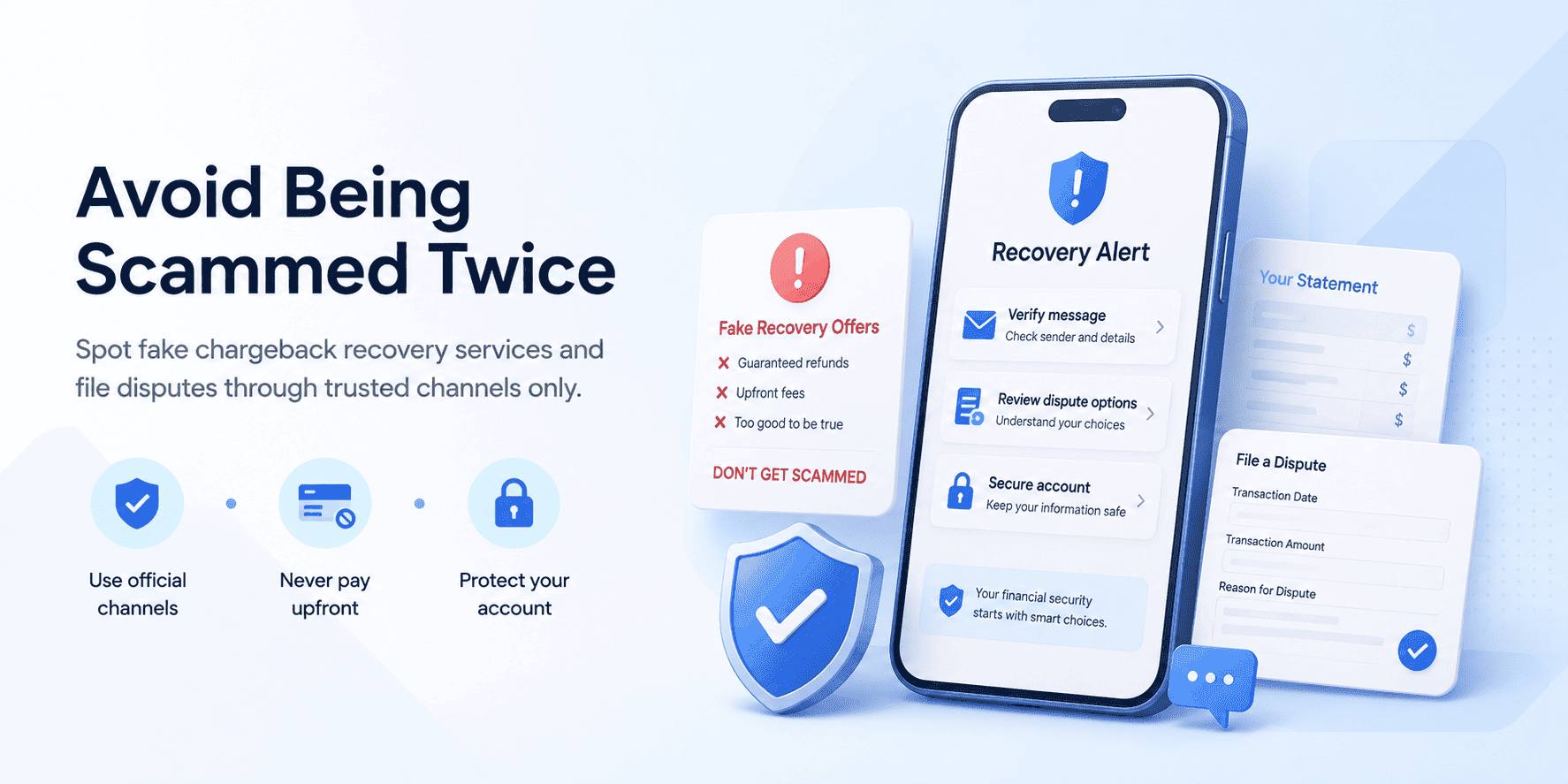
How to Spot Fake Chargeback Recovery Service Scams
This is the section that protects you from losing money twice. After a scam, you are exactly the kind of target these operators look for, and they tend to surface fast. Treat the following as warning signs:
“Guaranteed chargeback approval”
“100% recovery success”
Claims of secret access to Visa, Mastercard, banks, the FBI, the FTC, or IC3
Upfront fees before any review
Requests for your card login, online banking login, PIN, password, or one-time code
Telegram, WhatsApp, or Instagram-only “support”
Pressure to act before the “chargeback window closes”
Fake screenshots of recovered funds
Asking you to lie to your bank
Offering to “hack back” your funds
The second scam often wears a refund costume. If someone promises guaranteed recovery, treat the promise itself as evidence that you are looking at a scam. Before you pay, reply, or share anything personal, you can check a chargeback recovery message first.
How to Dispute a Chargeback Initiated by a Scammer Against You
This section is for merchants, freelancers, and sellers on the receiving end of a false dispute. The process runs through your payment processor, and your defense is built on evidence that matches the buyer’s specific claim.
Step 1: Read the Chargeback Reason Code
The reason code tells you what the buyer is actually claiming, whether that is fraud, non-delivery, duplicate billing, or “product not as described.” Your entire response should be aimed at that specific reason, so read it carefully before gathering anything.
Step 2: Gather Merchant Evidence
Pull together whatever rebuts the stated claim. Depending on the case, that can include the order confirmation, a signed contract or invoice, delivery confirmation showing the address, the tracking number, proof of service delivery, login or usage logs, customer messages, your refund and cancellation policies, photos or shipment records, a history of prior successful transactions with the same buyer, IP or device data where available, and any communication showing the buyer received the product or service.
Step 3: Submit Representment Through Your Processor
Merchants usually respond through their payment processor or platform, a process called representment, rather than dealing directly with the buyer’s card issuer. Follow your processor’s submission steps and deadlines exactly.
Step 4: Keep the Response Factual
Skip the emotional language. Match each piece of evidence to the specific claim in the reason code, and let the documents do the arguing. A tight factual package reads better to a reviewer than a frustrated narrative.
Step 5: Watch for Repeat Abuse
If a customer files suspicious chargebacks more than once, document the pattern and consider platform restrictions, account controls, or legal advice. Repeat abuse is itself evidence, and processors and platforms take patterns seriously.
How to File a Parallel FBI IC3 Report Alongside a Chargeback
A chargeback handles the money side, but if the scam was cyber-enabled, an IC3 report puts it into the federal record where patterns get connected. IC3 is relevant when your case involves a fake merchant website, business email compromise, an online marketplace scam, an account takeover, phishing, a romance or investment scam that ran through card payments, chargeback fraud tied to cyber-enabled conduct, or a fake recovery service.
IC3 says complaints may be analyzed and referred to federal, state, local, international, or partner agencies, and the FBI says cyber-enabled crime victims should file as soon as possible because rapid reporting can help support recovery of lost funds. When you file, include the transaction amount and date, the card issuer or payment processor, the merchant name or scammer identity, website URLs, emails and phone numbers, usernames, screenshots, shipping or tracking details, any crypto wallet addresses if the scam expanded, your bank or card case number, and your FTC report number if you have one.
Recovery Services That Handle Chargeback Filings for Scam Victims
A legitimate recovery support tool helps with the organizing and the thinking, not with promises. Used the right way, a tool like this can help you work out whether your issue looks like fraud, a billing error, a merchant dispute, or a fake recovery scam, then organize evidence, build a timeline, prepare dispute summaries, identify the right reporting channels, check suspicious refund offers, and avoid paying a fake chargeback firm.
What it cannot do is guarantee that a bank, card issuer, or card network will approve your chargeback. No one can promise that outcome, and the ones who do are the ones to avoid.
Chargeback Scam Checklist
A quick recap to keep you on track:
Stop communicating with the scammer.
Do not pay any recovery service yet.
Contact the card issuer through official channels.
Identify whether the issue is fraud, a billing error, goods not received, or a merchant dispute.
File online or by phone if available.
Follow up with a written dispute letter when appropriate.
Submit evidence, not just a short claim.
Keep copies of everything.
File FTC and IC3 reports when the scam was online or cyber-enabled.
Watch the issuer’s deadlines.
Avoid anyone promising guaranteed recovery.
FAQs
What is a chargeback scam?
A chargeback scam can mean either a scam transaction that a victim wants to dispute through a card issuer, or chargeback fraud where a buyer abuses the dispute process after receiving goods or services.
How do I file a legitimate chargeback after being scammed?
Contact your credit card issuer or bank through the number on your card, the official app, or the official website. Explain that the charge was fraudulent or connected to a scam, ask whether it can be reversed, and submit evidence. For credit card billing errors, the FTC says to send a written dispute within 60 days after the first bill with the error was sent.
What evidence helps win a chargeback dispute?
Useful evidence includes transaction screenshots, statements, receipts, order confirmations, merchant messages, product listings, delivery proof, refund requests, photos, scam emails, text messages, call logs, and any FTC or IC3 report numbers.
Do chargeback rules differ for debit and credit cards?
Yes. Credit card disputes are generally governed by FCBA and Regulation Z billing error rules, while debit card and bank-account electronic transfers are generally governed by EFTA and Regulation E. Debit disputes can be more time-sensitive because the money may already be out of your account.
Can a fake chargeback recovery service steal more money?
Yes. Fake recovery services often promise guaranteed refunds, ask for upfront fees, request bank login details or one-time codes, or claim secret access to banks and card networks. Those are major red flags.
What should I do if a scammer files a chargeback against me?
Review the chargeback reason, gather evidence that matches the claim, and respond through your payment processor or platform. Include delivery confirmation, contracts, messages, usage logs, your refund policy, and proof that the goods or services were provided.
Should I file an IC3 report with a chargeback?
Yes, if the scam involved online fraud, phishing, account takeover, fake websites, marketplace fraud, or another cyber-enabled crime. IC3 complaints may be referred to law enforcement or partner agencies, and the FBI recommends filing as soon as possible.
Can a recovery service guarantee a successful chargeback?
No. A support service may help organize evidence and prepare reports, but no one can guarantee that a bank, card issuer, or card network will approve a chargeback.
A Final Word
A chargeback can be a powerful recovery path after some scams, especially when a card payment was involved, but it depends on evidence, timing, payment type, issuer rules, and whether your claim fits a valid dispute category. File quickly, document everything, follow up in writing where appropriate, report cyber-enabled scams to IC3, and stay away from anyone promising guaranteed refunds.
Before you dispute the charge or trust a recovery offer, use Unscammed to organize your evidence and check for scam red flags.
Featured Articles