Pig Butchering Scam Recovery: Reporting and Fund Tracing
A pig butchering scam is a long con. Someone built trust with you over weeks or months, often through what felt like a friendship or a romance, then steered you toward a crypto or investment platform that looked completely real. You may have watched your balance grow in a slick dashboard, only to hit a wall when you tried to withdraw. Now you are here, trying to figure out whether any of that money can come back.
 Share:


The honest answer is that recovery is possible in some cases, but it is time-sensitive and depends on details you may not have thought about yet. How you sent the money matters. Whether the crypto has already moved across wallets matters. Whether a bank wire can still be recalled, whether an exchange can freeze anything, how fast you report, and how complete your evidence is all shape what happens next. None of this is about whether you were careless. These operations are built by organized criminal networks that run scripts refined on thousands of victims, and the grooming is the point.
What you can control right now is the record you build and the speed at which you act. Before you send another payment or respond to anyone offering to get your money back, organize your pig butchering scam evidence so your timeline, messages, wallet addresses, and reporting details sit in one place.
What Is a Pig Butchering Scam?
A pig butchering scam is a confidence-based investment scam where the fraudster builds a relationship before introducing a fake investment opportunity. The name comes from the grim idea of “fattening up” a target before the loss. Once trust is established, the scammer presents a crypto or trading opportunity, shows fake profits in an app or dashboard, and pressures the victim to deposit more and more. Withdrawals get blocked behind a wall of fees, taxes, or verification deposits that never end.
The FBI describes this as a type of cryptocurrency investment fraud where scammers build a relationship before introducing a fraudulent crypto investment opportunity and coaching victims to invest more. Understanding the shape of the scam helps you explain it clearly when you report, because investigators and banks respond to specifics, not just “I got scammed.”
Common Pig Butchering Scam Channels
These scams usually start somewhere ordinary, which is part of what makes them effective. First contact often comes through one of these:
Dating apps
WhatsApp
Telegram
Facebook
Instagram
LinkedIn
Text messages, including “wrong number” openers
Fake investment groups
Fake crypto exchanges and trading apps
Common Withdrawal Traps
The moment you try to take money out is usually when the second phase begins. The fake platform invents reasons you have to pay more before you can access “your” funds:
A “tax” payment required before withdrawal
An “anti-money laundering verification” fee
An “account unlock” deposit
A “VIP upgrade” fee
A “liquidity” requirement
A “gas fee” excuse
A “wallet validation” fee
Threats that your funds will be frozen unless you pay more
If you are being asked to pay a fee to withdraw your own money, that is the trap closing, not a step toward recovery. The money you would send for the fee is simply another loss.
Can You Recover Money from a Pig Butchering Scam?
Sometimes, but recovery is genuinely difficult, especially with crypto. The outcome depends far more on the mechanics of how the money moved than on how much you lost or how badly you want it back.
Recovery tends to be more realistic when you report immediately, when funds are still sitting at a regulated exchange that can freeze them, when a bank wire recall can be attempted within the first day or two, when transaction hashes and wallet addresses are preserved, and when law enforcement can connect your funds to wallets already tied to known scam activity. A regulated exchange or bank with established fraud processes also gives you more to work with than an obscure platform that vanishes overnight.
Recovery gets much harder when crypto was sent directly to a self-custody wallet the scammer controls, when funds were moved through mixers, bridges, or a chain of wallets, when weeks or months passed before you reported, or when the fake platform simply disappeared. It also gets worse if a fake recovery service has already gotten involved, because those operations frequently muddy the evidence and take more money.
The FTC says cryptocurrency payments are typically not reversible, and victims can usually only get crypto back if the person they paid sends it back. That is a hard truth, but it is also why fast reporting and clean evidence matter so much. They are what give an exchange, a bank, or an investigator a reason and a window to act.
Step-by-Step Pig Butchering Scam Recovery Process
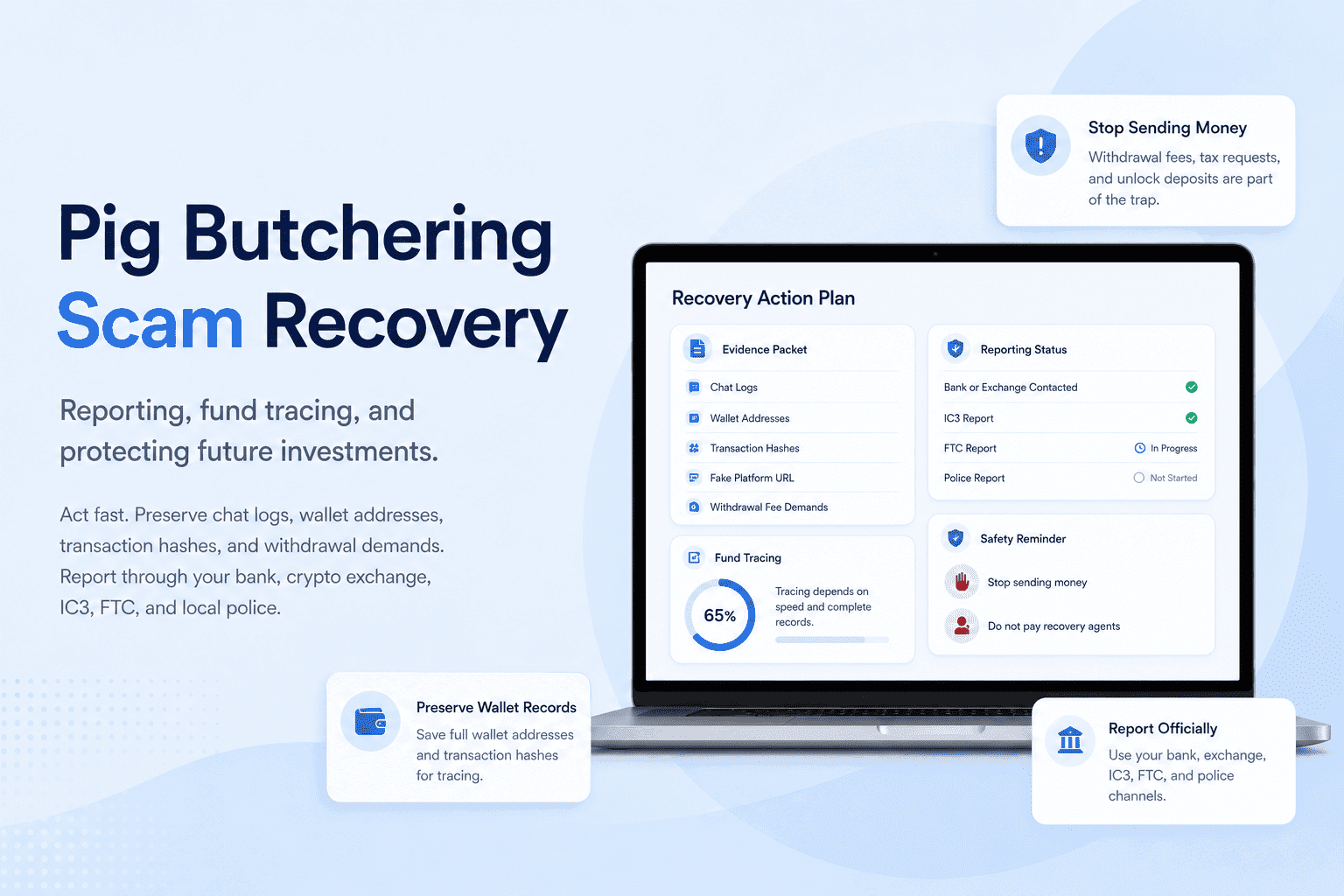
Step 1: Stop Sending Money Immediately
This is the single most important step, and it is worth being blunt about. Do not pay withdrawal fees. Do not pay tax deposits or account unlock fees. Do not pay a recovery agent. Do not send seed phrases, passwords, one-time codes, or wallet access to anyone. And do not keep negotiating with the fake platform in the hope that one more payment finally frees your balance, because it will not.
The FBI tells cryptocurrency investment fraud victims to stop sending money and report the fraud to IC3. Every additional dollar you send is a dollar that follows the first ones into the same place, so the bleeding stops here first.
Step 2: Preserve Every Piece of Evidence
It is tempting to delete everything out of anger or embarrassment, but the chats, screenshots, and records are the spine of any recovery attempt. Before you block anyone, save the conversation history, the profiles, the platform URLs, the dashboard screenshots, and the transaction records. You will need them for every report you file, and you cannot recreate them once they are gone. There is a full evidence checklist further down that you can work through methodically.
Step 3: Contact Your Bank, Exchange, or Payment Provider
If the money moved through a bank, wire, card, payment app, or crypto exchange, reach out to them right away through official channels. Use the number on the back of your card or the contact details on the institution’s real website, never a number someone gave you over chat. Ask them directly:
Can the wire be recalled?
Can the transfer be stopped?
Can the recipient account be flagged?
Can the exchange freeze funds?
Can you open a fraud claim?
Can you provide the transaction records I will need for reports?
Does the linked card or bank dispute path apply here?
The FDIC Office of Inspector General advises suspected pig butchering victims to notify their bank immediately, contact local police, file a police report, and file with IC3. Speed matters here because the window to recall a wire or freeze exchange funds can close fast.
Step 4: File an IC3 Report
The FBI’s Internet Crime Complaint Center at IC3.gov is the central federal intake for cyber-enabled investment fraud, and the FBI specifically directs cryptocurrency investment fraud victims to report there. Filing does not guarantee your money comes back, but it puts your case into the system where analysts connect patterns across complaints, and it can support a wire clawback if your loss is large and recent. There is a detailed section below on exactly what to include.
Step 5: Report to the FTC
ReportFraud.gov is the FTC’s official site for reporting fraud, scams, and bad business practices. It will not directly return your money, but it documents the scam in the federal record and feeds the broader enforcement and trend-tracking work that targets these networks. It takes a few minutes and strengthens the paper trail behind your other filings.
Step 6: File a Local Police Report
A local police report may be required later by banks, insurers, tax preparers, attorneys, or exchanges before they will escalate. The scammer is almost certainly overseas, so the police themselves may not investigate directly, but the report itself is documentation you will likely need. Bring your timeline and evidence so the report is accurate and useful.
Step 7: Protect Your Identity
If you shared an ID, Social Security number, bank details, address, phone number, passport, driver’s license, face photos, or account screenshots during the grooming process, treat this as identity exposure on top of the financial loss. There is a dedicated identity protection section below covering credit freezes, fraud alerts, password changes, and the other steps that limit the damage.
Step 8: Watch for Fake Recovery Agents
Pig butchering victims are targeted again, often within days, by people promising to recover the lost funds. Anyone guaranteeing recovery is a red flag, full stop. If you are unsure about a message offering help, check a fake recovery message before you respond or pay anything.
Where to Report a Pig Butchering Scam
You will usually report to more than one place, because each destination does something different. Use the table below to match your situation to the right channels, then file in the order that fits your case.
| Reporting path | When to use it | What it can do |
|---|---|---|
| FBI IC3 | Cyber-enabled investment scam, crypto scam, online fraud | Collects complaint data and may support investigations |
| FTC ReportFraud.gov | Consumer fraud and scam reporting | Documents the scam for enforcement and trend tracking |
| Local police | Theft and fraud documentation | Creates a police report for records and escalation |
| Bank or wire provider | Wire, ACH, card, or account-linked transfer | May attempt recall, fraud claim, or account protection |
| Crypto exchange | Funds passed through an exchange | May flag accounts, preserve records, or freeze funds if possible |
| State securities regulator | Fake investment platform or adviser | May investigate investment fraud |
| State attorney general | Consumer fraud affecting state residents | May support consumer protection complaints |
| CFPB | Unresolved bank or payment complaint | Routes complaints involving financial products |
| IRS or state tax professional | Large losses or tax questions | Helps assess tax documentation, not recovery |
No single report is a magic button. The point of filing across several of these is to build a complete record and to put your case in front of the one entity that might still be able to freeze or recall something.
How to File an IC3 Report for a Pig Butchering Investment Scam
A strong IC3 report reads like a clear story backed by hard data. The more precise you are, the more useful your complaint becomes when analysts cross-reference it against others.
What to Include in the IC3 Report
Pull together as much of this as you have before you start filling out the form:
A full timeline with the date of first contact
The platform or app where the scam started
Scammer names, handles, phone numbers, and emails
Dating app or social media profiles
The fake investment platform URL
Login and dashboard screenshots
Wallet addresses in full
Transaction hashes, not just screenshots
Crypto type and amount
Exchange names
Bank or wire details
Screenshots of deposits and fake profits
Withdrawal denial messages
Requests for taxes, fees, or unlock payments
Any threats, scripts, or coaching messages
Bank or exchange case numbers
FTC and police report numbers if already filed
IC3 Reporting Tips
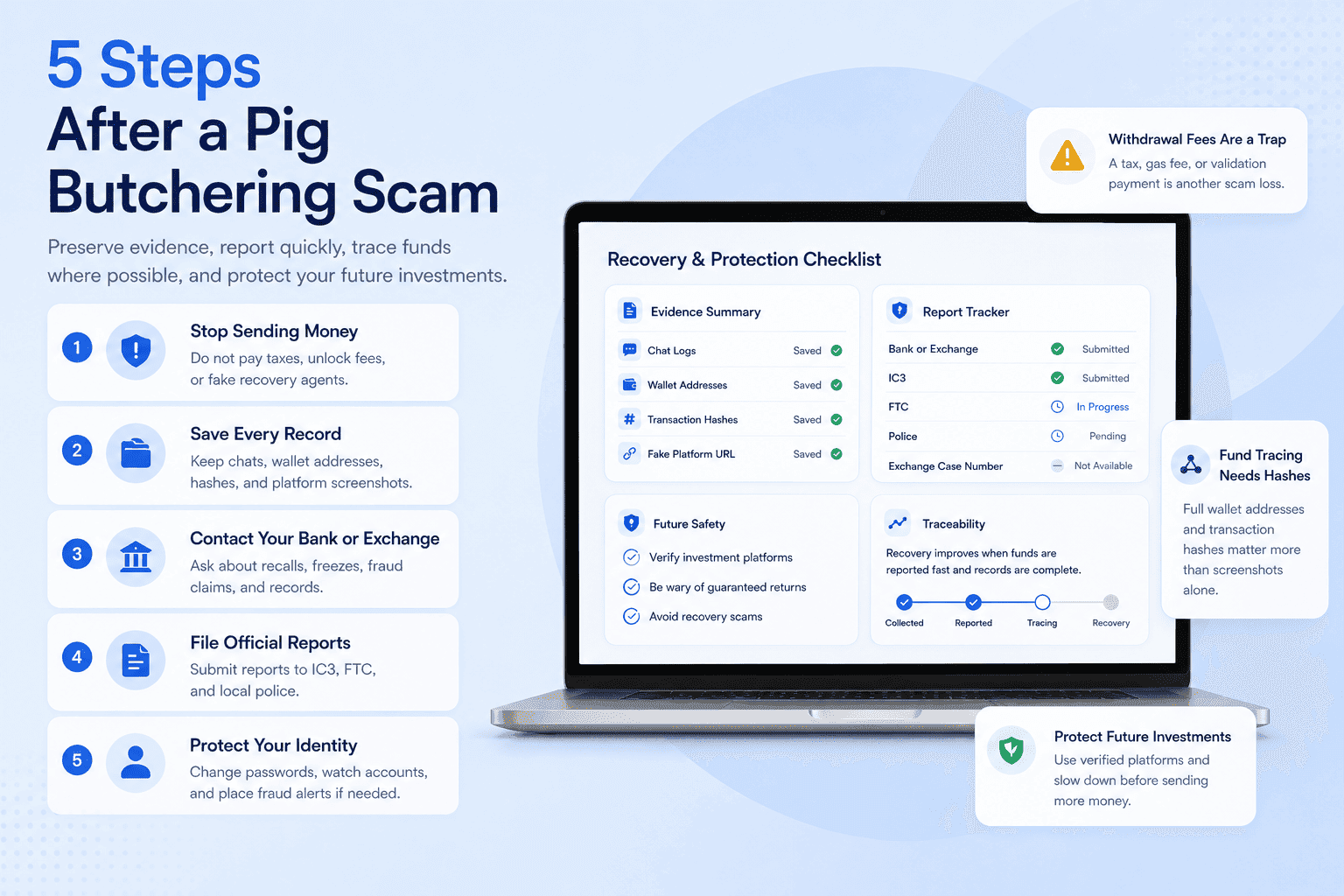
Use clear dates and exact dollar amounts wherever you can. Include wallet addresses in full and transaction hashes rather than relying only on screenshots, since hashes are what let investigators follow the money on-chain. Do not exaggerate or guess at figures, because inconsistencies weaken the file. Mention if the scammer pushed you toward secrecy or discouraged you from telling family or your bank, and note if you became aware of other victims or group chats. Finally, save your IC3 confirmation number, because banks and other agencies will often ask for it. If you want to assemble all of this cleanly first, you can prepare your IC3 report before you sit down to file.
Step-by-Step Guide to Documenting Evidence for Pig Butchering Scam Recovery
Evidence is what turns “I was scammed” into a case someone can act on. Work through this table and save everything you can, ideally before you block or delete anything.
| Evidence | Why it matters |
|---|---|
| Chat logs | Shows grooming, investment pressure, and false promises |
| Dating or social profile screenshots | Preserves identity clues before deletion |
| Fake platform URL | Helps investigators and exchanges identify the scam infrastructure |
| Login dashboard screenshots | Shows fake balances and blocked withdrawals |
| Wallet addresses | Essential for crypto tracing |
| Transaction hashes | Essential for blockchain analysis |
| Exchange deposit and withdrawal records | Shows where funds entered or left regulated platforms |
| Bank wire receipts | Supports recall attempts and fraud reports |
| Payment app records | Documents how funds moved before crypto purchase |
| Tax or fee demands | Shows the withdrawal trap |
| IP, device, or login alerts | May support account compromise claims |
| Government ID shared | Helps assess identity theft risk |
| Police, FTC, IC3 reports | Adds official documentation |
| Recovery scam messages | Helps document and prevent follow-up fraud |
Once you have these gathered, the work becomes assembling them into something a bank or investigator can follow quickly. You can use Unscammed to turn your messages, wallet addresses, transaction hashes, and screenshots into a clearer recovery evidence packet at app.unscammed.com.
Can a Bank Charge Back Wire Transfers Sent in a Pig Butchering Scam?
Usually not the way a credit card chargeback works, and this is an important distinction to understand before you call. A wire transfer is a push payment, so once the funds are received and moved, getting them back becomes much harder than reversing a card charge.
Wire Recall vs. Chargeback
A bank may be able to attempt a wire recall if you report quickly, which means it asks the receiving bank to return the funds. That is not the same as a chargeback, where a card issuer reverses a charge under consumer billing rules. With a wire, success depends heavily on whether the money is still sitting in the receiving account, and scammers move it fast.
What to Ask Your Bank
When you call, be specific so the representative opens the right process:
Can you initiate a wire recall?
Can you contact the receiving bank?
Can you flag the recipient account?
Can you open a fraud claim?
Can you give me a SWIFT or wire reference number?
Can you provide written confirmation of the recall attempt?
Can you preserve transaction records for law enforcement?
When Bank Recovery May Be Stronger
Your odds improve if the transfer was genuinely unauthorized, such as an account takeover where the fraudster moved the money, if the bank failed to follow its own security procedures, if the transfer is still pending, if the receiving bank can freeze the funds, or if you reported immediately.
When Bank Recovery Is Harder
It gets tougher when you personally authorized the wire under deception, when the funds have already moved on, when the receiving account is foreign or controlled by a money mule, when reporting was delayed, or when the evidence is incomplete. None of this means you should skip the call. It means you should make it fast and document the attempt either way.
How to Trace Stolen Funds Across Crypto Wallets After a Pig Butchering Scam
Crypto tracing gets talked about as if it were a recovery tool on its own, but it is closer to a map than a tow truck. It can show where the money went. Getting it back still depends on someone with authority acting on that map.
What Crypto Tracing Can Do
Tracing can follow funds across wallet addresses, identify exchange deposit addresses where the money landed, cluster related wallets in some cases, produce a forensic report, support law enforcement filings, support exchange freeze requests, and help an attorney understand how the assets flowed.
What Crypto Tracing Cannot Guarantee
It cannot force a wallet owner to return funds, it cannot reverse a blockchain transaction, it cannot guarantee that law enforcement will seize anything, and it cannot recover money without cooperation from an exchange, a bank, a court, or law enforcement. Blockchain tracing is a map, not a tow truck. It can show where funds moved, but recovery usually requires an exchange freeze, law enforcement action, a court order, or cooperation from a regulated entity.
What Victims Need for Tracing
If you pursue tracing, you will need transaction hashes, wallet addresses, the crypto type, exchange account records, dates and amounts, the fake platform’s deposit addresses, the scam platform URLs, and screenshots of withdrawal denials. Gather these regardless, because they are the same records every report needs.
Pig Butchering Scam Recovery Success Rates and Realistic Outcomes
There is no reliable public success rate that applies to every pig butchering scam, and you should be wary of anyone who claims one. Outcomes depend on timing, payment method, how far the crypto has moved, the quality of your reporting, whether an exchange is involved, law enforcement capacity, and whether the funds can be identified before they disappear into laundering routes.
The table below is a realistic way to think about your own situation rather than a promise about it.
| Scenario | Recovery outlook |
|---|---|
| Wire reported immediately before funds moved | Better, but not guaranteed |
| Crypto sent to regulated exchange deposit address | Possible if the exchange can freeze funds quickly |
| Crypto sent to self-custody scam wallet | Difficult |
| Funds moved through multiple wallets | Harder |
| Funds moved through mixers or cross-chain bridges | Much harder |
| Large loss with strong evidence and tracing | May justify attorney or forensic support |
| Victim paid a fake recovery service | Riskier and more complicated |
| Identity documents shared | Recovery may be secondary to identity protection |
Reading this honestly is part of protecting yourself, because the gap between what is realistic and what a “recovery agent” promises is exactly where the second scam lives.
Legal Services Specializing in Pig Butchering Scam Victim Recovery
Legal or forensic help can make sense for larger losses, particularly when funds touched a regulated exchange, when a receiving bank or exchange can be identified, when a civil subpoena or freeze order might be possible, when you are facing tax, identity, or cross-border complications, or when a bank or platform has already denied your claim.
If you talk to a legal service, ask whether they have actual crypto fraud recovery experience, whether they work with blockchain forensic analysts, whether they have handled pig butchering or romance-investment cases, what realistic outcomes look like for a case like yours, and what fees are charged and when. Ask whether you will get a written engagement agreement and what information they need from you. And if anyone guarantees recovery, walk away, because no legitimate attorney can promise that.
This article does not provide legal advice. Victims with large losses or complex bank, exchange, or identity issues should speak with a qualified attorney.
Identity Protection Steps After Sharing Personal Info with a Pig Butchering Scammer
If the scammer collected personal details during the grooming, your loss may not stop at money. Treat the following as a checklist for closing off identity risk:
Change passwords for email, bank, exchange, and social accounts, ideally from a device you trust
Turn on multifactor authentication everywhere it is offered
Freeze your credit with Equifax, Experian, and TransUnion
Place a fraud alert if identity theft is suspected
Report identity theft at IdentityTheft.gov if your personal data was misused
Contact banks and card issuers if account details were shared
Replace any compromised cards
Watch for SIM swap attempts and ask your mobile carrier to add account protection
Monitor for tax notices or IRS identity concerns
Replace your passport or driver’s license if the relevant agency advises it
Watch for blackmail or sextortion threats if photos were shared, and report them rather than paying
Doing these quickly limits how far the exposure can spread, even if the financial recovery turns out to be slow or partial.
Recovery Services That Help Pig Butchering Scam Victims Report to Multiple Agencies
A recovery support tool is useful for the organizing and reporting work, not for promises of returned funds. Used correctly, a tool like this can help you identify the scam type, organize evidence, prepare an IC3 report summary, prepare FTC and police report details, document wallet addresses and transaction hashes, build a bank or exchange escalation packet, review suspicious recovery messages, and avoid paying another scammer.
What it cannot do is guarantee crypto recovery, FBI action, exchange freezes, or bank reimbursement. No legitimate service can, and any guarantee of recovery is itself a red flag. Before you hire anyone or send another dollar, you can use Unscammed to verify a recovery service before paying and to organize your evidence in one place.
How to Avoid Future Investment and Recovery Scams
The same instincts that protect you from a repeat loss also make you a harder target going forward. A few practical habits:
Do not invest based on a relationship that started on a dating app, by text, or on social media
Verify investment platforms through official regulatory databases before sending anything
Be skeptical of guaranteed profits, since real investing does not work that way
Never pay a fee to withdraw your own money from an investment account
Do not trust screenshots of profits, which are trivial to fake
Do not install remote access tools to get “investment help”
Do not share seed phrases or private keys with anyone, ever
Use regulated exchanges directly rather than links sent to you
Be cautious of Telegram or WhatsApp-only investment groups
Ask a trusted person before moving large sums
Type URLs manually instead of clicking links
Be suspicious of anyone who discourages you from contacting your bank, the police, family, or regulators
That last point is worth holding onto. Scammers, including recovery scammers, almost always try to isolate you from the people and institutions that would warn you.
Pig Butchering Scam Recovery Checklist
Use this as a fast recap once you have read the detail above:
Stop sending money.
Preserve all chats, emails, screenshots, URLs, and profiles.
Save wallet addresses and transaction hashes.
Contact your bank, exchange, or payment provider immediately.
Ask about wire recall, account freeze, or fraud claims.
File an IC3 report.
Report to the FTC.
File a local police report.
Contact your state securities regulator if a fake investment platform was involved.
Freeze credit and protect your identity if personal data was shared.
Consider legal or forensic help for major losses.
Avoid fake recovery agents and check suspicious recovery offers before responding.
FAQs
How do I recover money from a pig butchering scam?
Start by stopping all payments, preserving your evidence, contacting your bank or crypto exchange, filing an IC3 report, reporting to the FTC, and filing a local police report. Recovery is difficult, especially with crypto, but fast reporting and complete wallet and transaction evidence can improve the chances that someone with authority is able to act.
Where do I report a pig butchering scam?
Report to IC3.gov, FTC ReportFraud.gov, local police, your bank or exchange, and possibly your state securities regulator. The FBI specifically directs cryptocurrency investment fraud victims to file with IC3.
Can I get crypto back after a pig butchering scam?
Sometimes, but it is difficult. The FTC says cryptocurrency payments are typically not reversible, and victims can usually only recover funds if the recipient sends them back. Exchanges, law enforcement, or courts may help in some cases if funds are traced and frozen quickly.
Can my bank charge back a wire transfer from a pig butchering scam?
A wire transfer usually does not work like a credit card chargeback. Your bank may attempt a wire recall if you report quickly, but recovery is not guaranteed, especially after the funds have been withdrawn or moved.
What evidence should I collect for pig butchering scam recovery?
Collect chat logs, dating or social profiles, fake platform URLs, wallet addresses, transaction hashes, exchange records, bank wire receipts, screenshots of fake profits, blocked withdrawals, tax or fee demands, and any IC3, FTC, police, bank, or exchange case numbers.
How do I trace crypto funds after a pig butchering scam?
You need wallet addresses, transaction hashes, the crypto type, dates, amounts, and exchange records. Blockchain tracing can show where funds moved, but it cannot reverse transactions or guarantee recovery without exchange, court, or law enforcement action.
Are pig butchering scam recovery success rates reliable?
No universal public success rate applies to every case. Outcomes depend on timing, payment method, how far the crypto has moved, exchange involvement, reporting quality, and whether funds can be frozen before they are laundered.
Should I hire a legal recovery service after a pig butchering scam?
Legal or forensic help may make sense for major losses, especially if funds touched a regulated exchange or a court order may be possible. Avoid anyone who guarantees recovery, asks for secret fees, or requests passwords, seed phrases, or one-time codes.
A Final Word
Pig butchering scam recovery is hard, but there are real steps worth taking, and most of their value comes from doing them quickly. Stop sending money, preserve your evidence, report to IC3 and the FTC, contact your bank and exchange immediately, protect your identity if your information was exposed, and steer clear of anyone promising to get it all back. The goal is to build the strongest possible record before evidence disappears or funds move further out of reach.
Before you file, escalate, or respond to a recovery offer, use Unscammed to organize your evidence and check for scam red flags.
Featured Articles