Wells Fargo Refund Denied: How to Escalate and Reclaim Your Money
The letter came back denied. Or the secure message did. Or you called and were told the case was closed and the transaction was considered authorized. Whatever the wording, the message underneath is that Wells Fargo has decided not to refund the money.
 Share:


Now you’re trying to figure out whether that’s actually the end of the road.
Bank denials are administrative decisions. They are made by people working from the evidence in front of them. And the evidence in front of them is often incomplete.
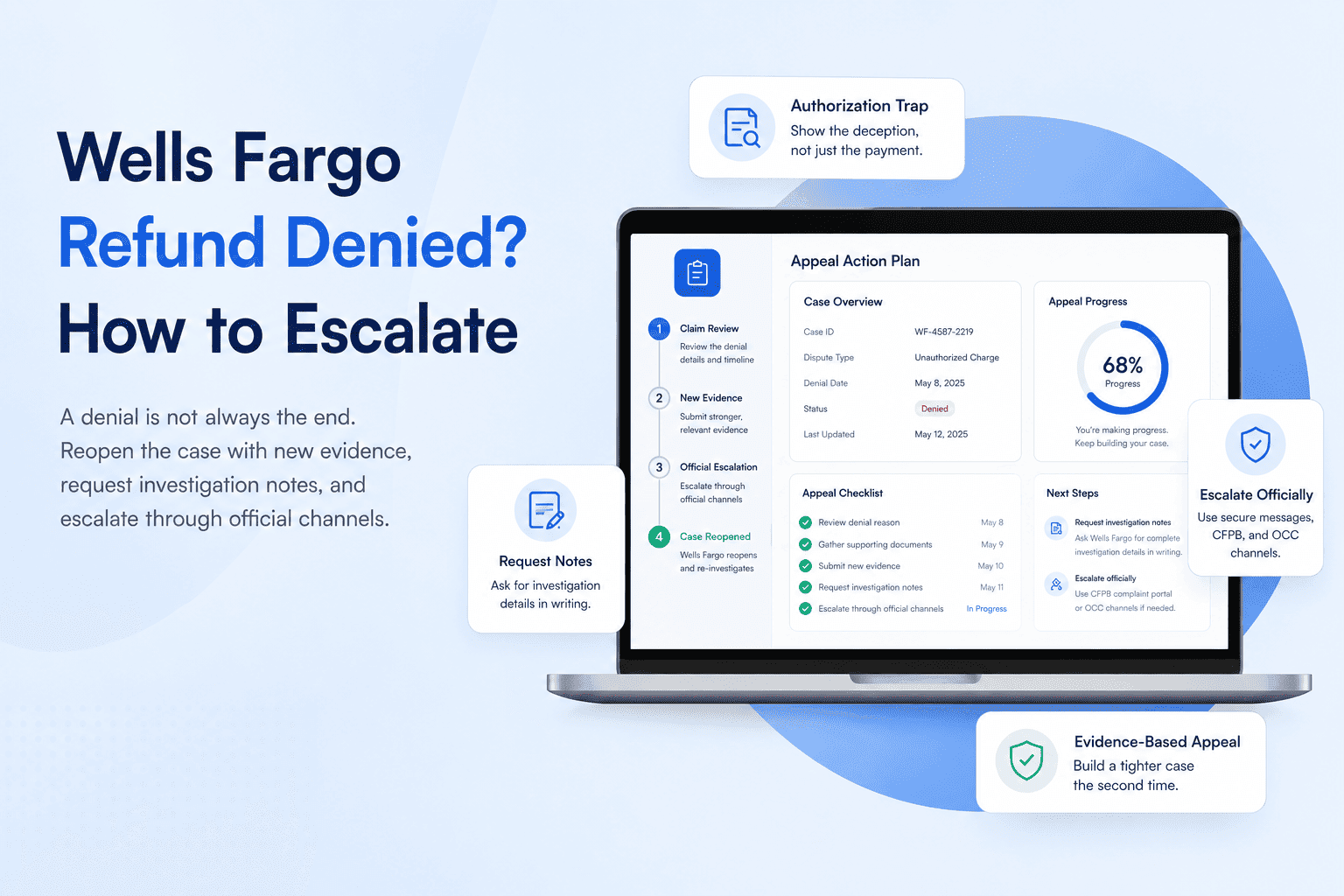
Reopening a denied Wells Fargo case requires a different mindset than filing the original claim. The first appeal is where most successful reversals happen, and they happen because the customer built a tighter case the second time around.
Before you reopen the claim or file a complaint, use Unscammed to organize your timeline, screenshots, denial reason, and reporting details into a clearer appeal summary.
Wells Fargo Denied My Scam Refund. What Should I Do Next?
If Wells Fargo denies your scam refund, the initial rejection is rarely the bank’s final position. Because the bank operates under intense federal scrutiny, a structured, evidence-based escalation can overturn a denial.
Follow this rapid framework to challenge the decision:
Deconstruct the denial language: Wells Fargo rejections rely on specific phrasing like “you authorized the transaction” or “no bank error found.” You must appeal the bank’s technical classification of the charge, not just the fact that you lost money.
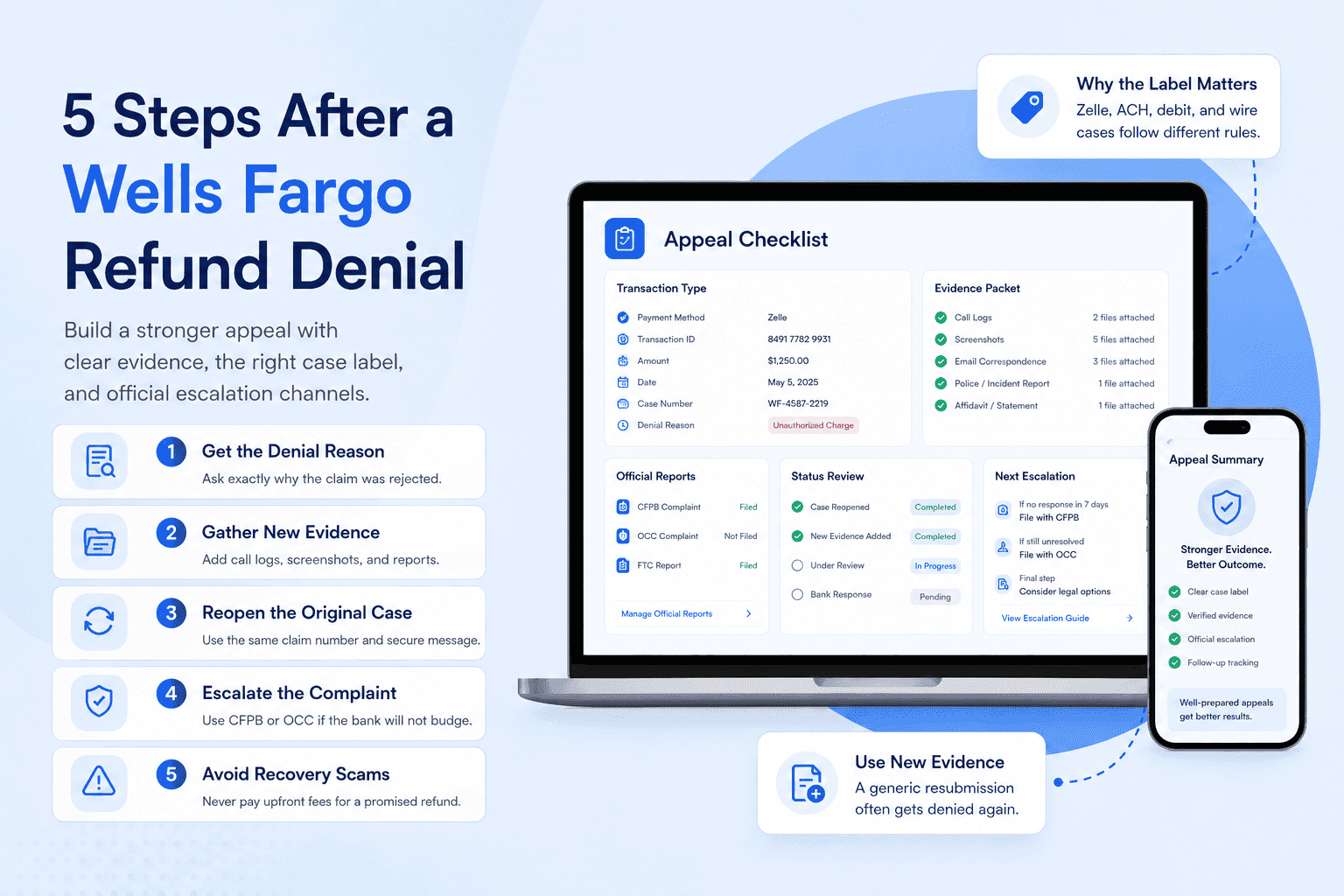
Determine the transaction type: Identify whether the funds moved via Zelle, wire, debit card, ACH, or check. Debit and ACH fall under Regulation E protections, credit cards follow strict chargeback rules, while Zelle and wires have the tightest reversal windows.
Challenge the “authorization” trap: If the bank claims you authorized the transaction, your appeal must prove deception. Gather evidence of spoofed bank phone numbers, impersonation tactics, or account takeovers to show your consent was entirely manipulated.
Never resubmit the same file: A generic resubmission triggers an automated re-denial. If Wells Fargo cited “insufficient evidence,” provide entirely new call logs, text screenshots, or police reports that were missing from the first claim.
Request investigation notes in writing: Submit a request via secure banking message for the bank’s internal investigation documents. You have a right to see what data they relied on and what they ignored.
Reopen the case via secure message: Do not open a new claim, which resets the clock. Request a case reopening using the original claim number through the secure online portal to establish a permanent, timestamped paper trail.
Call the official escalation line: Dial the official Wells Fargo complaints line at 1-844-931-2273 (Mon–Sat, 7 AM to 9 PM CT). Ask explicitly for the Executive Resolution Team. Avoid “executive email addresses” found on forums, as scammers often plant fake numbers to steal credentials from frustrated consumers.
Leverage the CFPB portal: If the bank refuses to cooperate, immediately file a formal complaint at consumerfinance.gov. Wells Fargo is under strict regulatory oversight and is legally required to respond to Consumer Financial Protection Bureau complaints within 15 days.
Flag systemic failures to the OCC: If the denial stems from an unfair bank policy or an improper account freeze rather than an isolated transaction error, log a complaint with Wells Fargo’s primary federal regulator via HelpWithMyBank.gov.
Link law enforcement reports: Submit parallel filings to the FTC and the FBI. Add your Wells Fargo case number directly to these reports. For fraudulent wire transfers over $50,000, filing an IC3 report within 72 hours gives the FBI Recovery Asset Team a viable window to attempt a wire clawback.
Screen out recovery scams: Beware of third parties who target recent scam victims online. Any private entity guaranteeing a refund or demanding an upfront fee, your PIN, or online banking passwords is a recovery scammer.
Why Wells Fargo May Deny a Scam Refund
Wells Fargo typically denies scam refunds by classifying the transaction as authorized if you physically initiated the payment yourself, even under severe deception. To overturn this denial, your appeal must shift away from the transfer mechanics and provide concrete evidence of the fraud itself.
| Denial reason | What it usually means | What to prepare next |
|---|---|---|
| “Transaction was authorized” | The bank believes you initiated or approved the payment | Evidence of deception, account takeover, impersonation, spoofed Wells Fargo number, or pressure tactics that show you weren’t acting freely |
| “No bank error found” | The investigation didn’t find a processing error or unauthorized access | Timeline, screenshots, login alerts, device evidence, and the scam communications themselves |
| “Reported too late” | The bank believes the report fell outside timing rules | Statement dates, first discovery date, first report date, call logs proving when you actually reported it |
| “Insufficient evidence” | The claim lacked documentation | Messages, call logs, emails, URLs, police report, FTC and IC3 report numbers |
| “Zelle payment cannot be reversed” | The bank treated the transfer as a completed authorized payment | Evidence of impersonation, account takeover, or unauthorized access that converts the case from “authorized” to “unauthorized” |
| “Merchant issue, not fraud” | The bank sees it as a purchase dispute, not unauthorized fraud | Receipts, cancellation proof, seller messages, delivery evidence |
The number one reason scam refunds get denied is the “authorized” label. Technically, the bank’s logs are correct because you did initiate the transfer. But they completely ignore that you only did it because a criminal masquerading as Wells Fargo pulled the strings.
Because of this, your appeal shouldn’t waste time arguing over who physically pressed the buttons. Instead, your entire case needs to focus on exposing the deception that put you in front of those buttons in the first place.
Fraud Claim vs. Scam Dispute vs. Zelle Claim: Why the Label Matters
Wells Fargo does not organize financial crimes under a single, universal “scam” category. The technical label assigned to your file determines which rules apply, which team reviews your evidence, and which protections you can argue for.
The Unauthorized Transaction
An electronic transfer or withdrawal is classified as unauthorized when an outside actor gains access to your credentials or moves money completely without your permission. Under Federal Regulation E, you maintain maximum liability protection if you can prove an outsider took over your account.
This is the strongest legal category for the customer, which is why the bank fights hardest to keep cases out of it. To force Wells Fargo into this classification, your appeal must focus entirely on technical security breaches rather than the scam itself.
You need to document unfamiliar device logins, unrequested password resets, sudden changes to your profile contact information, or security alerts triggered from unrecognized locations at the exact time of the transfer.
The Authorized Payment to a Scammer
This classification is used when a scammer tricks you into manually executing a payment yourself, such as a fake representative calling you from a spoofed bank number to reverse a suspicious charge.
Wells Fargo routinely denies these claims using boilerplate phrasing stating that the customer unknowingly participated in a fraud scheme. Because you physically initiated the transfer, the bank argues the payment falls outside of standard Regulation E protections.
To win this specific appeal, you must shift your argument away from the mechanics of the transfer and provide exhaustive proof of the deception itself, including phone spoofing logs and transcripts of the high-pressure impersonation tactics.
The Zelle Scam Dispute
Disputes involving the Zelle network feature high settlement speeds and highly inconsistent coverage because these payments are designed to be instant and irreversible. When appealing a denied Zelle claim, focus heavily on the exact instructions you were given.
Specifically highlight if the fraudster told you to send funds to yourself, a holding account, or a safe wallet under the guise of verifying your identity. This phrasing is the tactical fingerprint of a bank-impersonation scam.
Under intense regulatory pressure, the Zelle network now allows reimbursement exceptions for victims of direct bank impersonation, meaning your appeal will fail unless you explicitly prove the criminal masqueraded as a Wells Fargo employee.
The Debit Card Fraud Claim
Handled by a separate checking and savings unit, debit disputes carry rigid reporting deadlines, and your consumer protections drop sharply the longer you wait to report a compromised card or ATM withdrawal.
It’s critical to note that business checking accounts are legally excluded from Regulation E consumer rules entirely, meaning a business debit appeal must prove a failure in bank-side security infrastructure rather than consumer compliance.
Furthermore, large administrative holds or frozen checks must be escalated directly through the bank’s deposit hold unit rather than a standard transactional fraud claim.
Regulation E Rights After a Wells Fargo Scam Refund Denial
Regulation E is the federal rule governing electronic fund transfers. While it serves as the primary legal framework for scam refund appeals, it’s frequently misunderstood.
When Regulation E Applies
This rule protects you against unauthorized electronic fund transfers, which the CFPB defines as transfers initiated by someone other than you without actual authority, providing you no financial benefit. You have a strong case for this classification if your account experienced:
Unrecognized device logins
Forced password resets
Unauthorized changes to your profile contact information
Stolen credentials used to move money via debit cards or ACH networks
Why Timing Dictates Your Refund
Your financial liability for an unauthorized transfer depends entirely on how quickly you report it to the bank.
Reporting within two business days of discovering the compromise limits your maximum liability to $50.
Reporting between three and 60 business days after your monthly statement is generated pushes your potential liability up to $500.
Reporting after the 60-day window closes can leave you responsible for the entire stolen amount.
Once you flag a transaction error, Regulation E legally obligates Wells Fargo to investigate within 10 business days. The bank can extend this window up to 45 days, but only if they issue a provisional credit to your account during those first 10 days. If the bank misses this deadline without crediting your account, that procedural failure is a valid ground for appeal.
When Regulation E Fails
Regulation E rarely provides a straightforward path to a refund if you were tricked into manually authorizing the payment yourself. The bank will classify the transaction as an authorized purchase dispute rather than a security breach.
However, Regulation E does cover internal banking system malfunctions. Wells Fargo has a documented history of technical glitches that temporarily erase or mishandle valid deposits. If your funds simply vanished due to a processing error rather than a scam, you are dealing with a covered bank error that frontline fraud teams often misclassify.
If your claim falls into the difficult category of authorization under deception, do not argue that the transfer was technically unauthorized. Instead, base your entire appeal on proving that your consent was entirely manipulated through phone spoofing and deep brand impersonation.
How to Appeal a Wells Fargo Scam Dispute Denial
Step 1: Ask for the exact reason for denial
Before you write anything, get clarity on what you’re actually appealing. Ask Wells Fargo directly:
Was the claim denied because the transaction was considered authorized?
Was it denied because the report was late?
Was it denied because the evidence was insufficient?
Was it treated as fraud, a merchant dispute, or a Zelle scam?
What evidence would change the decision?
Get the answer in writing, such as a secure message, a letter, or at minimum a representative’s name and the date of the call. Verbal answers that contradict written denials are useful later in escalation, but only if you can show what was said.
Step 2: Build a stronger evidence packet
The appeal is only as good as the documents behind it. Build the packet before you write anything.
| Evidence | Why it matters |
|---|---|
| Wells Fargo denial letter or message | Shows the reason that must be addressed |
| Transaction details | Shows amount, date, recipient, and channel |
| Account alerts | May show suspicious logins, password changes, or device activity |
| Call logs | Helps document fake bank representative or impersonation calls |
| Texts and emails | Shows phishing, pressure, or false instructions |
| Screenshots of Zelle recipient | Documents where the money went |
| Timeline of events | Shows discovery, reporting, and response dates |
| Police report | Adds documentation for theft or fraud |
| FTC report | Documents the scam with a federal consumer agency |
| IC3 report | Documents cyber-enabled fraud with the FBI |
| CFPB or OCC complaint numbers | Shows escalation history |
| Bank call notes | Shows who was contacted and when |
Use Unscammed to organize your denial reason, evidence, and timeline before you ask Wells Fargo to reopen the case.
Step 3: Submit a concise written appeal
Long emotional letters get skimmed. Tight, structured appeals get read. Your written appeal should include:
Claim number
Account type (checking, savings, debit, Zelle, ACH, wire)
Transaction date and amount
Date the scam was discovered
Date Wells Fargo was first notified
The denial reason as Wells Fargo stated it
Why the denial is incomplete or wrong, addressed directly to that reason
New evidence attached, labeled clearly
External report numbers (FTC, IC3, police, CFPB, OCC if filed)
A clear, single-sentence request — reopen, reconsider, explain, or escalate
Keep it under two pages. Investigators reviewing appeals work fast, and the goal is for them to immediately see what’s new and why it matters.
Step 4: Ask for written confirmation
Whatever Wells Fargo says next, get it in writing. Save:
Claim numbers (often a new one is issued on reopen)
Appeal submission date
Names or employee IDs of representatives, if provided
Screenshots of secure messages
Letters and PDFs
Any new case or complaint IDs
This becomes the evidence package for the next escalation level if the appeal also gets denied.
How to Escalate a Wells Fargo Zelle Scam Refund Denial
Wells Fargo frequently denies Zelle fraud claims by classifying the transaction as authorized if you physically pressed send. To overturn a Zelle denial, your appeal must focus on bank impersonation. Under specific industry rules, victims of qualifying imposter scams are eligible for a refund if they can prove a criminal manipulated them by masquerading as a bank employee or a trusted institution.
What to Document in a Zelle Scam Appeal
A successful Zelle appeal relies on granular tactical details rather than general complaints. In your written submission, explicitly include the following data points:
Recipient Credentials: Document the scammer’s Zelle recipient name, email address, or phone number alongside the precise date and transaction amount.
Impersonation Type: Detail whether the fraudster masqueraded as a Wells Fargo employee, a government agency, a business entity, or a utility provider.
Spoofing Logs: Note whether the criminal used spoofed bank phone numbers or a callback line featuring a fake automated bank greeting.
Manipulative Phrasing: List the exact instructional language used, such as directions to send funds to “yourself,” a “safe account,” or a “secure holding wallet” to protect your money.
Technical Evidence: Note any unrecognized device logins, forced password resets, or security alerts received around the time of the transfer.
Passcode Deception: State clearly if you were manipulated into sharing a one-time passcode under the guise of an identity verification check.
Bank Monitoring Failures: Highlight if multiple rapid transactions or out-of-pattern transfers were sent to an unverified recipient without triggering Wells Fargo’s internal fraud blocks.
Questions to Ask Wells Fargo
To force a human review of your denied claim, submit these specific questions in writing through your secure online banking portal:
Was this case evaluated under Wells Fargo’s specific impersonation scam reimbursement policy?
Was the transaction categorized as a Zelle scam, an unauthorized electronic fund transfer, or an authorized payment? Which explicit regulatory rule supports that decision?
Did the risk team review my device login history, active fraud alerts, or phone records indicating a spoofed bank number?
Did Zelle’s internal fraud monitoring network flag the recipient account before or after my transfer was completed?
What explicit evidence did the bank rely upon to issue the final denial notice?
Can this case be officially reopened if I provide a formal FTC report, an FBI IC3 filing, a police report, and wireless call logs?
How to File a CFPB Complaint Against Wells Fargo After a Refund Denial
A CFPB complaint is appropriate when:
Wells Fargo denied the claim without explaining why
Wells Fargo didn’t review submitted evidence
You believe Regulation E was misapplied
The bank failed to respond or gave inconsistent answers
You have a claim number and denial documentation
The CFPB says it sends complaints to the company for review and response, or routes them to another agency when appropriate. In practice, the CFPB complaint process requires the company to respond within roughly 15 days and provide a final response within 60 days. That timeline often produces a more substantive review than the original claim, because the bank knows the response is on the public record.
What to include in your complaint:
Wells Fargo claim number
Denial letter
Timeline of the scam and your reporting actions
Transaction details
Evidence list
Why you believe the denial was wrong
What resolution you are requesting — be specific (refund of $X, reopening of claim, written explanation)
FTC, IC3, police, or OCC report numbers if available
How to File an OCC Complaint Against Wells Fargo for Scam Denial
An OCC complaint escalates a Wells Fargo dispute directly to its primary federal regulator, the Office of the Comptroller of the Currency. While the OCC does not personally resolve individual transactions, filing an online complaint via HelpWithMyBank.gov forces the bank to review potential operational or compliance failures under strict regulatory oversight.
When to File an OCC Complaint After a Wells Fargo Dispute Denial
Filing a complaint with the OCC is an entirely separate escalation track from a CFPB filing. While the CFPB focuses broadly on individual consumer products, the OCC is Wells Fargo’s chartering and prudential regulator. This agency ensures the institution adheres to federal banking laws, making it the proper channel when you believe your Wells Fargo dispute denial stems from systemic process failures.
Filing an OCC complaint is highly effective if you face the following patterns:
Wells Fargo systematically misapplied Wells Fargo Regulation E scam refund deadlines to your detriment.
The bank’s fraud unit refused to review physical evidence or call logs proving an Wells Fargo unauthorized transaction claim.
The institution failed to issue your required provisional account credit within 10 business days of an error notification.
Frontline teams misclassified your transaction types to intentionally place your file outside of standard consumer protection laws.
The OCC possesses immense structural power over the bank. In past enforcement actions, the agency capped the bank’s entire operational growth following its legacy sales scandals. While that severe Federal Reserve asset cap was lifted in mid-2025 after compliance milestones were met, active regulatory consent orders remain. This history ensures that when multiple consumers file similar compliance complaints, the OCC takes notice.
How to Initiate the OCC Escalation Process
Before escalating to the federal level, the OCC requires you to attempt to reopen a Wells Fargo scam case directly with the bank. If those internal efforts fail to reverse the Wells Fargo denied fraud claim, route your file through official regulatory channels.
Online Portal: Submit a formal customer complaint form electronically at HelpWithMyBank.gov.
Telephone Support: Reach the OCC Customer Assistance Group directly at 1-800-613-6743 (Monday through Friday, 8 AM to 8 PM Eastern Time).
Written Mail: Send physical documentation packets to the dedicated consumer processing address listed on the official HelpWithMyBank website.
What to Include in Your Complaint File
To ensure your complaint triggers a substantive regulatory review rather than an automated brush-off, keep your narrative concise and attach the following specific identifiers:
Corporate Entity Name: Explicitly label the organization as Wells Fargo Bank, N.A.
Transactional Tracking Numbers: Provide your original fraud claim number alongside any secondary case identifiers generated during a Wells Fargo scam dispute appeal.
Financial Product Details: Clarify whether the funds moved through a personal checking account, savings account, debit card, wire transfer, ACH network, or if your case involves a Wells Fargo Zelle scam refund denial.
A Timeline of Events: State the exact date the fraud took place, the date you alerted the bank, and the final date your Wells Fargo fraud claim was denied.
Documentary Evidence: Upload clear digital copies of your bank statement, phone logs showing spoofed numbers, and the formal written denial letters sent by the bank.
Targeted Violation Summary: Clearly explain what the bank failed to do. Avoid an emotional story; focus on the concrete details of how your Wells Fargo scam reimbursement was improperly handled or evaluated.
Wells Fargo Executive Complaint Contact for Denied Scam Refunds
You’ll find executive escalation emails and direct numbers circulating on forums and complaint sites. Be careful with those. Some are outdated. Some are scam phone numbers planted in comment sections to capture credentials from frustrated customers.
Use Wells Fargo’s official complaint and feedback channel:
1-844-WF1-CARE / 1-844-931-2273
Monday to Friday and Saturday, 7 AM to 9 PM Central Time
When you call:
Ask for escalation to a complaints or executive resolution team
Provide your claim number and the denial reason
Ask for a written response, not just verbal assurances
Do not send sensitive account details, login credentials, or one-time codes to any email address that wasn’t given to you through Wells Fargo’s secure messaging system
Legal Options After Wells Fargo Refuses Scam Reimbursement
You can hire a consumer protection attorney to challenge a Wells Fargo dispute denial. If the bank misapplied Wells Fargo Regulation E scam refund guidelines or violated 12 CFR Part 1005 compliance rules during an Wells Fargo unauthorized transaction claim, a licensed lawyer can force the bank into mandatory individual arbitration to recover your stolen funds.
Regulation E Compliance Audits: Your attorney will review whether the bank met its strict 10-business-day investigation deadline, issued required provisional account credits, or miscalculated your consumer liability tier under 12 CFR Part 1005.
Contractual Liability Review: A lawyer will evaluate Wells Fargo’s deposit account agreement to identify specific reporting time limits, notice requirements, and potential small claims court exceptions available in your state.
Evidentiary Assessment: An attorney can evaluate your text logs, spoofed caller IDs, and bank communications to determine if your case has sufficient legal standing for a formal corporate demand letter.
The Reality of Wells Fargo’s Mandatory Arbitration Clause
Wells Fargo’s deposit account agreement contains a strict binding arbitration provision and a class-action waiver. This means you cannot sue the bank in a traditional court of law or join a class-action lawsuit if your Wells Fargo fraud claim was denied.
The American Arbitration Association (AAA): Most consumer banking disputes must be handled individually through the AAA. Under the bank’s agreement, Wells Fargo is typically required to pay the standard arbitration filing fees.
Mass Arbitration Leverage: While individual lawsuits are blocked, consumer law firms frequently launch mass arbitration campaigns. By filing hundreds of separate, identical Wells Fargo Zelle scam refund denial claims simultaneously, firms create intense financial pressure on the bank’s legal department.
Small Claims Exceptions: Depending on the exact version of your account agreement, a small claims court carve-out may exist. This allows you to bypass arbitration for localized losses under a specific state-level threshold, which typically ranges from $5,000 to $25,000.
How to Avoid Recovery Scams and Find Verified Legal Help
Before paying any third-party entity to reopen a Wells Fargo scam case, utilize free federal escalation channels. Be highly suspicious of unsolicited online communications offering retrieval assistance.
Identify Recovery Fraud: Watch out for “fund retrieval specialists” or “fraud recovery lawyers” who target recent victims on social media forums. Any entity demanding upfront administrative fees, your online banking PIN, or secure SMS login passcodes is running a secondary scam.
Verify Professional Licensing: Legitimate consumer protection attorneys do not cold-call victims or send unsolicited direct messages. Always verify an individual’s licensing credentials through your local state bar association directory.
Locate Verified Consumer Advocates: To find a legitimate attorney specializing in consumer financial fraud and banking violations, search the national member directory at consumeradvocates.org, managed by the National Association of Consumer Advocates (NACA).
Recovery Services That Help Reverse Wells Fargo Scam Refund Denials
If your initial Wells Fargo fraud claim was denied, you will likely be targeted by fraudulent recovery networks. Legitimate consumer security tools never make promises or demand access to your banking dashboard. Instead, real support utilities are strictly analytical and help you:
Decode the technical bank language behind your Wells Fargo scam refund denial to find formatting errors.
Organize your call logs, screenshot timestamps, and text records into a structured, chronological sequence.
Identify gaps in your evidence, such as missing cellular provider call records or spoofed banking messages.
Formulate clear, factual prose for an Wells Fargo executive complaint or a parallel Wells Fargo OCC complaint.
Cross-reference unsolicited phone calls or text alerts against databases of known bank-impersonation scripts.
Red Flags of a Second-Wave Recovery Scam
Once your data is exposed in a cyber fraud ring, scammers will contact you pretending to be “fund retrieval specialists” or “asset recovery attorneys.” They capitalize on your desperation to overturn a Wells Fargo denied fraud claim to steal even more money.
Guaranteed Reimbursement Claims: No private entity has a back-channel to Wells Fargo’s internal risk department. If a service guarantees a Wells Fargo scam reimbursement, it is a fraud.
Upfront Fee Demands: Scammers routinely demand advance payments, calling them “processing fees,” “regulatory taxes,” or “retained deposits.” Legitimate consumer attorneys operate on hourly or contingency structures, and federal regulatory reporting is entirely free.
Government Affiliation Lies: Fraudsters frequently claim they work directly with federal law enforcement or regulatory agencies. The FTC, FBI, and CFPB explicitly state they never partner with private recovery groups or contact consumer victims out of the blue to return funds.
Untraceable Payment Methods: If an entity insists you pay for recovery services using cryptocurrency, gift cards, wire transfers, or peer-to-peer apps, terminate contact immediately.
Demands for Sensitive Credentials: Real advocacy tools will never ask for your online banking password, ATM PIN, or secure one-time SMS verification codes. Sharing this data grants the scammer full access to execute a secondary Wells Fargo unauthorized transaction claim.
Fabricated Tracking Credentials: To appear authentic, recovery scammers will generate fake “federal case numbers” or “official tracking IDs” to mimic legitimate regulatory processes.
If a third-party solicitor contacts you offering a swift resolution to your Wells Fargo Zelle scam refund denial, ignore the message. True wire and peer-to-peer clawbacks are handled exclusively by federal law enforcement through an official IC3 portal submission at ic3.gov, never by a private third-party intermediary.
If someone claims they can reverse your Wells Fargo scam denial, check the message with Unscammed before you pay or share information.
FAQs
What should I do if Wells Fargo denied my scam refund?
Review your rejection letter to identify the bank’s technical classification, then gather concrete evidence like spoofed call logs to directly counter their reasoning. Submit a formal written request to reopen the case through Wells Fargo’s executive complaint channels. If the bank refuses to reverse its decision, immediately escalate the dispute by filing a complaint with the CFPB or OCC.
Can I appeal a Wells Fargo scam dispute denial?
Yes, Wells Fargo maintains dedicated review teams to reconsider closed fraud claims when fresh, compelling evidence is introduced. Your written appeal should focus entirely on hard facts, including a chronological timeline of the scam, screenshots of fraudulent correspondence, and official police report numbers. Providing this objective data forces a human compliance specialist to manually re-evaluate your file.
Does Regulation E protect Wells Fargo scam victims?
Federal Regulation E provides robust protection if your funds were moved via an unauthorized transfer where an outside actor took over your account without your permission. It is significantly harder to leverage this rule if you were manipulated into pressing the send button yourself. However, intense regulatory pressure has recently expanded coverage definitions for victims of direct bank-impersonation scams.
How do I file a CFPB complaint against Wells Fargo?
You can file an official dispute online by navigating to consumerfinance.gov/complaint. Input your active Wells Fargo claim numbers, attach digital copies of your bank denial letters, and provide a factual timeline of the incident. This federal portal legally compels Wells Fargo to review your claim and issue an official response within 15 days.
How do I file an OCC complaint against Wells Fargo?
If internal bank channels and a CFPB complaint fail to resolve your dispute, navigate to HelpWithMyBank.gov to engage the Office of the Comptroller of the Currency. Fill out the online consumer assistance form with your technical checking, savings, or Zelle transaction details. This step is especially effective if Wells Fargo systematically violated compliance mandates, such as failing to issue mandatory provisional account credits.
How do I escalate a denied Wells Fargo Zelle scam claim?
Demand that the bank clarify whether your case was categorized as an unauthorized account takeover or an authorized payment. Then, submit a specialized evidence packet containing the recipient’s Zelle handles, cellular bills highlighting spoofed incoming bank numbers, and reference codes from an FBI IC3 filing. Explicitly proving that a criminal masqueraded as a bank employee is the key to moving your claim out of the automated denial pool.
What Wells Fargo number should I call after a scam refund denial?
For personal checking, savings, or ATM card fraud, call 1-800-869-3557, while active debit card claim inquiries should be routed to 1-800-548-9554. For corporate complaints and executive feedback, contact the bank directly at 1-844-931-2273. As a critical security precaution, never trust customer service numbers displayed in paid internet search ads or embedded in unsolicited text messages.
Should I report a Wells Fargo scam to IC3?
Yes, if your financial loss involved any form of internet-enabled deception, phishing links, remote access tools, or a Zelle scam, you should file a comprehensive alert at ic3.gov. The FBI’s Internet Crime Complaint Center tracks these digital patterns to map out wider criminal networks. These official federal tracking numbers also add immense legal weight to your bank appeal.
A Final Word
A Wells Fargo scam refund denial is rarely the final verdict. Instead, it’s a signal that the bank’s automated first-line review successfully used boilerplate language to shield itself from liability. Your appeal must pivot from a defense of what happened to an aggressive, documented attack on the exact classification the bank relied on to reject you.
By forcing a human compliance specialist to look at hard evidence like spoofed call logs and technical security breaches, you strip away their excuses.
Move calmly, force every interaction into writing, and track every regulatory deadline. Most importantly, ignore the second-wave recovery predators lurking in the aftermath of your loss. The most effective weapon against a corporate denial is a precise, unrelenting paper trail routed through the federal regulators who hold the bank accountable.
Before you reopen the case or file a complaint, use Unscammed to organize your scam timeline, evidence, denial reason, and next steps.
Featured Articles