Venmo Scam Dispute: How to Report Fraud and Recover Money
You sent money through Venmo, and something went wrong. Maybe the item never arrived. Maybe you noticed a charge you did not make. Maybe you realized the person on the other end was running a scam. Whatever happened, the next few hours matter.
 Share:


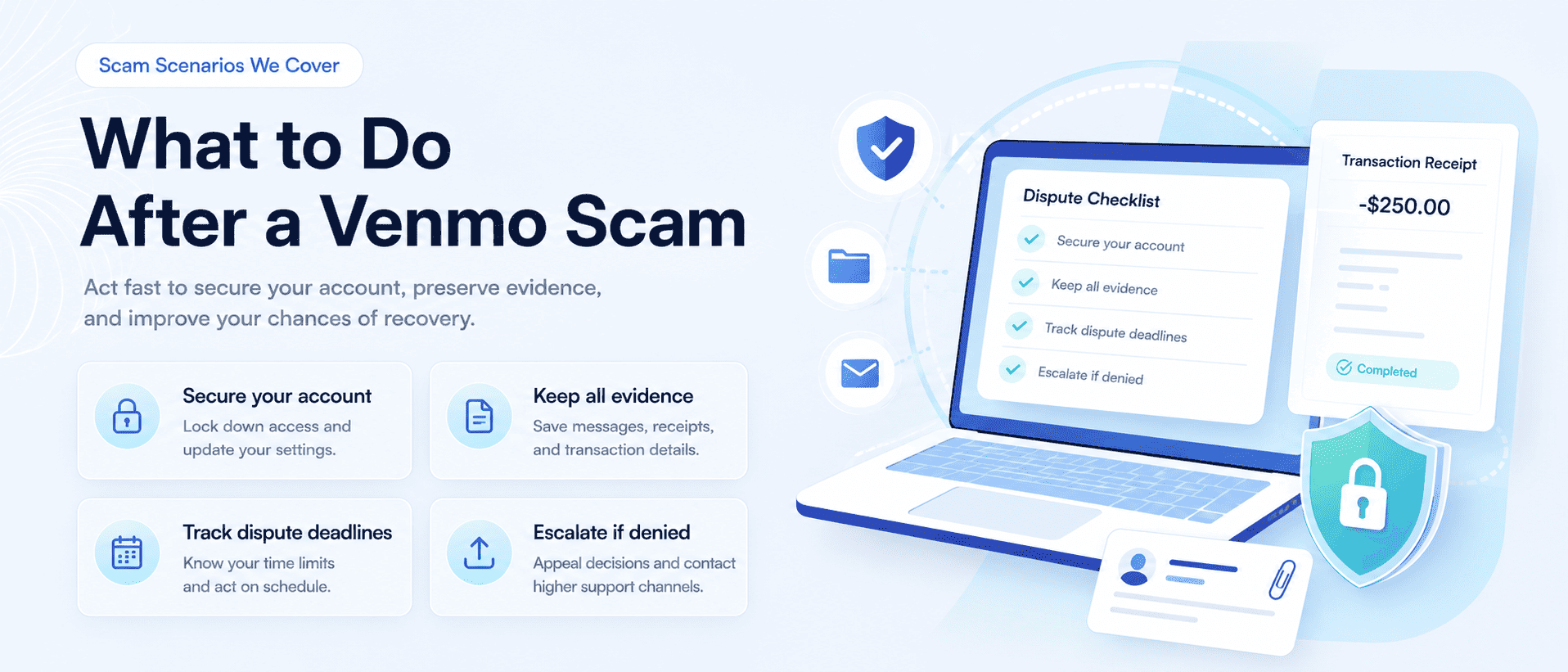
A Venmo dispute depends on several things: the type of transaction, how the payment was funded, whether Purchase Protection applied, and whether you authorized the payment or someone else did. This guide walks through the full process, from filing inside the app to escalating with your bank and reporting externally, so you can take the strongest steps available.
Before you file, use Unscammed to organize what happened, identify red flags, and prepare the details you may need for Venmo, your bank, or a fraud report.
Review your scam evidence with Unscammed
Can you dispute a Venmo transaction after being scammed?
Sometimes, but it depends on the situation. Not all Venmo transactions carry the same dispute rights, so the first step is understanding which category yours falls into.
Unauthorized Venmo transactions
An unauthorized transaction means someone used your account without your permission. This could involve account takeover, stolen login credentials, or a payment you did not make. Venmo says users should report unauthorized activity as soon as possible through Support, and the sooner you report, the stronger your position.
Authorized payments to scammers
If you intentionally sent the payment, even if you were tricked into it, recovery is harder. Venmo may treat this differently than an unauthorized account takeover. The FTC notes that sending money through a payment app can be like sending cash, which is why reporting fast and preserving evidence matters so much.
Purchases made with Venmo Purchase Protection
Qualifying goods and services payments may be eligible for Venmo Purchase Protection, which covers situations like items not received or items significantly not as described. Personal payments usually do not qualify. Venmo notes that sellers pay a 2.99% fee when a buyer turns on Purchase Protection, so this only applies when the transaction was set up as a goods-and-services payment.
Payments sent to the wrong person
If you sent money to the wrong Venmo user by mistake, this is not a scam dispute, but you still need to act. If the payment has not been claimed, you may be able to cancel it in the app. If it has already gone through, contact Venmo Support and ask whether the payment can be returned. Do not send a second payment to “fix” the first one.
Venmo Debit Card transactions
Venmo’s official dispute guidance says that Venmo Debit Card transactions and online purchases cannot be disputed or reported as unauthorized in the Venmo app. Users should contact Venmo Support directly to file these disputes.
Payments funded by a credit card or bank account
If the Venmo payment was funded by a linked debit card, credit card, or bank account, you may have additional dispute options through that institution. More on that in Step 5 below.
Step-by-step Venmo dispute filing process for scam victims
Work through these in order. The earlier steps are the most time-sensitive.
Step 1: Stop communicating with the scammer
Do not send more money. Do not refund an “accidental” payment. Do not click links. Do not share verification codes. Every response keeps the hook in, and scammers escalate with live targets.
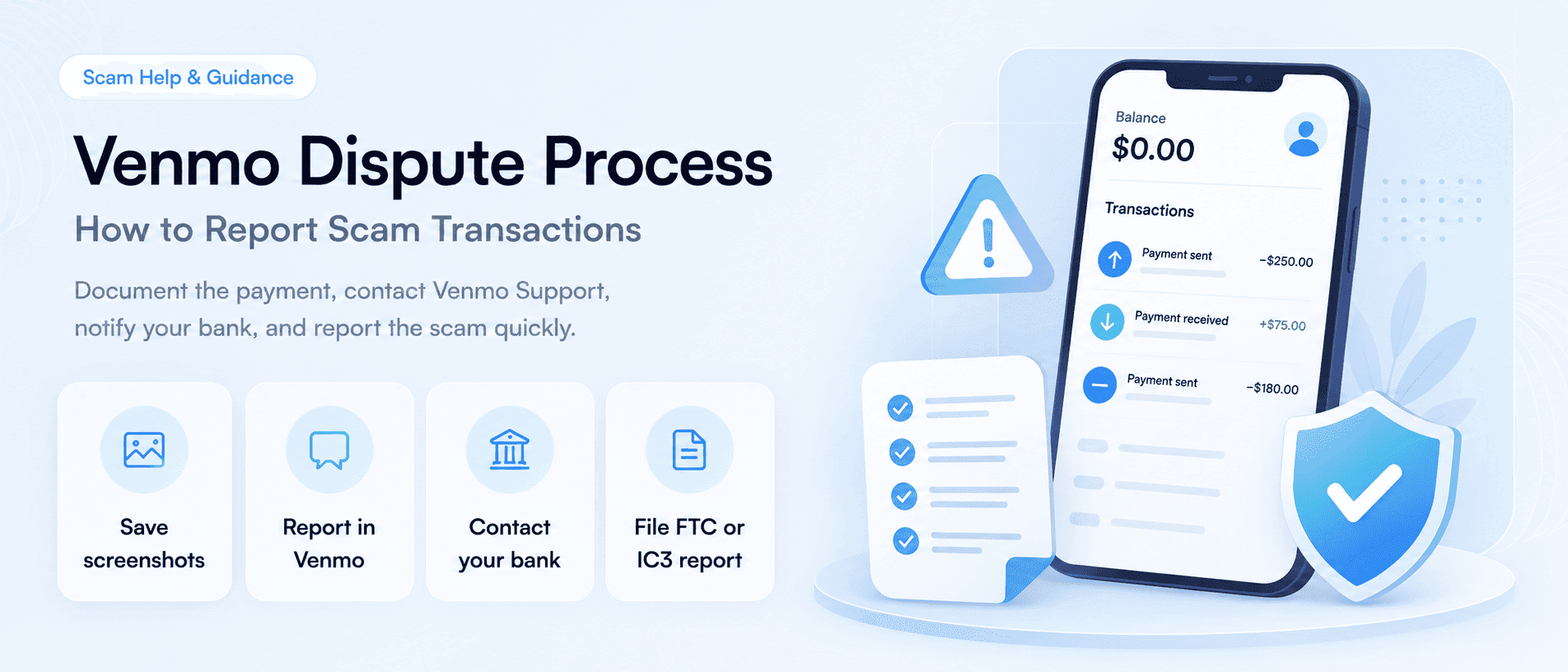
Step 2: Screenshot everything
Before anything gets deleted or changed, capture it all. Screenshots are the foundation of a strong dispute.
| Evidence type | Why it helps |
|---|---|
| Transaction screenshot | Shows amount, date, recipient, and payment note |
| Venmo profile screenshot | Helps identify the account involved |
| Chat history | Shows promises, pressure tactics, or false claims |
| Product listing | Supports goods-not-received or misrepresentation claims |
| Shipping information | Shows whether tracking was fake, missing, or unrelated |
| Emails or texts | Shows off-platform scam communication |
| Bank or card statements | Helps connect the Venmo payment to the funding source |
| Police or FTC report number | Adds documentation after external reporting |
| Timeline of events | Helps support agents understand what happened quickly |
Venmo’s own dispute documentation guide explains what buyers should prepare for item-not-received, significantly-not-as-described, duplicate, and incorrect-amount disputes.
Step 3: Report the transaction to Venmo
Venmo’s official guidance directs users to open a dispute in the app: go to Me, then Settings, then Get Help, then Chat With Us, and ask for an agent.
If the transaction cannot be disputed in-app, Venmo says users should contact Support to file the dispute directly. For common scams on Venmo, including fake support, impersonation, job scams, and rental deposit fraud, Venmo tells users to contact Support if they believe they have been the victim of a scam.
Step 4: Secure your Venmo account
Change your Venmo password immediately. If you reused that password on your email or bank account, change those too. Enable multifactor authentication where available. Remove any unknown devices. Review your linked cards and bank accounts. Check your full transaction history for anything else you did not authorize. And remember: Venmo will never ask for your password or verification code. If someone claiming to be Venmo support asks for either, that is the scam.
Step 5: Contact your bank or card issuer if the payment was funded externally
If the payment was funded by a linked bank account, debit card, or credit card, contact that institution, explain what happened, and ask what dispute rights or fraud-review options apply. Provide the Venmo transaction ID, date, amount, and recipient details along with your evidence.
Do not assume the bank can override Venmo’s decision. Each institution reviews the facts independently, and the outcome depends on the specifics of your case. Our step-by-step on how to report a Zelle scam covers similar bank escalation timelines and may help if your bank handles both platforms.
Step 6: Report the scam externally
Filing beyond Venmo creates an official record and supports future enforcement action.
Report to the FTC at ReportFraud.ftc.gov. Prepare the scam type, amount lost, payment method, the scammer’s Venmo username, contact details they used, screenshots, and a timeline.
Report to the FBI’s IC3 through the IC3 complaint form for cyber-enabled fraud. IC3 accepts reports even if you are not sure whether the complaint qualifies. Include online messages, payment details, links, usernames, email addresses, phone numbers, and any bank transfer or crypto details if the scam expanded beyond Venmo.
File a local police report if your bank, insurer, or recovery process asks for one, or if you have specific information about the scammer. Keep the report number.
For a broader view of where different fraud types go, our roundup of top scam reporting platforms maps it out.
Venmo dispute filing deadlines
Timing matters, and Venmo publishes specific windows. According to Venmo’s dispute filing timeframes:
Item not received or significantly not as described: open the dispute within 180 days of the transaction.
Unauthorized transactions: tell Venmo at once. The sooner you report, the better your protection.
Other errors: Venmo says it must hear from you no later than 60 days after the first statement where the problem appeared.
Missing these windows can limit your options, so do not wait.
How to follow up on an existing Venmo dispute
Once you have filed, you can check the status and add information. Venmo says users can go to Me, then Settings, then Get Help, then Disputes, tap the case, and submit more information if prompted.
If Venmo requests additional evidence, respond quickly. Delays can slow down or weaken your case.
Venmo dispute phone number and customer support hours
This section exists because fake Venmo support numbers are everywhere, and searching for them is one of the most common ways people get scammed a second time.
According to Venmo’s official Contact Us page:
| Support option | Details |
|---|---|
| In-app chat | Me, then Settings, then Get Help, then Chat With Us |
| Message support hours | 8 AM to 10 PM CT |
| General support phone number | (855) 812-4430 |
| General phone support hours | Every day, 8 AM to 8 PM CT |
| Debit card support | Use the number on the back of the Venmo Debit Card |
Always verify support details on Venmo’s official site before calling.
Only use Venmo support details from venmo.com or help.venmo.com. Do not call phone numbers from social media comments, pop-up ads, sponsored-looking search results, or random forums. Fake support numbers are one of the most common Venmo scam tactics.
How long does a Venmo dispute take to resolve?
There is no single answer. Dispute timelines vary based on the transaction type, evidence provided, funding source, and whether Venmo or a bank needs additional review.
Some disputes may move quickly. Others can take longer if Venmo, a bank, a card issuer, or a merchant needs to review more information. Check your email and Venmo app regularly so you do not miss requests for evidence, and respond promptly when asked.
Can I get my money back from a Venmo scam?
Maybe, but the honest answer is: it depends on the details. Here is how the scenarios generally break down.
| Scenario | Refund outlook |
|---|---|
| Unauthorized transaction | Stronger basis for review if reported quickly |
| Account hacked | May qualify for unauthorized activity review |
| Goods or services with Purchase Protection | May have more protection if the transaction qualifies |
| Personal payment willingly sent to scammer | Harder to recover |
| Payment funded by credit card | Card issuer may have separate dispute options |
| Payment funded by bank account | Bank may review, but outcome depends on facts |
Venmo does not guarantee a refund for online purchase problems, and no dispute process guarantees that you will get your money back. What it does is give you the best available path to try. If you were scammed through an online shopping transaction, our guide on what to do if you get scammed online shopping covers dispute steps across multiple platforms.
Why there is no reliable public dispute success rate
Dispute outcomes depend on account activity, payment type, evidence quality, timing, and funding source. A public, universal “success rate” would be misleading because every case is different. Be skeptical of anyone claiming a specific number.
Not sure how to explain what happened? Use Unscammed to turn your screenshots and messages into a clearer scam timeline before you file your dispute.
Organize your scam report before filing
What to do if your Venmo dispute is denied
A denial is not always the end. Stay calm and work through the options.
Read the denial reason carefully. Check whether Venmo requested evidence you did not provide. Gather additional proof, including anything new since you first filed. Ask Venmo Support whether the case can be reviewed again.
If the dispute was denied but the transaction was funded by an external bank account, debit card, or credit card, contact that institution directly. Provide the Venmo transaction ID, date, amount, recipient details, and your evidence. Explain whether the transaction was unauthorized, fraudulent, or goods-and-services related, and ask what dispute or fraud-review options apply. Keep a record of all case numbers.
Do not assume that bank escalation will override Venmo’s decision. Each institution reviews the situation independently.
File or update reports with the FTC and IC3 if you have not already. If identity theft is involved, filing an identity theft police report creates a paper trail for future disputes.
“Accidental payment” scams: a common Venmo trap
This one deserves its own warning because it catches people who are trying to do the right thing.
A stranger sends you money on Venmo and then messages you claiming it was an accident, asking you to send it back. It feels like the honest thing to do. But the original payment was often made with a stolen card or compromised account. When Venmo reverses that fraudulent payment, the money comes out of your balance, and the “refund” you sent is gone for good.
Venmo says if a stranger sends you money and claims it was a mistake, contact Venmo Support so they can help reverse the payment properly rather than sending a new payment back. Never send money to someone you do not know just because they ask.
Common Venmo scams that lead to disputes
Knowing the pattern helps you spot it faster. These are the most common types that end in a dispute.
Fake marketplace sellers who take payment and never ship.
Fake ticket sellers for concerts or events.
Fake landlords collecting rental deposits on places they do not own.
Romance scams where money gets sent over time.
Impersonation of a friend or family member.
Fake Venmo customer support.
“Accidental payment” scams.
Job onboarding scams where the victim is told to buy equipment.
Overpayment scams.
Prize or giveaway scams.
Fake charity requests.
Bank or Venmo impersonation texts.
For employment-related scams, our guide on employment scams and identity protection covers reporting and what personal information to never hand over.
How recovery services can help with Venmo scam transactions
Scam recovery support can help victims understand what type of scam occurred, organize screenshots and evidence, prepare a clearer dispute summary, identify which agencies to report to, and avoid follow-up scams.
But this section comes with a serious warning. Many “recovery services” are scams themselves. If someone promises they can guarantee your money back, asks for upfront payment, or claims to have special access to Venmo, treat that as a major red flag. The FTC’s guidance on refund and recovery scams explains the pattern in detail, and our guide on how to avoid fake scam recovery services covers the full playbook.
If someone contacts you claiming they can recover your Venmo funds, check the message with Unscammed before you pay or share information.
Check whether a recovery offer is safe
Venmo dispute checklist
Before you close out, make sure you have covered every step.
Stop communicating with the scammer.
Do not send more money.
Screenshot the transaction and all messages.
Report the issue to Venmo Support through the app.
Secure your Venmo and email accounts.
Contact your bank or card issuer if the payment was externally funded.
Report the scam to the FTC at ReportFraud.ftc.gov.
File with IC3 if the scam was online or cyber-enabled.
Keep every case number.
Watch for fake recovery agents.
Frequently asked questions
How do I dispute a Venmo transaction after being scammed?
Start by collecting screenshots and reporting the issue to Venmo Support in the app through Me, then Settings, then Get Help, then Chat With Us. If the transaction cannot be disputed in-app, Venmo says to contact Support to file the dispute.
Can I get my money back from a Venmo scam?
It depends on whether the transaction was unauthorized, covered by Purchase Protection, funded by a bank or card, or sent as a personal payment. Unauthorized transactions and qualifying protected purchases may have stronger dispute options than personal payments willingly sent to a scammer.
How long does a Venmo dispute take?
Dispute timelines vary based on the transaction type, evidence, funding source, and whether additional review is needed. Watch your Venmo app and email for requests for more information.
What is Venmo’s dispute phone number?
Venmo lists (855) 812-4430 for general support, every day from 8 AM to 8 PM CT. In-app messaging is available from 8 AM to 10 PM CT. Always verify support details on Venmo’s official Contact Us page before calling.
What evidence should I submit for a Venmo scam dispute?
Submit screenshots of the transaction, Venmo profile, messages, product listing, shipping information, emails, texts, phone numbers, websites, and a clear timeline of what happened. Include FTC, IC3, police, bank, or card case numbers if available.
What should I do if Venmo denies my dispute?
Review the denial reason, gather stronger evidence, ask whether Venmo can review the case again, and contact your bank or card issuer if the payment was funded externally. You can also report the scam to the FTC and IC3 for documentation.
Should I report a Venmo scam to the FTC or IC3?
Yes. ReportFraud.ftc.gov is the FTC’s site for reporting scams and fraud, and IC3 accepts reports about cyber-enabled fraud and scams. Filing creates an official record and supports law enforcement.
Your Venmo dispute is strongest when you move fast and stay organized
A dispute with Venmo is not just about tapping “report.” The strongest recovery attempt starts with evidence, the right support channel, a secured account, and fast reporting to the right agencies. Preserve every message, avoid fake support numbers, and escalate carefully when the payment was funded by a bank or card.
Before you file or respond to anyone claiming they can recover your money, use Unscammed to review the message, organize your evidence, and avoid a second scam.
Featured Articles