What to Do If a Family Member Is Being Scammed Right Now
 Share:


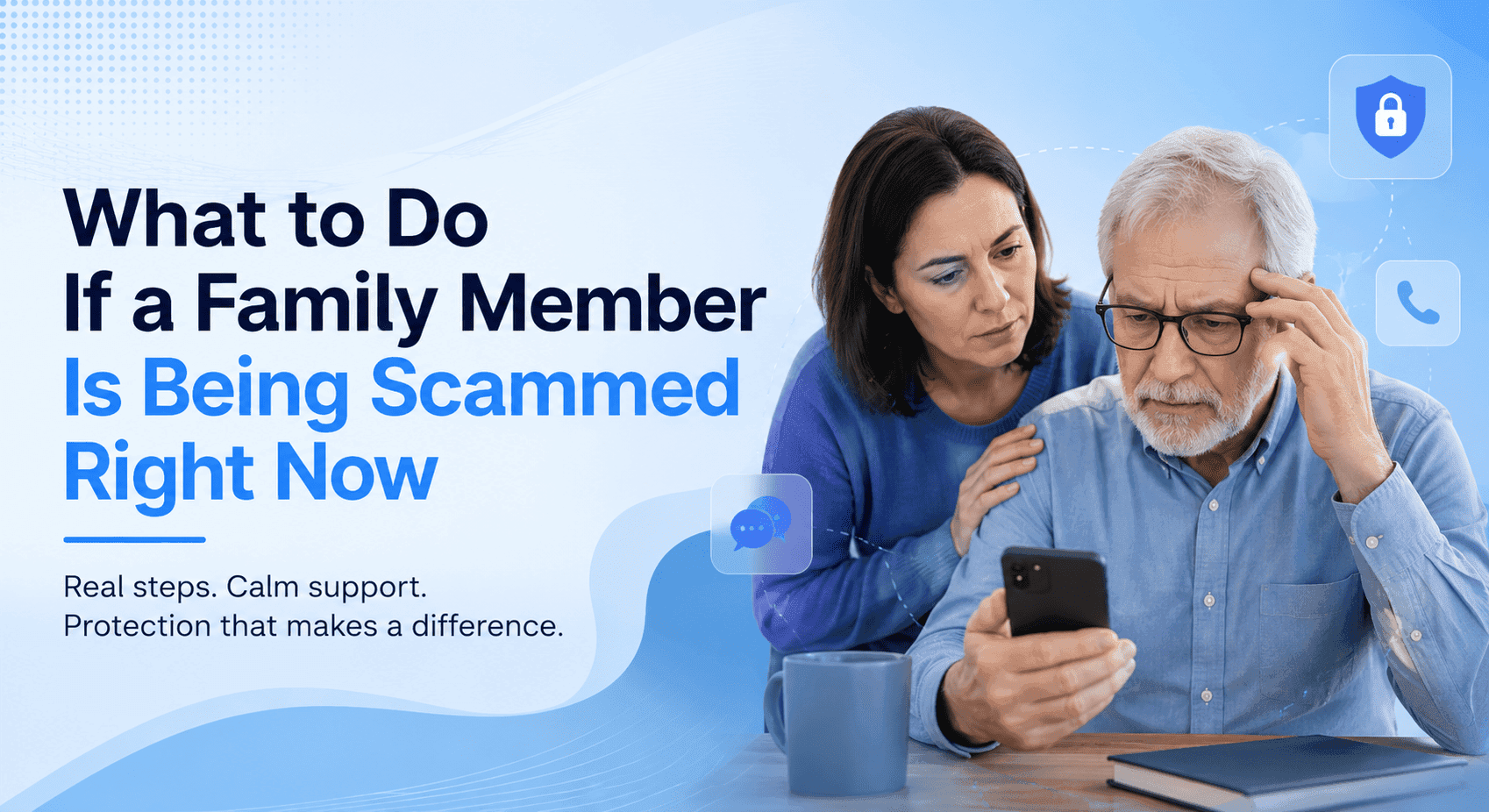
Knowing what to do if a family member is being scammed comes down to speed. The money is what the scammer wants, and every minute a payment sits unrecalled lowers the odds of getting it back. Scam calls pretending to be family members have become one of the most convincing fraud tactics in the country, and they are engineered to rush a person past their own better judgment. This guide gives you the order of moves that works, the phone numbers that matter, and an honest read on which payments can still be pulled back.
If a family member is being scammed right now, tell them to stop all payments and hang up, call their bank’s fraud department to freeze or recall the transfer, save the evidence, then report the scam to the FTC and FBI IC3. Speed decides whether the money comes home.
Fraud is not a rare event anymore. The Federal Trade Commission reported that people in the United States lost $12.5 billion to fraud in 2024, a 25 percent increase over the prior year, with impersonation among the most common complaint types. A calm, ordered response beats panic when the phone rings and a “relative” is in crisis.
If you only have a minute, do these five things first:
1.Tell them to stop all payments and hang up immediately.
2.Call their bank’s fraud line to freeze or recall the transfer.
3.Save the evidence: screenshots, phone numbers, receipts, and transaction IDs.
4.Report the scam to the FTC at ReportFraud.ftc.gov and, for wire or online losses, the FBI IC3 at ic3.gov.
5.Watch for follow-up “recovery” scams. Anyone asking for an upfront fee to get the money back is the second scam.
What Should I Do If I Think My Parent or Relative Is Being Scammed Right Now?
Work the first five minutes as a checklist. Do not stop to prove the scam is real before you protect the money. You can confirm the details afterward.
1.Get them to stop paying. No more transfers, gift-card codes, or cash handoffs until the situation is verified. If a payment is mid-process, cancel it if the app still allows it.
2.Have them hang up. Do not follow any instruction the caller gives, and do not read out any code or one-time password. Ending the call breaks the scammer’s control.
3.Call the bank’s fraud line. Use the number printed on the card or a statement, not a number the caller provided. Ask for a fraud hold, a stop payment, or a wire recall by name.
4.Preserve the evidence. Screenshot texts and messages, write down the caller’s number and any names or company used, and keep every receipt and transaction ID.
5.Report the active scam. File with the FTC at ReportFraud.ftc.gov and, for wire or online losses, with the FBI IC3 at ic3.gov. Fast reporting can trigger a recall attempt.
Set a family password while you are at it. This is a private phrase every household member knows and a stranger cannot guess. Any emergency money request must include it, or the request is treated as fake. It takes ten seconds and it defeats the next attempt too.
Not sure the call is real?
Verify a suspicious call or message before anyone pays.
Scam Calls Pretending to Be Family Members: How the Impersonation Works
The reason scam calls pretending to be family members feel so real is that the technology behind them has caught up to the story. Two tools do most of the work: caller ID spoofing and AI voice cloning.
Spoofing lets a scammer show any name or number they want. The display can even read a real relative’s saved contact. The Federal Communications Commission explains that caller ID spoofing disguises the true source of a call, which is why a familiar number on the screen proves nothing about who is actually calling.
Voice cloning raises the stakes further. A scammer needs only a short clip of someone talking, often pulled from social media, to generate a convincing imitation. The FTC has warned that scammers now use AI to enhance family emergency schemes, mimicking a loved one’s voice to make a fake crisis sound authentic.
Common “Family Member” Impersonation Scams
| Scam Type | How It Works | Who It Targets | Typical Ask | Urgency Tactic | Top Red Flag |
|---|---|---|---|---|---|
| Grandparent scam | Caller claims to be a grandchild in trouble | Older adults, grandparents | Wire, gift cards, or cash courier | “I’m in jail, don’t tell my parents” | Secrecy plus immediate payment |
| Family emergency scam | “Relative” reports an accident, arrest, or hospital bill | Any family member | Same-day wire or app transfer | “I only have one phone call” | Refuses to verify identity |
| AI voice-clone scam | Cloned voice mimics a real relative from social audio | Parents, spouses, siblings | Bail, ransom, or urgent transfer | Distressed or crying voice | Voice matches but story does not; won’t call back |
| Kidnapping / ransom hoax | Caller claims to hold a relative | Parents of adults or teens | Fast crypto or wire ransom | “Stay on the line or they get hurt” | Cannot let you speak to the “victim” freely |
| Bail / arrest scam | Fake lawyer or officer collects “bail” | Older relatives | Gift cards, wire, or courier pickup | Court deadline “within the hour” | Courts asking for gift cards |
How do I know if a call claiming to be family is fake?
Real emergencies rarely come with a script. Watch for a pattern of pressure: extreme urgency so there is no time to think, a demand for secrecy such as “don’t tell Mom or Dad,” an unusual payment method like gift cards or crypto, a refusal to answer simple questions only the real person would know, and resistance when you offer to call back. Any two of these together mean stop and verify.
What if the caller sounds exactly like my relative?
A perfect voice match is now evidence of nothing. When the voice sounds right but the situation feels off, hang up and call the real person back on a number you already have saved. If they do not answer, try another family member who might be with them. A cloned voice cannot pass this test, because the scammer does not control the number you are dialing. In cases we have reviewed, this one habit stopped payments that were minutes from going out.
How Do I Stop a Wire Transfer or Payment in Progress?
Reversibility depends almost entirely on the method and how fast you act. Some payments have a real recall window measured in minutes. Others are gone the moment they clear. The table below shows where the money can still be caught.
Can This Payment Be Stopped or Reversed?
| Payment Method | Reversible? | Realistic Time Window | Who to Contact | First Action | Recovery Odds |
|---|---|---|---|---|---|
| Bank wire (domestic) | Sometimes | Minutes to same business day | Sending bank’s fraud/wire desk | Request a wire recall immediately | Moderate if fast |
| Bank wire (international) | Rarely | Very short, often gone same day | Sending bank + SWIFT recall | Ask bank to initiate recall | Low |
| ACH transfer | Sometimes | Up to a few business days | Bank ACH or fraud department | Dispute as unauthorized/fraud | Low to moderate |
| Zelle, Venmo, Cash App | Rarely | Almost instant, hard to claw back | App support + linked bank | Report fraud in-app and to bank | Low |
| Credit card | Often | Days; chargeback window applies | Card issuer fraud line | File a dispute or chargeback | High |
| Debit card | Sometimes | Report fast for best protection | Bank fraud line | Report the unauthorized charge | Moderate |
| Gift cards | Almost never | Minutes before card is drained | Card brand fraud line | Call brand, give card numbers | Very low |
| Remittance (Western Union, MoneyGram) | Sometimes | Before pickup only | Provider fraud line | Request a transfer recall | Low to moderate |
| Cryptocurrency | No | Irreversible once confirmed | Exchange (may freeze) + IC3 | Report to exchange and IC3 | Very low |
| Cash courier / mailed cash | Rarely | Before pickup or delivery | Police non-emergency + carrier | Report immediately | Very low |
Should I contact their bank directly, or have them do it?
In most cases the account holder has to authorize the action, so the fastest route is a three-way call. Your relative stays on the line to confirm their identity while you help explain the situation and ask the right questions. If you hold financial power of attorney for a parent, you may be able to act on their account directly, so mention that to the fraud representative. When time is short, dial together rather than debating who should call.
Can a bank actually reverse a scam payment?
Sometimes, and the method decides the outcome. A domestic wire caught within hours can often be recalled. A credit card charge can be disputed with strong odds. Zelle and other instant app transfers are far harder, because the money lands in the scammer’s account within seconds. Gift cards and cryptocurrency are close to unrecoverable once redeemed. The honest rule is simple: the faster you call and the more traceable the method, the better your chance.
Get real-time, step-by-step help while the scam is happening.
Open the Unscammed live help tool
Who Do I Call First If a Family Member Is Mid-Scam?
Order matters. Protect the money before you file paperwork, and call for physical safety before anything else if there is a threat. Use this priority list.
Who to Contact and When
| Contact | What They Do | When to Use | How to Reach | Priority |
|---|---|---|---|---|
| Bank / payment provider fraud team | Freeze funds, attempt recall, block accounts | The moment money moves or is about to | Number on the card or statement | 1 (first) |
| Unscammed verification and reporting tools | Verify a caller or message, guide next steps | While the scam is active or suspected | app-us.unscammed.com | 1 (parallel) |
| 911 | Emergency response | Physical threat, coercion, or danger | 911 | Urgent if safety at risk |
| Local police (non-emergency) | File a report that supports disputes | After stopping payment, for evidence | Local non-emergency line | 2 |
| FTC | Records the scam; consumer protection | For every scam, active or past | ReportFraud.ftc.gov | 2 |
| FBI IC3 | Cyber-enabled and wire fraud reports | Online, wire, or crypto losses | ic3.gov | 2 |
| Adult Protective Services | Investigates elder financial exploitation | When an older adult is targeted | State APS line | 2 (elder cases) |
| National Elder Fraud Hotline | Guidance and case support for older victims | Elder-specific recovery | 833-372-8311 | 3 |
| State Attorney General / CFPB | Complaints against institutions | If a bank mishandles a fraud claim | State AG site / consumerfinance.gov | 3 |
See how our team helps families fight financial fraud.
Meet the Unscammed team
What Evidence Should I Gather Immediately?
Evidence turns a frantic phone call into a case a bank or investigator can act on. Collect it while it is fresh, because scammers often delete numbers and messages within hours.
1.Screenshots of every text, email, and chat message, including the sender details.
2.The exact phone number that called, plus any alternate numbers used.
3.Transaction IDs, confirmation numbers, and receipts for anything paid.
4.Timestamps for each call and payment, since recall windows are measured in time.
5.Any names, titles, badge numbers, or company names the scammer used.
6.Voicemails or call recordings, if your state law permits recording.
Store copies in a second place, such as a shared folder, so nothing is lost if a device is reset. Strong evidence shortens bank disputes and gives police a real starting point.
How Do I Approach a Relative Who Won’t Believe They’re Being Scammed?
Resistance is normal, and it is not stubbornness. Victims often feel embarrassed, they may have already sent money and cannot accept the loss, and the scammer has usually spent hours building a bond and isolating them. Shame closes the conversation. Calm curiosity keeps it open.
Openers that lower the temperature:
1.“I’m not saying you did anything wrong. Let’s just call them back together on a number we know.”
2.“This exact call is happening to a lot of families this year. Can we check it before any money moves?”
3.“You know this person’s voice, and I believe you. Real family will still be there in ten minutes if we pause to confirm.”
4.“If it’s real, we lose nothing by verifying. If it isn’t, we just saved you a lot.”
Skip the lines that assign blame:
1.“How could you fall for this?”
2.“I told you to be careful.”
3.“You should have known better.”
The goal is to move the person from defending the caller to standing beside you. Once they agree to verify, the scam usually collapses on its own.
What if the Scammer Is Still on the Phone With Them?
This is the moment that decides the outcome, so keep it simple. First, get your relative to stop moving money and to hang up. A scammer’s most common script is “stay on the line, do not hang up,” precisely because ending the call ends their power. Treat that instruction as proof the call is fake.
If your relative is not ready to hang up, ask them to put the phone on speaker so you can hear the pressure tactics for yourself. Do not let anyone read out one-time codes, card numbers, or account details. Then pick up a separate phone and call the real family member or the bank on a known number, without disconnecting the manipulation you can now hear. Hearing the scripted urgency out loud often convinces a hesitant relative faster than anything you can say.
Run the number or message through our free scam check now.
Check a suspicious caller in seconds
How Do I Report an Active Scam Targeting a Family Member?
Reporting is not only paperwork. Fast reports can trigger recall attempts and get the scammer’s accounts flagged before the next victim pays. Work these channels in order.
1.The bank or payment provider fraud team. This is first because it is the only channel that can freeze or recall money in real time.
2.FTC. File at ReportFraud.ftc.gov for every scam, active or past. The FTC’s guidance on fake family emergencies also confirms the verify-before-you-pay approach.
3.FBI IC3. File at ic3.gov for any wire, online, or crypto loss. Prompt reports feed the IC3 recovery process.
4.Local police non-emergency line. A police report number strengthens bank disputes and insurance claims.
5.State Attorney General and the CFPB. Use these if a financial institution mishandles the fraud claim.
Elder financial exploitation is rising sharply. The FBI’s Internet Crime Complaint Center reported that Americans age 60 and older lost more than $4.8 billion to fraud in 2024, so an elder case deserves the full reporting chain, not a single call.
How Do I Help an Elderly Relative Recover After Realizing It’s a Scam?
Recovery has two tracks that run at once: the money and the person. Neither works well without the other.
On the financial side, dispute every fraudulent transaction in writing and file a fraud affidavit with the bank. Change passwords and account credentials, and replace any card or account the scammer touched. Place a credit freeze with all three bureaus so no new accounts can be opened, and set up monitoring for the coming months. If a Social Security number or other identity data was exposed, treat it as identity theft and follow the FTC’s recovery plan at IdentityTheft.gov.
On the human side, lead with support rather than blame. Watch closely for repeat targeting, because scam victims are frequently placed on “sucker lists” and contacted again. Be especially wary of anyone who calls offering to recover the lost funds for an upfront fee. That is almost always a second scam built on the first. For older victims, involve Adult Protective Services and the National Elder Fraud Hotline, which the Department of Justice runs to provide case support to older fraud victims at 833-372-8311.
Lock down every account with our online safety checklist.
Open the online safety checklist
Where Can Families Get Real-Time Guidance During an Active Scam?
The hardest part of a live scam is the clock. You are trying to verify a caller, calm a frightened relative, and reach a bank at the same time, often within minutes. Real-time verification and reporting tools exist for exactly that pressure. They let you check a suspicious number or message, get a clear next step, and document the incident while it is still unfolding, so you are not guessing alone at midnight.
Unscammed is built to sit in that gap. You can verify a caller, get guided actions in the moment, and keep a record that supports your bank dispute and police report later. When a scam threatens a family business as well, the response involves invoices, vendor accounts, and employees, so it needs its own playbook.
Open real-time help now and walk through the next step.
Get live help from Unscammed
Protecting a family business? Explore our business fraud resources.
Expert Viewpoint: The Three Moves That Decide Whether the Money Comes Back
First, speed beats certainty. In our casework we see it separate the recovered cases from the lost ones. Families who stop the payment and then confirm the scam recover far more often than families who try to prove the scam before touching the money. A domestic wire flagged within the hour can come back. The same wire flagged the next morning usually cannot.
Second, hang up and call back on a known number. This is the strongest single defense we have against caller ID spoofing and AI voice cloning. It costs nothing and it works every time, because the scammer never controls the number you choose to dial.
Third, protect the victim from the second wave. After a loss, upfront-fee “fund recovery” offers are almost always a follow-on scam. Report those through the same channels: the FTC, the FBI IC3, and the bank. If you take one action after reading this, save your bank’s fraud line in your phone today, and open our app the moment something feels wrong.
Frequently asked questions
Can you get scammed money back after a wire transfer?
Sometimes, if the bank recalls it within minutes to hours. Domestic wires have the best odds when reported immediately, while international wires often clear the same day. Call the sending bank’s fraud desk first and ask for a wire recall by name before doing anything else.
Is it too late to stop a Zelle or Cash App payment to a scammer?
Usually these are very hard to reverse, because the money lands almost instantly. Report the fraud in the app and to the linked bank right away anyway. Fast reporting can occasionally freeze funds before they are withdrawn, and it strengthens any later dispute.
Should I call 911 if a family member is being scammed?
Call 911 only if there is a physical threat, coercion, or immediate danger, such as a kidnapping hoax with a real safety concern. For a financial scam with no physical threat, the bank’s fraud line and the local police non-emergency number are the right first calls.
How do I set up a family safe word to beat voice-cloning scams?
Agree on a private phrase now, before any emergency. Every household member should know it, and it should be something a stranger cannot find online. Require the phrase during any urgent money request. If a caller cannot give it, treat the request as fake.
Who investigates elder financial exploitation?
Adult Protective Services investigates cases involving older or vulnerable adults, alongside local police and the FBI IC3. The Department of Justice also runs the National Elder Fraud Hotline at 833-372-8311, which provides guidance and case support to victims age 60 and older.
Are “fund recovery” companies that ask for upfront fees legitimate?
Treat any upfront-fee recovery offer as a second scam. Real agencies and banks do not charge victims a fee to return stolen money. Scammers often target people who were already defrauded, so report these offers to the FTC and the FBI IC3.
What should I do if the scammer already has my relative’s account details?
Freeze the account and change every credential immediately. Place a credit freeze with all three bureaus so no new accounts can be opened, then monitor for identity theft. If a Social Security number was exposed, follow the recovery plan at IdentityTheft.gov.
Can a family member report a scam on someone else’s behalf?
Yes. You can file reports with the FTC at ReportFraud.ftc.gov and the FBI IC3 on a relative’s behalf. Bank actions such as a freeze or recall usually still require the account holder to authorize them, so a three-way call is often the fastest route.
You’re not on your own from here
The panic is real, but the plan is short. Cut off the payment, chase the money through the bank, gather evidence, report the scam, and stay alert for the recovery scam that often follows. You cannot undo the moment it happened, and you can still control the next hour, which is the one that matters most.
You don’t have to handle an active scam alone.
Get real-time help from Unscammed
Featured Articles