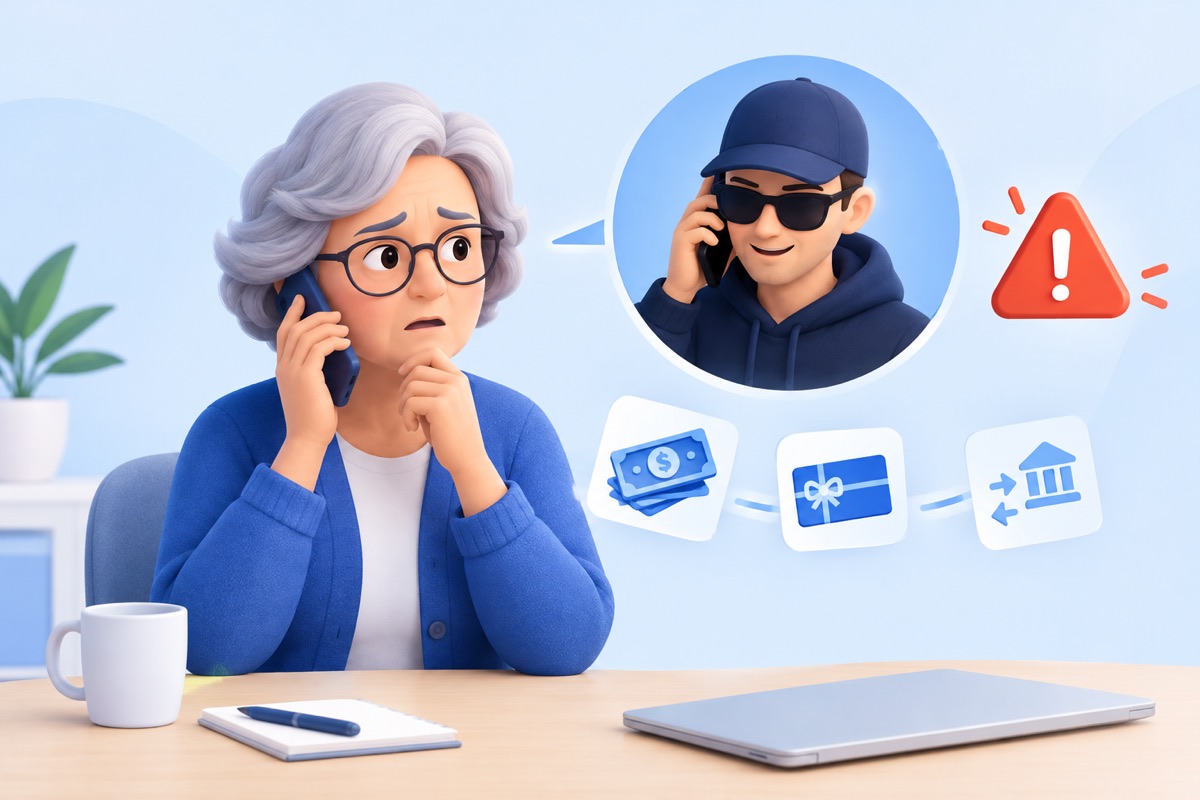
A caller claims to be a grandchild in trouble and needs money right now. Learn how the grandparent scam works, how to verify the call, and where to report it.
What happens when a caller claims to be a grandchild in urgent trouble and asks for money right away?
Calls like this are being placed across the United States every day, and federal agencies have been
tracking the pattern behind them since 2008.
The FBI's Internet Crime Complaint Center classifies the scenario as a "distress scam" and reported that it cost victims more than $5 million in
2025. Older adults filed over 201,000 fraud complaints that year, with reported losses exceeding $7.7
billion, according to IC3 data. This article explains how the scam works, the warning signs identified by
federal agencies, and the steps to verify a call and report it.
What Is the Grandparent Scam?
The grandparent scam is a type of fraud involving an imposter who pretends to be a grandchild, or someone
speaking for them, and asks for immediate money to resolve a fabricated crisis. The FTC classifies this under family and friend imposter scams, though most people know it as the "grandparent scam."
How Does the Grandparent Scam Work?
The grandparent scam follows a consistent, documented pattern across most reported cases. Understanding
each step, from initial contact to payment collection, helps identify the scam early and verify a
claimed emergency before sending money.
1. Initial Contact
The scammer calls, often without identifying themselves right away. A common opening line is "Hi
Grandma, it's me," prompting the victim to supply the grandchild's name, which the caller then uses for
the rest of the call.
2. The Claimed Emergency
In about half of reported cases, the caller claims to be in jail or facing other legal trouble. About a third of reports involve a
claimed car accident.
3. A Request for Secrecy
The scammer may ask the grandparent not to tell the child's parents about the situation.
4. A Handoff to a Second Impersonator
The caller may hand the phone to someone posing as a lawyer, bail bondsman, or police officer to request
immediate payment.
5. Payment Instructions
The victim is told to send money quickly, usually through a method that is difficult to trace or
reverse.
Federal agencies note that the scam relies on urgency and emotional pressure rather than sophisticated
hacking. The caller's goal is to get the victim to act before verifying the story with another family
member.
How Do Scammers Know Details About My Grandchild?
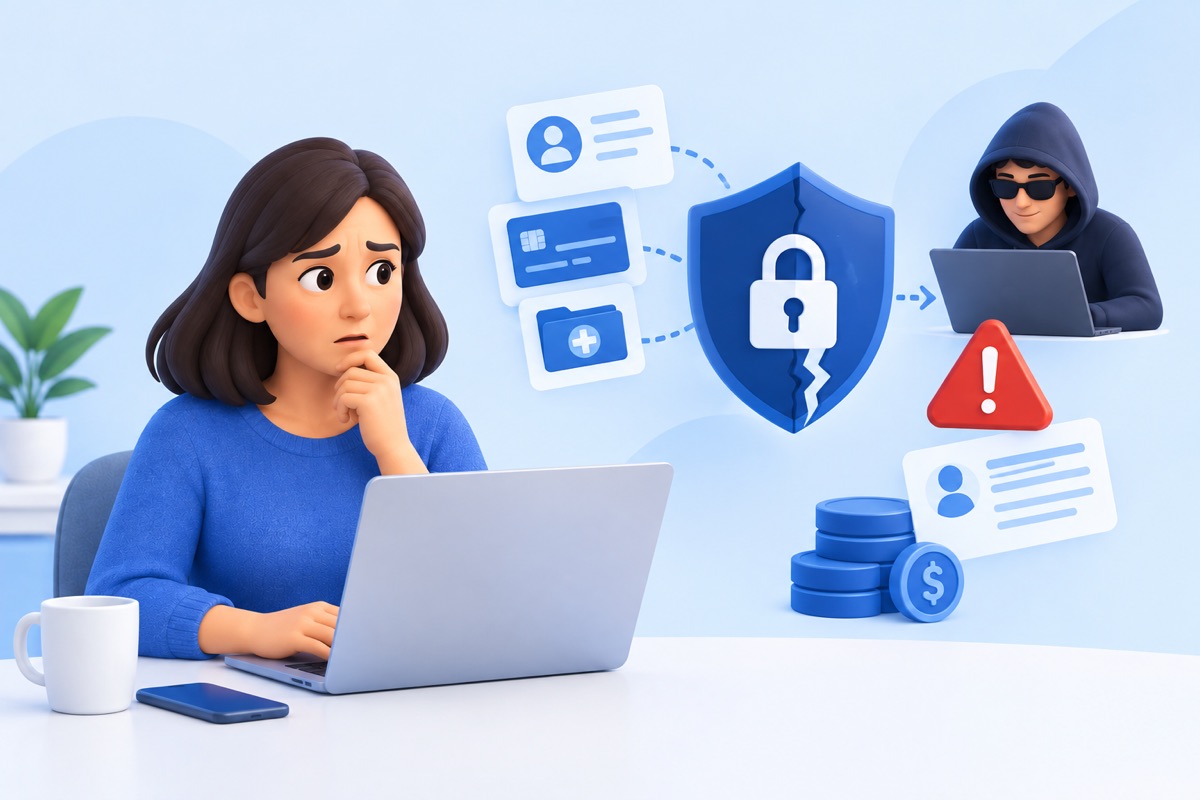
Scammers typically build their story using information that is publicly available or purchased from data
brokers, not information obtained by hacking the family member directly.
Scammers who gain access to consumers' personal information do so by mining social media or purchasing
data from cyber thieves, then use those details to build a believable storyline. A scammer may know a
victim's name, where they live, and other information found on social media sites, or obtained by
hacking a family member's email account. In some cases, they simply guess and let the victim fill in the
blanks.
Information shared in family group chats, social media posts, and public records can also be combined to
make a story sound credible. For example, a scammer who learns that a grandchild frequently travels for
work may build a "stranded abroad" story around that detail rather than a generic one.
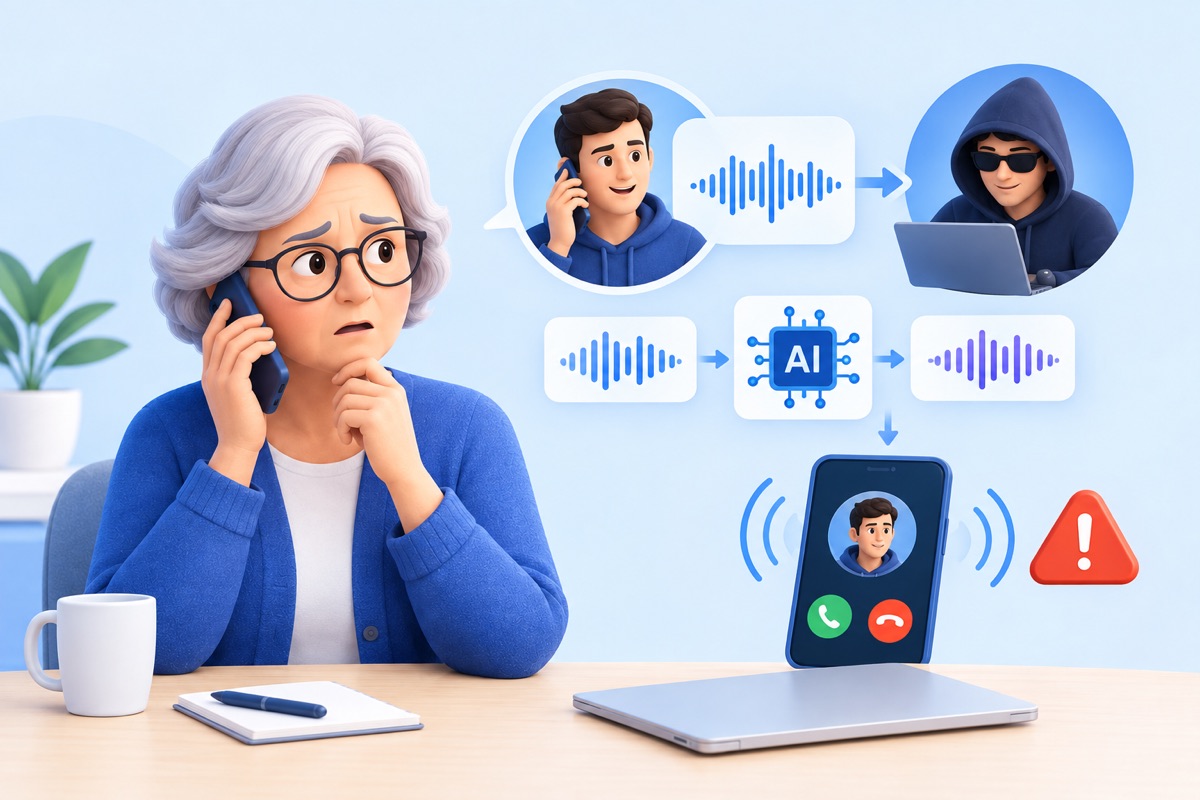
Artificial intelligence has added a further layer to this tactic. A scammer can now use AI to clone the
voice of a loved one, using short audio clips that may already be publicly available on social media.
Scammers gaining access to personal information can create storylines to prey on the fears of
grandparents, and callers may also "spoof" the caller ID to make an incoming call appear to come from a
trusted number.
Because the caller may not actually know specific verifying details, agencies recommend testing this
directly. A family password shared only among relatives can confirm identity quickly, since a scammer
asked for the password will typically end the call.
Why Do Grandparent Scammers Ask for Gift Cards or Wire Transfers?
Grandparent scammers typically instruct victims to pay using methods that are hard to trace and hard to
reverse. This includes a bank wire transfer, sending cryptocurrency, using a payment app such as Venmo, Cash App, Zelle, or PayPal, or purchasing a gift card and reading the numbers on the back to the caller. Once the money is sent
through any of these methods, it is usually difficult or impossible to get back.
| Payment method | Why scammers prefer it |
|---|
| Gift cards | Once the card number and PIN are shared, the balance can be redeemed immediately and is generally not refundable. |
| Wire transfer | Funds move quickly between accounts and are difficult to reverse once processed. |
| Cryptocurrency | Transactions are irreversible and harder to trace to an individual. |
| Cash by mail | Some victims are instructed to divide cash into envelopes hidden inside a magazine and send it using a carrier such as UPS, FedEx, or the U.S. Postal Service, which leaves no bank record of the transaction. |
The FTC states plainly that anyone who asks for payment by gift card or money transfer is a scammer, without exception. No legitimate
court, law enforcement agency, or bail bondsman accepts payment in gift cards.
The instructions given for these payment methods are often specific and rehearsed. Callers have been
reported to give detailed directions on how to send cash, including which carrier to use and how to
package it, which is designed to make the process feel procedural and legitimate rather than suspicious.
How AI Voice Cloning Makes the Grandparent Scam More Convincing
AI voice cloning has
added another method to grandparent scams. Scammers can use a short recording of a person's voice to
create a convincing imitation and then use it in a fake family emergency call. Because of this, a
familiar-sounding voice should not be treated as proof of identity. Our guide to AI voice cloning scams covers the technique in
detail.
1. Voice Cloning Can Imitate a Family Member
The Federal Trade Commission (FTC) says scammers can use artificial intelligence to clone a loved one's
voice. A short audio clip can be used with voice-cloning software to create an imitation that sounds like
the person being impersonated.
2. Public Audio Can Provide the Voice Sample
Scammers may obtain audio from content that has been posted online. The FTC specifically notes that a
short audio clip from online content can be enough for voice cloning. This means publicly available
videos or other recordings may provide material that scammers can use.
3. The Cloned Voice Can Be Used in a Fake Emergency
A scammer may use the cloned voice while pretending to be a grandchild who has been arrested, injured, or
involved in another emergency. The caller then asks for money and may request payment through methods
such as gift cards, cryptocurrency, or a wire transfer.
4. A Familiar Voice Is Not Enough to Verify Identity
The FTC advises consumers not to rely on the caller's voice when receiving an unexpected family emergency
call. Instead, contact the person who supposedly called by using a phone number you already know is
theirs. If that person cannot be reached, contact another family member or a trusted person who can
independently verify the situation.
5. Phone Numbers and Personal Information Can Also Be Spoofed
Voice cloning is not the only technology used in these scams. The FCC warns that scammers can spoof phone
numbers and use personal information gathered from social media or other sources to make an
impersonation appear credible. A familiar phone number or accurate personal detail should therefore not
be treated as independent proof of identity.
6. The Recommended Response Is Independent Verification
The most reliable response is to verify the caller through a separate communication channel. End the
unexpected call and contact the family member directly using a previously saved number. If the person cannot be reached, contact another family member or trusted
person before sending money or sharing information.
How Can I Verify If a Call From a "Grandchild in Trouble" Is Real?
Federal agencies recommend verifying a claimed family emergency independently before sending any money,
regardless of how urgent or convincing the call sounds. The FTC and FCC recommend the following steps:
- Slow down before reacting. The scam depends on the victim acting quickly, before there
is time to think it through or check the story.
- Contact the family member directly. Call or text the grandchild using a phone number
you already have on file, not a number provided by the caller.
- Call another relative to confirm. A parent, sibling, or other family member may be able
to confirm the grandchild's location or situation.
- Ask a question only the real person would know. Avoid questions with answers that could
be found on social media.
- Use a family password. Households can set a shared word or phrase in advance that only
real family members know. A caller who cannot provide it, or who reacts by hanging up, is very likely a
scammer.
- Do not rely on caller ID. Scammers can spoof caller ID to make a call appear to come
from a trusted or local number.
Note: A scammer may know some basic details about your family from social media, but
they usually can't answer specific questions. AI voice cloning can also copy a familiar voice, so a call
sounding real is not proof it is.
If a call or message feels off, check it with Unscammed's scam verification tool before you respond or
send money.
What's the Fastest Way to Confirm a Family Emergency Is Real?
The fastest verification method recommended by federal agencies is to end the call and contact the family member directly using a phone number already on file, rather
than any number provided during the call.
This single step addresses the core mechanism the scam depends on: keeping the victim on the line long
enough to prevent independent verification. Ending the call removes that control immediately.
If the grandchild does not answer right away, the next fastest option is to contact another relative who
may know the grandchild's location or reach them through a different channel, such as texting instead of
calling. A family password, if one has been set up in advance, can also resolve the situation within the
original call, since a legitimate family member will know it and an imposter will not.
Agencies advise against:
- Calling back a number provided by the caller
- Sending any money before the story is confirmed
- Assuming a familiar-sounding voice is proof of identity, given the availability of AI voice cloning tools
If the caller pressures the victim to stay on the line while sending money, or discourages hanging up to
verify, this is treated as a warning sign on its own, since a real emergency does not require preventing
a family member from confirming the situation independently.
What Should I Tell My Elderly Parents About the Grandparent Scam?
Federal agencies recommend discussing this scam with older family members before a call happens, rather than after money has already been sent.
- Explain how the scam typically opens. The caller usually claims to be a grandchild and
starts with a vague line such as "It's me," waiting for the victim to supply the name. Advise family
members never to confirm a name first.
- Explain that a familiar voice is not proof of identity. AI voice cloning tools can
reproduce a loved one's voice using only a short public audio sample. A voice sounding correct should
not be treated as confirmation on its own.
- Set up a family password in advance. A word or phrase known only to family members can
be requested during any suspicious call. A real relative will know it; a scammer will not.
- Explain that legitimate emergencies do not require secrecy. A caller who asks the victim
not to tell other family members, or who discourages hanging up to verify, is exhibiting a known warning
sign.
- Explain that gift cards and wire transfers are the scam's primary payment methods. No
court, bail bondsman, or hospital accepts payment in gift cards. The FTC states that anyone requesting
payment by gift card or money transfer is a scammer, without exception.
- Provide a direct number to call for verification. Family members should know they can
call another relative or the police department directly to confirm a claimed emergency before sending
money.
- Explain where to report a scam call, even if no money was lost. Reports filed with the
FTC (ReportFraud.ftc.gov) or FBI IC3
(ic3.gov) help agencies track scam patterns and identify phone numbers
already in use by known scammers.
How Common Is the Grandparent Scam?
The grandparent scam falls under the FBI's "distress scam" category within its annual elder fraud data. Federal reporting shows this scam has grown substantially in scale and financial impact in recent years, driven partly by the increasing
use of AI voice cloning technology in these calls.
| Metric | Figure |
|---|
| Fraud complaints filed by adults 60+ in 2025 | 201,000+ |
| Total losses reported by adults 60+ in 2025 | $7.7 billion+ |
| Year-over-year increase in losses (2024 to 2025) | ~59% |
| Losses reported specifically for distress scams in 2025 | $5 million+ |
| Losses tied to AI-referencing complaints among seniors | $352 million+ |
Where Do I Report a Grandparent Scam?
Reporting a grandparent scam, even if no money was lost, helps federal agencies track scammer phone
numbers, payment destinations, and patterns across cases. The following resources accept reports or can
help you prepare one.
| Agency / Resource | What to report |
|---|
| Federal Trade Commission | General scam reports, including gift card, wire, or cash payment scams |
| FBI Internet Crime Complaint Center (IC3) | Scams involving phone calls, spoofed caller ID, or online contact |
| IdentityTheft.gov | If personal information was shared with the scammer. See also filing an identity theft police report online. |
| Federal Communications Commission (FCC) | Spoofed caller ID or illegal robocalls used in the scam |
| Local police department | To create an official police report, often required for bank disputes and extended fraud alerts. |
| Unscammed | If you've been targeted by a grandparent scam, we can help you report it to the FBI, FTC, local police, and your bank if you lost money. |
Grandparent Scams Rely on Urgency and Emotional Pressure
The grandparent scam relies on urgency, emotional pressure, and increasingly, AI voice cloning, to
convince a family member to send money before verifying a claimed emergency. Federal data from the FBI's
IC3 shows that losses tied to this category have grown substantially in recent years, with distress scams
alone accounting for more than $5 million in reported losses in 2025.
The most effective response is verification before payment. Ending the call and contacting the family
member directly through a known phone number addresses the core mechanism the scam depends on. If a
payment has already been sent, contacting the bank, wire service, or payment platform immediately,
followed by filing reports with the FTC and FBI IC3, gives the
best chance of recovery or of helping investigators track the scam network involved.
Having a hard time reporting a scam to the right authorities? Let Unscammed handle it. We
help report scams to the FBI, FTC, your local police, and the bank if you lost money, all in under 10
minutes and for free.
Frequently Asked Questions
Does the FBI actually investigate individual grandparent scam cases?
Usually not. The FBI has stated that losses in individual grandparent scam cases, while often substantial for the victim, typically do not meet the financial thresholds required to open a federal investigation. Victims are advised to contact local authorities or their state consumer protection agency directly, in addition to filing a report with IC3, which aggregates complaints to identify patterns and links between cases.
Why do scammers sometimes ask for a courier or rideshare driver to pick up cash?
The FBI has issued specific warnings about this variation, in which scammers instruct victims to package cash a certain way and hand it to a rideshare driver or courier at their home, rather than using a bank or wire service. This method avoids the transaction records that a bank or wire transfer would create, and some drivers used for pickups are reportedly unaware they are part of a scam.
Can the police recover money already picked up by a courier?
Recovery is unlikely once cash has been handed to a courier or rideshare driver, since the funds typically change hands multiple times before reaching the scammer. Victims are still advised to file a report with local police and the FBI's IC3, since the details, including the pickup address pattern and driver information, are used to support broader investigations.
Why does the scammer ask about a "gag order" from a judge?
This is a documented tactic used to enforce secrecy. Scammers instruct victims not to tell other family members about the call, sometimes claiming a judge has imposed a gag order that would cause the grandchild further legal trouble if broken. No court issues a gag order that prevents a family member from confirming an arrest with another relative.
Is it a scam if the caller mentions a car accident involving a pregnant woman or diplomat?
This is a specific narrative pattern the FBI has flagged in grandparent scam reports, sometimes used to explain unusually high bail or medical fee demands. The specific details of the accident do not change the recommended response: verify the story independently before sending money.
What should I do if I already gave the scammer personal information but did not send money?
Federal agencies recommend monitoring bank and credit card statements closely and considering a fraud alert or credit freeze if identifying information, such as a Social Security number or account details, was shared. A report can still be filed with the FTC and IC3 even if no financial loss occurred.
Does reporting a scam call help if the scammer used a spoofed number?
Yes. The FBI and FTC still request the number displayed on caller ID, even if it was spoofed, since patterns of spoofed numbers used across multiple victim reports can help investigators identify a scam network's tactics.
How long has the grandparent scam been tracked by federal agencies?
The FBI's Internet Crime Complaint Center has been receiving grandparent scam reports since 2008. Agencies note the scam has become more sophisticated over time, particularly due to personal details available on social media and, more recently, the use of AI voice cloning.

 Share: