How to Get Your Money Back From a Scam: Complete Recovery Guide
Being scammed does not mean the money is gone in every case, but recovery depends on speed, the payment method, the evidence you can produce, and whether the transaction can still be stopped, reversed, disputed, or investigated. If you are reading this feeling panicked, embarrassed, or financially trapped, the most useful thing you can do is slow down just enough to act in the right order. Chaos is the scammer's friend, not yours.
 Share:


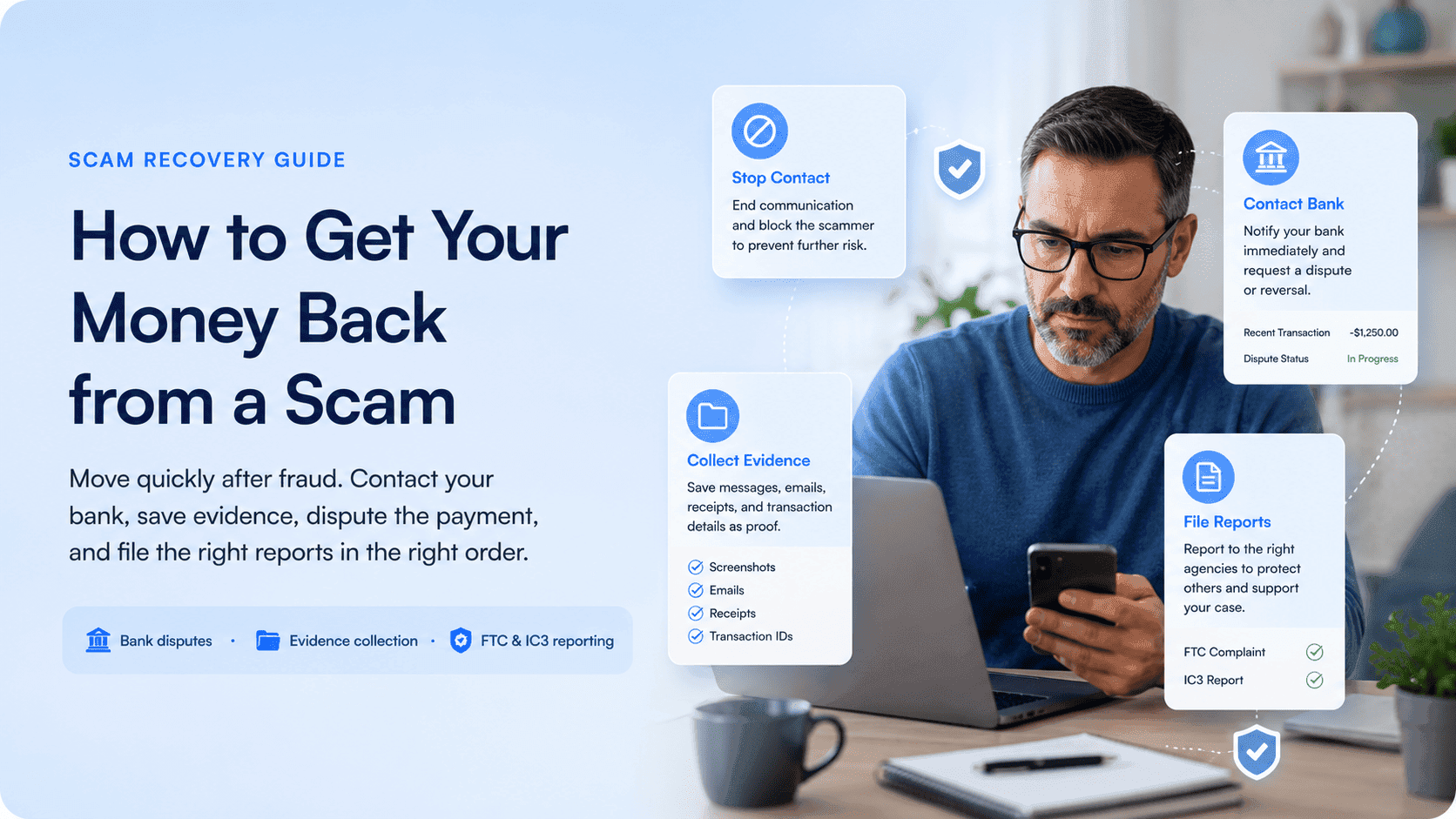
The order that tends to work looks like this: cut off contact with the scammer, secure your accounts, contact the payment provider or bank immediately, collect your evidence, file official reports, escalate carefully if you are denied, and stay alert for the fake “recovery” offers that target people right after a loss. This guide walks through each of those, explains which payment methods are easier or harder to recover, and lays out which U.S. agencies actually refund victims and which only take reports. The honest version of all of this is more useful to you than false hope, so that is what you will get here.
Before you file reports or respond to anyone promising a refund, you can organize your scam recovery evidence so your timeline, evidence, and next steps sit in one place.
Can You Really Get Your Money Back from a Scam?
Sometimes. Whether you do depends far more on how the money moved than on how much you lost.
Recovery is more likely when the transaction was unauthorized, when a credit card was used, when a debit card or bank transfer is reported quickly, when a wire is reported immediately, when the funds have not yet been withdrawn or converted, when you have strong evidence, and when the payment provider offers buyer protection or a dispute path.
Recovery is harder when you willingly authorized the payment, when the money went out through Zelle, a wire, gift cards, or crypto, when the scammer has already moved or withdrawn it, when reporting was delayed, when the evidence is thin, or when you paid a fake recovery service afterward. Knowing which side of that line your case falls on helps you set realistic expectations before you start making calls.
Step-by-Step Recovery Process After Being Scammed Online
Step 1: Stop Communicating with the Scammer
Do not send more money, and do not pay any “taxes,” “release fees,” “verification fees,” or “recovery fees,” because there is always one more. Do not share codes, passwords, PINs, seed phrases, or remote access. Do not be moved by threats about police, immigration, lawsuits, or account closures, which are pressure tactics rather than real consequences. If it is safe to do so, save everything before you block them.
Step 2: Secure Your Accounts
Assume the scammer may have more access than you think and close those doors. Change the passwords for your email, banking, payment apps, and any affected accounts, turn on multifactor authentication, and remove any devices you do not recognize. Lock affected cards, and freeze or monitor your credit if identity information was exposed. If there is any SIM swap risk, contact your phone carrier, and if remote access software was installed, scan the device before logging into anything sensitive.
Step 3: Contact the Payment Provider Immediately
The FTC advises scam victims to contact the company or financial institution used to send the money and ask whether the transaction can be reversed, refunded, or stopped. The right contact depends on how you paid:
Credit card: call the issuer and dispute or report the fraud.
Debit card: call your bank immediately.
Bank transfer or ACH: call your bank and ask about a reversal or fraud claim.
Wire transfer: call your bank or wire company immediately and ask for a recall.
Money transfer app: report to the app and to the linked bank or card if one was used.
Gift card: contact the gift card issuer immediately and ask whether funds remain.
Crypto: contact the exchange or platform, preserve wallet addresses, and report quickly.
Check: call your bank and ask about a stop payment or fraud claim.
Marketplace platform: use the platform’s dispute or buyer protection tools.
If a money transfer app was linked to a credit or debit card, the FTC says to also report the fraud to the card company or bank and ask them to reverse the charge.
Step 4: Collect Evidence
Gather everything before accounts, listings, or scammer profiles disappear, since they often vanish within hours of a victim catching on. There is a full evidence checklist further down to work from.
Step 5: File Parallel Reports
Most cases call for more than one report, each going to a different kind of body. Depending on what happened, file with your payment provider or bank, the FTC at ReportFraud.gov, the FBI’s IC3, your state attorney general, local police, the CFPB for unresolved financial product complaints, the OCC or another regulator for bank complaint routing, and IdentityTheft.gov if identity theft occurred.
Step 6: Escalate if Denied
If a refund or dispute is denied, that is rarely the final word. Review the denial reason, submit additional evidence, ask for reconsideration, and escalate through the complaint channels covered later in this guide.
Recovery Outlook by Payment Method
How you paid is the single biggest factor in whether the money comes back, so it helps to see the methods side by side. The outlook below is general guidance, not a guarantee for any specific case.
| Payment method | Recovery outlook | What to do first |
|---|---|---|
| Credit card | Often stronger if a fraud or goods/services dispute applies | Call the issuer, dispute the charge, submit evidence |
| Debit card | Depends heavily on timing and whether activity was unauthorized | Call the bank immediately and ask about a fraud claim |
| Bank transfer or ACH | Possible if reported quickly, harder once settled | Ask the bank about reversal, fraud claim, Regulation E review |
| Wire transfer | Time-sensitive and often difficult | Call the bank or wire company immediately and ask for a recall |
| Zelle | Often difficult for authorized scam payments | Report to the bank or Zelle, document impersonation or unauthorized access |
| Venmo, Cash App, PayPal | Depends on transaction type, funding source, and protection rules | Report to the app and to the linked card or bank if applicable |
| Gift cards | Usually hard once redeemed | Contact the issuer immediately with the card number and receipt |
| Crypto | Very difficult once sent on-chain | Contact the exchange, preserve wallet addresses, file an IC3 report |
| Check | Possible before it clears or if forged or altered | Contact the bank and ask about a stop payment or fraud claim |
| Marketplace payment | Depends on platform buyer protection | Open a platform dispute and preserve the listing and messages |
The pattern across the table is consistent. The faster you report and the more clearly the transaction was unauthorized, the better your odds. You can use Unscammed to prepare your refund request before you make these calls so you are not scrambling for details on the phone.
Which Agencies Refund Scam Victims in the United States?
This is worth being very clear about, because a lot of people file a report expecting a check to follow. Most agencies do not directly refund scam victims just because a report was filed. Their roles are different from that.
| Agency or organization | What it does | Does it directly refund victims? |
|---|---|---|
| Bank or card issuer | Reviews fraud claims, disputes, chargebacks, reversals | Sometimes, depending on rules and facts |
| Payment app | Reviews platform disputes and unauthorized activity | Sometimes |
| FTC | Collects scam reports and may bring enforcement actions | Not usually directly through individual reports |
| FBI IC3 | Collects cybercrime reports and may support investigations or fund recovery | Not a guaranteed refund channel |
| CFPB | Routes financial product complaints to companies for response | Does not directly pay refunds |
| OCC | Handles complaints involving national banks | Does not directly pay refunds |
| State attorney general | Investigates consumer fraud patterns and may take action | Not usually immediate individual refunds |
| Local police | Creates official reports and investigates crimes | Usually does not directly recover funds |
Reports can improve your documentation and may help investigations, but the fastest recovery path usually starts with the payment provider, bank, card issuer, or platform that handled the transaction. The agencies matter for the record and the bigger enforcement picture, while the money question usually gets decided much closer to home.
How Banks Decide Whether to Refund a Scam Payment
Banks weigh a fairly consistent set of factors, and understanding them helps you frame your claim accurately. They look at whether the transaction was unauthorized or whether you authorized it under deception, what payment method was used, and when you reported the issue. They consider whether you shared login credentials, codes, or remote access, whether the account itself was compromised, and whether there are account alerts, unusual logins, or device changes that support your story. They check whether the claim is covered by Regulation E, card network rules, or their own policies, whether the evidence supports your timeline, and whether you have filed inconsistent claims.
The distinction between unauthorized and authorized-under-deception is the one that decides the most cases, which is why being precise and honest about how the transaction actually happened matters so much when you call.
Regulation E and Unauthorized Electronic Transfers
Regulation E may apply when an electronic transfer was unauthorized. CFPB guidance explains that liability for an unauthorized electronic transfer depends on timing and circumstances, which is exactly why fast reporting is so important. The rule is strongest when someone else initiated the transfer without your actual authority. It is harder to lean on when you personally approved a payment after being deceived, because the bank tends to treat that as authorized. That does not mean you should skip raising it, only that you should be realistic about which category your case fits.
Best Evidence to Collect When Trying to Get Scam Money Back
The quality of your evidence shapes nearly every decision a bank or agency makes. Gather as much of this as applies, and do it before anything disappears.
| Evidence | Why it matters |
|---|---|
| Transaction screenshots | Shows amount, date, recipient, and payment method |
| Bank and app statements | Confirms how the money moved |
| Scammer profile or account | Preserves usernames, phone numbers, emails, and handles |
| Texts, emails, and chats | Shows deception, impersonation, pressure, or false promises |
| Call logs and voicemail | Documents fake bank, government, or support calls |
| URLs and website screenshots | Shows fake shops, fake login pages, or phishing sites |
| Receipts or invoices | Supports goods-not-received or fake merchant claims |
| Gift card numbers and receipts | Helps the issuer check whether funds remain |
| Crypto wallet addresses | Helps IC3 and exchanges trace the transaction |
| Timeline of events | Helps banks and agencies understand the case quickly |
| Denial letters | Helps with appeals and complaints |
| FTC, IC3, police, CFPB, or bank case numbers | Shows your official reporting history |
A clean timeline does a lot of quiet work here, because it lets a reviewer grasp the case in one read. You can use Unscammed to turn your screenshots, messages, and payment details into a cleaner recovery timeline before filing reports.
How Long Does It Take to Recover Money After a Scam?
There is no single timeline, and anyone who quotes you one is guessing. Recovery can take hours, days, weeks, or months depending on the payment method and the type of investigation. Some transactions can be stopped quickly if you report immediately. Others require bank review, a platform investigation, a chargeback process, law enforcement reports, or complaint escalation.
| Situation | Typical timing guidance |
|---|---|
| Pending card charge | May move faster once posted or eligible for dispute |
| Bank or card investigation | Often days to weeks, sometimes longer |
| Wire recall | Must be attempted immediately |
| Gift card recovery | Only possible if funds remain unredeemed |
| Crypto recovery | Usually difficult and rarely quick |
| CFPB complaint | Company response timelines vary by process |
| IC3 report | Supports investigation and intelligence, not an instant refund |
The throughline is that the time-sensitive recoveries, wires and gift cards especially, reward you for moving in hours rather than days.
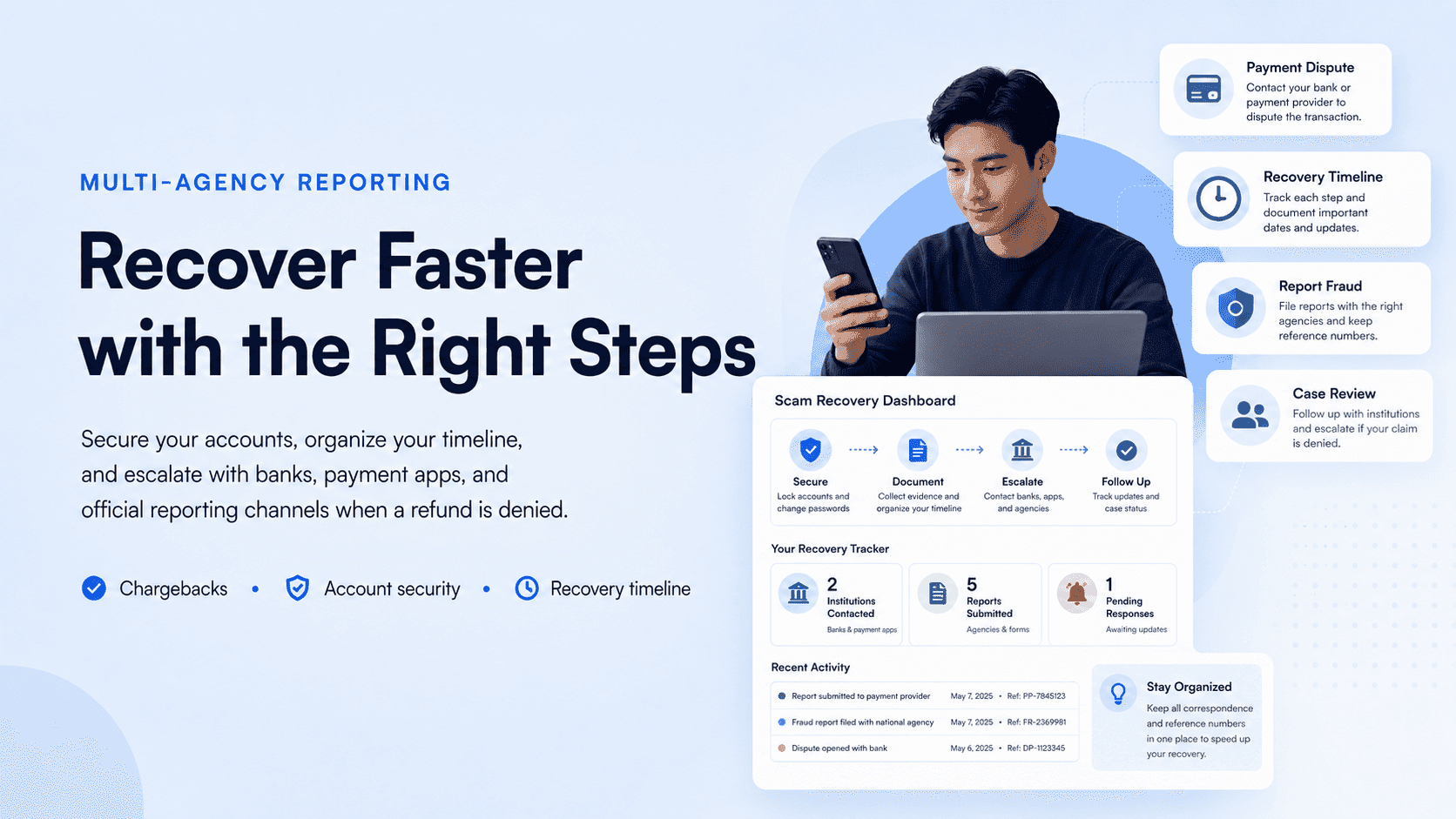
How to File Parallel Reports with the FBI, FTC, and State Authorities
Report to the FTC
ReportFraud.gov is the federal government’s site for reporting fraud, scams, and bad business practices. Include the scam type, the amount lost, the payment method, the scammer’s contact details, a timeline, screenshots, any bank or app case numbers, and whether identity theft occurred.
Report to the FBI IC3
IC3 is the FBI’s main intake form for cyber-enabled fraud and scam complaints, and the FBI says rapid reporting can help support recovery of lost funds. Include emails, phone numbers, usernames, websites, wallet addresses, payment details, bank transfer or wire information, screenshots, IP addresses or email headers if you have them, and any case numbers from your bank, app, or the FTC.
Report to State Authorities
Depending on the scam, you may also report to your state attorney general, your state consumer protection office, your state financial regulator, and your local police department. A local police report can be useful for documentation even when the scammer is outside your city or state, because banks, insurers, and other parties sometimes require one before they will act.
What to Do if Your Bank Refuses to Refund You
A denial is a classification decision, and classifications can be challenged. Work through it in order:
Ask for the denial reason in writing.
Identify whether the bank treated it as fraud, a scam, a merchant dispute, or an authorized payment.
Ask what evidence would change the decision.
Submit new documentation.
Request reconsideration or an appeal.
File a CFPB complaint if the issue involves a financial product.
File an OCC complaint if it involves a national bank and you have already used the bank’s complaint route.
Update your FTC and IC3 reports.
Consult a consumer protection attorney for major losses or unresolved Regulation E issues.
The first appeal is often where reversals happen, because the second time around you can address the exact reason the bank gave and fill the gaps it pointed to.
Legal Options When Banks Refuse to Refund Scam Victims
For larger or stuck cases, legal options exist, though they vary by situation. They can include a consultation with a consumer protection attorney, a Regulation E review for an unauthorized electronic transfer, small claims court where appropriate, arbitration depending on your account agreement, a state consumer protection complaint, an attorney general complaint, and a police report alongside civil documentation.
This article does not give legal advice. Scam victims with large losses, identity theft, denied unauthorized transaction claims, or complex bank disputes should speak with a qualified attorney about their specific facts.
Recovery Services That Automate Scam Reporting and Refund Requests
A scam recovery support tool earns its place by handling the organizing and the reporting prep, not by promising outcomes. Used well, a tool like this can help you identify the scam type, organize evidence, build a clear timeline, draft report summaries, identify the relevant agencies, review suspicious follow-up messages, avoid fake recovery agents, and prepare the dispute language for your bank or app.
The limitation is firm: no recovery service can guarantee a refund. Anyone promising guaranteed recovery, special access to banks or law enforcement, or “hacker” recovery is dangerous, and the promise itself is the tell. Before paying anyone who claims they can recover your money, you can verify a recovery service before paying.
How to Avoid Getting Scammed Twice by Fake Recovery Agents
The second scam often arrives wearing a rescue costume, and it tends to find you soon after the first one. Treat recovery promises with the same suspicion you wish you had applied to the original scam. The warning signs:
Guaranteed refund claims
Upfront “unlock,” “tax,” “tracing,” or “release” fees
Claims of secret access to banks, the FBI, the FTC, crypto exchanges, or payment apps
Requests for login details, seed phrases, PINs, or one-time codes
Pressure to keep the recovery private
Fake screenshots of recovered funds
Telegram, WhatsApp, or Instagram-only “support”
Threats that you will lose the money forever unless you act now
If a message offering to get your money back trips any of these, scan a scam message before responding rather than engaging with it.
Scam Recovery Checklist
A fast recap to keep beside you:
Stop communicating with the scammer.
Do not send more money.
Secure your email, banking, and payment accounts.
Contact the payment provider immediately.
Ask whether the payment can be reversed, recalled, disputed, or frozen.
Contact the linked bank or card issuer if a payment app was used.
Collect screenshots, transaction records, and messages.
File FTC and IC3 reports.
File state or local police reports when helpful.
Ask for written denial reasons if a refund is refused.
Escalate through the CFPB or OCC where appropriate.
Avoid anyone promising guaranteed recovery.
FAQs
How do I get my money back from a scam?
Start by contacting the bank, card issuer, payment app, gift card company, wire company, or crypto platform used to send the money. Ask whether the transaction can be reversed, refunded, frozen, recalled, or disputed. Then collect evidence and file official reports with the FTC, IC3, and other relevant agencies.
Which agencies refund scam victims in the United States?
Most agencies do not directly refund scam victims. The FTC, FBI IC3, CFPB, OCC, state agencies, and police collect reports, support investigations, route complaints, or enforce laws. Actual refunds usually come from banks, card issuers, payment apps, merchants, platforms, or enforcement settlements.
Can my bank refund money I sent to a scammer?
Sometimes. Banks are more likely to refund unauthorized transactions than authorized payments sent under deception. The outcome depends on the payment method, timing, evidence, bank rules, and whether laws like Regulation E apply.
What payment method is easiest to recover after a scam?
Credit card payments often have stronger dispute options than gift cards, crypto, wire transfers, or authorized instant payments. Even so, every case depends on timing, evidence, the merchant facts, and the card issuer’s rules.
How long does scam recovery take?
It can take hours, days, weeks, or months. A wire recall or gift card freeze must happen quickly. Bank and card investigations may take longer, and crypto recovery is usually difficult once the funds leave the account.
Should I report a scam to the FTC and FBI IC3?
Yes. ReportFraud.gov is the FTC’s official site for fraud and scam reports, while IC3 is the FBI’s intake form for cyber-enabled fraud and scam complaints. Reports help document the case and may support broader investigations.
What evidence do I need to recover scam money?
Collect transaction screenshots, bank and app statements, messages, emails, phone numbers, websites, usernames, receipts, wallet addresses, gift card receipts, call logs, and a clear timeline. Also save case numbers from your bank, payment app, the FTC, IC3, police, the CFPB, or other agencies.
Can a recovery service get my scam money back?
A legitimate recovery support service may help organize evidence, prepare reports, and guide your next steps, but no service can guarantee a refund. Be suspicious of anyone who demands upfront fees, promises guaranteed recovery, or asks for passwords, PINs, verification codes, or crypto wallet seed phrases.
A Final Word
Getting money back from a scam is possible in some cases, but speed and evidence are what make the difference. Secure your accounts, contact the payment provider immediately, collect your documentation, file FTC and IC3 reports, escalate denied bank claims carefully, and avoid the fake recovery services circling in the aftermath.
Before you file, escalate, or respond to a recovery offer, use Unscammed to organize your scam evidence and check your next step.
Featured Articles